Showing posts with label Sitcoms. Show all posts

Big Bang Theory: Comic Books and the Unintentional Sexism of Amy

One of the ongoing jokes of Big Bang Theory's early seasons is that the comic book shop is devoid of girls. Not even Lucy comes to the comic book shop on purpose--she stepped in because she saw the lonely hearts party sign. 

The joke is self-mocking. The men are lampooning interests that appear to isolate them from others. 

Later, Amy states that more women would visit the comic book shop if more comics had strong female superheroes, beyond just Wonder Woman, presumably. Stuart concurs, stating that he sees more and more women in his store due apparently to changes in comics. 

I don't hold Amy's belief against her--it is entirely in keeping with the character and with someone who isn't that interested in comic books to begin with. 

But the belief implies NOT that women might be more interested in shojo manga--which is a plausible argument regarding female versus male tastes overall (Stuart could branch out to manga)--but that the only thing keeping women from superhero comics is a lack of strong female role models. 

As if women aren't interested in story and art. 

I went to comic book stores in the 1990s. I did not walk in and exclaim, "Where are my female role models?!" I went because I have always been drawn to the combination of text and art. When I was in high school, a few of my friends got into the Elf Quest comics, and  I read the initial volumes. Post-high school, I encountered Miller's Batman graphic novels. I never found the X-Men particularly engaging (despite, shocker of shockers, the series having MORE female role models than Batman!). In any case, my tastes tend to run more to standalone comics/graphic novels--such as Kurt Busiek's fantastic Superman: Secret Identity--than to series. But in the 1990s, I happened across a comic called The Next Nexus and wanted to find more volumes. 

What is interesting about Amy and The Big Bang Theory writers is that Amy's viewpoint is a credible part of her character, not necessarily a political point of the show. Not only does Leonard meet a very cool woman at the comic book store--who is there to collect, not simply there by accident--Stuart later dates a woman, Denise, who loves sci-fi and fantasy and is so well-versed in graphic novels, she helps Sheldon (by giving him a Busiek suggestion!). So the possibility of women caring about story and art and genre is there. 

In addition, the series' underlying theme is that everyone collects something (such as Hello Kitty), which theme applies to Amy. Her primary "collecting" interest is Little House on the Prairie, which comes with its own level of unreality (of which she is aware). Sheldon touchingly supports her interest--though part of his support leads them both to get very realistic food poisoning. 

Amy is a well-rounded character who does, in fact, face sexism in her profession--however, she draws the wrong (though common) conclusion about comic books and women. 

Quincy, Luther's Dog: Great Character Actor

In my most recent A-Z List, I've been exploring characters that change. 

One of the funniest non-human examples is Luther's dog Quincy. 

Quincy is a basset hound. As the guy at the pound says, "A ficus tree and basset hound are pretty much the same thing." 

Except--

Quincy will go crazy when he is left alone or when he sees certain people/colors. So, he destroys the band room and later attacks the band director. 


The hilarity of these moments is how entirely sleepy and unaffected Quincy looks when he appears on-screen--as compared to what people hear him doing or hear about him doing. 

Rather touchingly, Quincy also changes in terms of getting older and eventually dying. That is, he lives a full pet life with Luther, who is equally impacted by Quincy. Eventually, Luther ends up with a new "little" Quincy.  


A-Z Characters Who Could Transform: Major Frank Burns Deserved a Better Ending

Larry Linville left MASH when he (correctly) judged that his character, Major Frank Burns, was never going to expand beyond his role as the jerk/butt of jokes. 

I think the writers failed Burns (and Larry Linville). They replaced him with the complex-from-the-start Winchester but truth is, like Howard from Big Bang Theory, Burns had the potential to progress beyond his less palatable behavior. He just needed better writers. 

From the beginning, Linville gave the character a degree of self-knowledge as well as wistfulness at others' irritation. That is, Linville allowed that Burns might be teachable or trainable. 

Here's what I think could have happened:

Frank's wife back home divorces him (she has learned about Houlihan). Frank goes off the deep end when Houlihan gets married to another cheater (another Frank but more shallow). So far, these events follow the show (more or less). 

Unlike in the show, he stays with the 4077. A woman surgeon visits. Frank falls for her 100%. (My personal assessment is that Frank's personality requires a non-abstract relationship for him to improve.) 

Unlike Houlihan, this fellow surgeon not only likes Frank: she knows how to handle him. She demands that he live up to a certain standard. She then leaves, but they stay in contact through letters. Frank goes back to his old ways sometimes. He rises above them other times. 

In other words, Frank becomes very much like Howard and like Eustace from The Silver Chair. A guy whose "better self" is in process. 

I enjoyed David Ogden Stiers' Winchester. But I don't think the problem was that the show required a different character. I think the problem was the writers didn't know how to write themselves out of the useful-for-one-purpose hole they put Frank in.  

Give Characters Jobs: Being Santa

I'm a big fan of giving characters jobs--the characters can then talk about something other than the problem of the week. (In Bones, interestingly, the job of parenting and marriage become the secondary topic for Bones and Booth to discuss during cases.) 

A number of shows produce working Santas. Bones, for instance, produces a Santa who may, in fact, be the REAL Kris Kringle. Bones and Booth then have to deal with other working Santas, including their bells. 

Castle produces a dead Santa; he was trying to fix a past mistake that happened in a previous job.  

In MASH, Hawkeye--in a Santa outfit--has to go off suddenly to the front. A soldier in a foxhole is amazed to see that Santa is...real! 

And in Frasier, Roz falls for hottie Dean Cain, but only when he is working as Santa. 

There are many, many more examples. 

The working aspects of Santa's life can be fodder for mystery and sitcom plots as much as the lore of Santa.  

Give Characters Job: Mandy as Business Owner

I'm a big fan of characters having jobs. From a writing perspective, jobs give the characters things to talk about, care about, focus on (as opposed to the "problem of the week"). How they handle jobs exhibits their personalities, and if the jobs can connect to the plot, even better!

The three sisters in Last Man Standing all have jobs. Mandy's is especially intelligent. Eve is focused on figuring herself out. The oldest sister, Kristin, is more focused on the job of being a wife and mother--though some of the best episodes do deal with her job as the restaurant manager at the Outdoor Man Grill. 

But Mandy's job is truly inspired. She starts out as the entertainment-oriented, not-so-great-at-school, popular sister, and in the early episodes, when Mandy and Eve are still in high school, that "job" works. But after she enters college, the writers have her start her own business. The daughter who seems the least like her father turns out to be the most like him.  

She and Mike have opportunities to discuss stock, advertising, taxes, trial-and-error, not giving up on a plan, retail versus online sales, pricing...

Mandy also develops and learns. Although she initially walks away from college to start her business, she decides that taking classes on "businessing" is a good idea. 

And Mandy's business gives other characters a chance to reveal aspects of herself. Vanessa wants Mike to help Mandy and convince her to continue because she sees herself as a negative reflection: she didn't realize that she wanted to teach geology until she already spent years in corporations being less than satisfied. I actually find this approach to Vanessa quite satisfying--I think that people can undergo quite a "crooked" road (as Joe versus the Volcano would say) that eventually takes them to what they truly want.

Mandy's job leads to more ideas and more insights. Incredibly smart writing!  

What is It about Doctor Shows?

Some of the earliest popular television shows were doctor dramas. And almost from the beginning--even in the 1/2 hour shows--they were soooo angst-filled.

I spent a lot of time in the Maine Med ER these past four+ years waiting for people to put my parents through tests, and I can attest that doctors aren't sitting around clutching their heads and hearts. They aren't constantly experiencing crisis of faith or belief or whatever. Thank goodness! 

Arguably watching angst-filled people still perform efficiently is the attraction of these shows. (Watch life and death being handled by a professional!) But the look-at-so-much-competence-amongst-so-much-HORROR is rather draining.

Between Ben Casey and Dr. Kildare, I found Dr. Kildare slightly less oppressive, in part because Richard Chamberlain is a decent actor and also because the day-to-day grind is often emphasized (in the earlier seasons, at least). 

But generally speaking, these shows bring home why early MASH was so comparatively impressive. For one, it had already laid claim to the ultimate angst: War! Consequently, the doctors act more like actual doctors, focused on their expertise, guided mostly by practical self-interest and basic needs. 

It didn't take long for MASH to become self-conscious (by about Season 4). I used to put down the change to anti-war lecturing pompousness taking over. But now I wonder if the looming tradition of Important and Suffering Doctors was the factor. 

Too bad. Watching people do a job is more interesting, ultimately, than watching people clutch their heads and hearts.  

Barney Miller Memorable Moment: James Gregory

James Gregory shows up in a great many classic television shows, including Columbo. I love him best, however, in Barney Miller where he plays the "old-school" Frank Luger. 

Frank Luger underscores the true tolerance of Barney Miller--not tolerance for a select group but tolerance even for the loud, tactless, old-school, supporter of corrupt politicians, fundamentally decent Luger.

What I love the most with Gregory is his physical acting. Barney Miller reminds me of The Closer; when rewatching The Closer, I often get the impression that James Duff, the producer, told a guest star, "Just do whatever you want! What character type do you want to play?" 

I feel the same with the guest stars on Barney Miller. 

The images are when Luger discovers the panties that a male shoplifter stole. He calls the man a pervert, asks him who is going to vote for, waves the panties around, and then nearly walks off with them. 

The entire sequence is utterly hilarious, made more so by rapidly changing expressions on Gregory's mobile face. 


Books to Movies: Is the Movie Giving Readers What They Loved in the First Place?

What do people love about a book? If a movie doesn't capture the thing that people truly love, has the movie failed?

I've read The Scarlet Pimpernel by Baroness Orczy and frankly, it is over-the-top sentimentalism (in one scene, Percy kisses his wife's footprints). The legend of the Scarlet Pimpernel, however, is of a foppish, silly, mentally lacking gentleman who turns into a clever, brave operative. It's a variation, in some ways, on the laid-back hero. 
 
Anthony Andrews' Scarlet Pimpernel is the ultimate version--funny and high-energy, he engages both as the fop and as the clever spy. 
 
I was equally impressed--rather to my surprise--by Leslie Howard's Scarlet Pimpernel. He switches within seconds from drawling aristocrat to serious planner. He isn't quite as engaging as Andrews, who manages to retain his joie de vivre no matter his persona, but he does capture the legend.

Richard E. Grant's version doesn't quite capture those double roles. His Scarlet Pimpernel is less foppish and more sarcastic. He seems to be deliberately baiting his enemies rather than "hiding" in plain sight. Of course, the Richard E. Grant version takes place after Percy and Marguerite have reconciled and Chauvalin is already convinced of Percy's true self. 
 
The series has its points, namely the political and interpersonal wrangling between Chauvlin (Martin Shaw) and Ropiespierre (Ronan Vibert). 
 
But is the series a faithful rendering of the BOOK? Or, if not the book, of the legend that people love?
 
In many ways, the Blackadder III episode "Nob and Nobility" is more faithful. This is the episode in which BlackAdder pretends (or, rather, pretends that he is going to pretend) to be a spy in the style of Scarlet Pimpernel and keeps running into noblemen, including one played by Tim McInnery, who claim, "I am the Scarlet Pimpernel."
 
The issue here is why I feel that post-Hickson Agatha Christie BBC productions fail while Criminal Games, the recent French versions of Agatha Christie, succeed, despite taking enormous liberties. The things that I love about Christie (the hint of wryness, the anti-melodrama since everything is so ultimately normal, day-to-day life, matter-of-fact commentary) is distilled in the case of Hickson and Criminal Games. The other versions seem to take a tiny element and ignore the rest for the sake of BIG MEANING AND SELF-APPOINTED DARKNESS.
 
*Heavy sigh.*
 
Did the book get turned into a movie--or just the title?


Good Titles Continued

In an earlier post, I discuss good episode titles.

Frasier does good titles, but what is even funnier about Frasier is the title cards, the titles that show up throughout the show. They are almost like text in picture books since they become part of the joke. 

I can never say enough good things about Frasier. Yes, the show had dudes. But what gets me every time I rewatch a season is how much is packed in there. You can, in fact, skip those title cards. If you miss one, that's okay. You'll pick it up the next time around. 

In the meantime, there are still plenty of jokes. 


Slamming Doors and Removing Shoes: Cultural Instincts in Art

In the Season 2 episode of Frasier, "Roz in the Doghouse," Roz gets offended when Frasier questions why Bulldog wants her to work on his show. To demonstrate how mad she is, she stomps to the door and slams out of the apartment!

Well, that's the plan anyway. She's on crutches, so she has to slowly hobble her way to the door, yelling as she does: "I'm out of here!" She reaches the door! 

And then she has to come back because she forgot her purse. 

I always think of this episode when I'm watching Asian dramas and people take their shoes off while they are in the middle of a fight. 

Yup, he paused to slide off his shoes.
It isn't the same thing precisely. Roz is deliberately provoked and provoking. 

The shoe-taking-off is instinctual. In one episode, a character rushes home to stop a family confrontation and...he slides off his shoes at the door. He doesn't draw attention to the fact. He simply does it. 

The point of similarity is that Roz is enacting an understood cultural performance. In anger, one stomps away and slams the door! It is a known behavior pattern. 

Likewise, taking off one's shoes is ingrained. It's habit but it also can be performed: quickly, as the image shows here, or thoughtfully, as occurs in other dramas.

As Agatha Christie would say, "People can't help but give themselves away even when they are trying to hide stuff."

Like Victorians swooning on couches, people communicate in and use the cultural language they know.

Floyd Lawson: Great Character Played by a Great Character Actor

Floyd Lawson or Floyd the Barber in The Andy Griffith Show, played, usually, by Howard McNear, is a fantastic character. Like many sweet-natured and slightly bumbling great characters, he is a canny dope: a seemingly innocent member of the community who perceives the truth more readily than others. 

My favorite episode is "Floyd, the Gay Deceiver" in which online dating makes an appearance! 

Not really. The dating takes place by mail. But like "cat-fishing" today, both Floyd, innocently, and the woman, less innocently, have misrepresented themselves. Andy, Aunt Bee, and Opie all contribute to help Floyd appear well-to-do and polished. Andy and Opie end up Floyd's sons!

Howard McNear was a marvel as Floyd. Like many actors of the time, he showcased a wide range of skills and emotions. He could play silly and absent-minded. He could play serious and down-to-earth. He could deliver hilarious lines in a dead-pan manner. 

Even after his stroke, when Andy Griffith asked him to return, McNear continued to deploy a wide range of behaviors and attitudes, which distilled themselves into a well-rounded individual, rather than a character who becomes whatever the script requires him to be. 

Jack Dodson's Howard Sprague made a decent replacement in the later seasons, but McNear--when he ultimately left the show--was dearly missed.

Smelly Cats and Defunct Websites

Currently Available
Years ago, I worked for what I guess was supposed to be the new Yahoo or MSN: Examiner.com. 

The idea was to produce news that would have the same impact as news from larger, national sites, only the Examiner website would reflect local events. Reporters had to pick specific, local topics to comment on. 

I picked "Cats." I either wasn't plugged into "cat culture" in Portland, Maine (in retrospect, I should have linked up with the Greater Portland Animal Refuge League and showcased a cat a week on my feed) or Portland, Maine is more of a "dog" than "cat" city (also true). I struggled to come up with articles. 

In fairness, so did everyone. The company tried to pay us in "goods" (services), which interested me not at all. I wanted money.

However, I stuck with the organization until it folded (apparently, it has returned), and I regularly published--enough to keep myself active. It was good discipline and good practice at brainstorming ideas and churning out articles, even on a fairly meager topic. I ended up writing a great many entertainment-based articles (though I got special attention for posting a PowerPoint on how to make a cat game).

I recently thought of a topic, "Oh, I would post about that on Examiner!" 

Instead, I'm posting it here:

Smelly Cats

In the world of "problems with pets," dogs bite and bark. Cats smell and escape. 

Smelly cats show up in Major Crimes and on Friends. In "Two Options," Season 3 of Major Crimes, Rusty is requested to take a smelly cat out of its cage, so Lieutenant Tao can check it for a chip. 

At this point, if I was still working for the site, I would make a note to myself to write a separate article about "chips." My most recent cat Chloe has one (she came with it). I haven't bothered to register it. She is strictly an indoor cat and unlike some of my previous cats, she cannot get out. But the arrival of a cat with a chip in my house means that many owners are dealing with the pros and cons of the technology, whether they like to or not. 

In any case, to return to Rusty's ordeal...

Cats on television are rather like babies on television. The protesting cries nearly always occur when the cat's head is turned away. Viewers may rest assured that the animal is actually being well-treated--and is likely quite docile. 

Likewise, the cat, Princess, in "Two Options," may smell, but it is obviously beautifully maintained. 

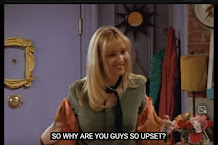
On Friends, of course, "Smelly Cats" are idolized in Phoebe's tribute song. 

At this point, the Examiner article would address non-smelly cat litter and "dry" shampoo wipes for cat fur. 

It is much more fun to end with Phoebe's song. Her version comes first. The music video version is below. 


Animals: Dead Dogs

Speaking of animals...

A surprising number of children's books end with dead animals, dead dogs in particular. As the Friends' clip indicates, Phoebe's well-meaning but ultimately unhelpful mother switched off films before the horrible endings. Phoebe is utterly shocked at Old Yeller's fate!

Maybe, instead, her mother should have put the movie in the freezer.

One children's book with a dead animal that works is L.M. Boston's The Stranger at Green Knowe. Hanno, the gorilla, escapes the zoo and ends up at Green Knowe where his presence is temporarily protected by Ping. The writer pulls no punches. Hanno's capture is detailed. The zoo's inefficiences are clearly presented. The keeper is portrayed as intelligent, kindly, and well-meaning. He knows Hanno's limitations in captivity but there is only so much he can do. The risk to Ping is clear--Hanno is not some cutesy, tamed pet. He may love Ping. He could also easily kill him.

Consequently, as the story moved towards its climax, I was at a loss for how it could possibly be resolved to any degree of satisfaction. 

And yet, the end is satisfactory. 

Finally, yes, yes, it's Cosby. And the clip is fantastic! (Dogs occur at the beginning; gorillas occur at the end.)


Great Sitcom Moments: Frasier's Play On Words and Jokes About Bars

In "Moon Dance," Martin tries to dissuade the newly separated Niles from going to a ball with Daphne. He is afraid that Niles, who is still trying to reconcile with Maris, will say something he regrets. 

He tells a story of when he separated from Niles and Frasier's mother. He was attracted to the local coroner. One day, he slipped up and told her how he felt. He regretted it, and she was embarrassed.

"Boy, it was no fun going to the morgue after that!" he states.

In the middle of the story, he says, "One night, I invited her down to the corner bar."

"Coroners have their own bars?" Niles says. 

"No--CORNER bar."

It's the kind of play on words that backs my argument that many jokes arise out of the backroom as writers work on scripts together. I can picture one writer muttering, "Corner," and another mishearing it as "coroner." And suddenly they are all laughing, and voila! it goes in the script. 

It also highlights a commonality in sitcoms, namely, jokes about bars. When Coach ends up in a gay bar to track down one of his players, he states, "I've never even been in a gay bar--not that there is anything wrong with it--you people need a place to drink...you people need to dance."

And a Season 8 NCIS episode that explores death and mourning revolves around a joke about bars. 

Perhaps it all comes down to that joke (which is also a riddle):

"A man walks into a bar..."

Discipline in the Genre of Choice and Another 80's Video

In an Andy Griffith episode "The Senior Play " Helen Crump allows the teens to plan their own production. Their play involves rock n' roll dancing. The principal of the school objects. He considers the dancing degenerate and cancels the senior play.

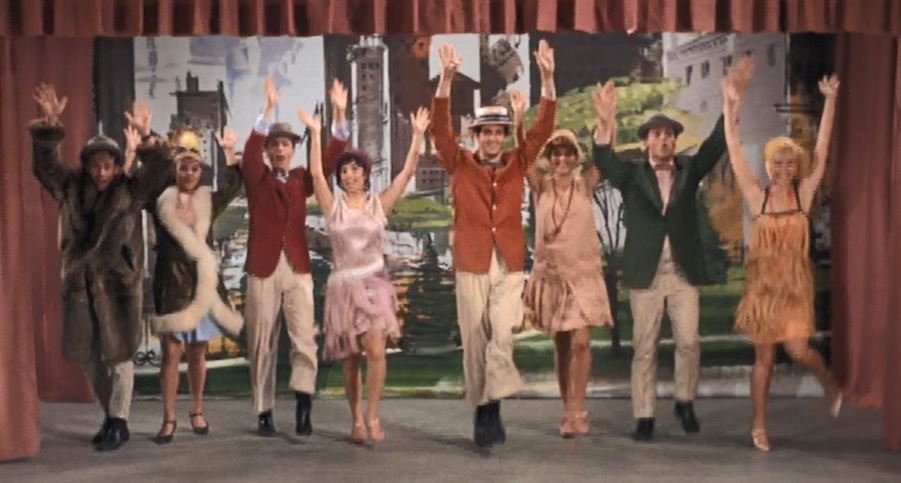
Helen Crump protests. She asks the principal to sit through another dress rehearsal. This time, the kids announce a dance from "your generation" (the principal's generation) or the "good old days." They then perform the Charleston complete with flappers and sheiks.

The point--an entirely valid point, by the way--is that the principal's parents saw his generation as degenerate (read Cheaper by the Dozen for the father's reactions to his daughters' bobbed hair, slimmer bathing suits, and panty-hose).

The episode then gets a little preachy as Helen Crump pleads that the teens--who planned the play in the first place--be allowed to express themselves. The speech falls into the "poor teens need to be pandered to during their troubled years!" category (the episode aired in 1966; the musical Grease--the ultimate celebration of teen self-indulgence--came out in 1971).

The speech barely works and only (sort of) because Aneta Corsaut, who plays Helen Crump, is a skilled actress and something of  a force of nature.

1920s dance--compare to the mish-mash in the first image.
Here's the problem (and I am speaking as a rock 'n roll fan): the rock 'n roll dance is far less disciplined and exhibits far less talent than the 1920s Charleston. The difference is huge. Although Andy and Howard apparently enjoy the rock 'n roll dance more, it is, frankly, boring while the 1920s production is not.

I'm a huge believer that one judges a thing by what it is--not by what it isn't. In this sense, I agree with Helen. Why shouldn't the teens do something contemporary (to them)?

I also believe that the thing being done should be done as well as its genre and style allow for. Rock 'n roll has produced amazing artists. I consider "You Can't Always Get What You Want" one of the finest artistic productions of the 20th century. And it was produced by people with talent, who worked hard (however stupidly they lived their lives).

Young people may wish to express themselves. That doesn't mean they shouldn't be held to standards of discipline and excellence in the genre/style of choice.

"Beat It" was respected--and still is--for a reason (as one commentator mentions, it's impressive when the lead singer is a better dancer than his "chorus line"--though all these guys are talented).

Bloopers of Bloopers and Red Hair

Sometimes I'm reading bloopers on Amazon videos, and I think, "But that's not a mistake."

Sure, there's stuff like, "You can see the cameramen reflected in the window" or "Obviously, the 'yard' in the sit-com is a carpet."

But occasionally, the "mistakes" are either poetic license or not mistakes at all.

In one Last Man Standing episode, Mike gets on Ed's case about his treatment of employees. He says something along the lines of, "You had employees work that day."

"It was a Thursday."

"It was Thanksgiving!"

This was supposedly a blooper because the episode aired before Thanksgiving. But the first time I saw the episode, I never assumed that Mike was referring to that year's Thanksgiving. I thought he was calling on some past year's Thanksgiving to make his point.

The weirdest so-called blooper was the critic who got snarky about when The Andy Griffith Show went from black & white to color and, wow, look, red-haired Opie has a dark-haired father!

Uh, hullo, dark-haired parents do have red-headed kids--and red-headed parents have dark-haired children. I checked my mundane knowledge (my mother's mom had red-hair; my parents have dark hair; one of my brothers is sandy-blond but grows a red beard). Here is what I discovered from "The Big Question: Will You Have a Red-Headed Baby?"
If only one parent has the locks but the other is a carrier, the baby’s chances are 50/50. If neither of you are red but you both are carriers, you have a one in four chance of a fiery-haired child. And, sorry to say, if only one parent is not a carrier (even though the other is), you’ve got no shot...Even though you might not be a redhead yourself, studies estimate that 25 percent of Caucasian Americans carry the ginger gene, so if you fall into this category you might end up with a redheaded baby when you’re least expecting it.
By the way, we never see Opie's mom.

My main thought when I read that "blooper": Didn't the critic know any families with redheads? 

Back to bloopers, I do a kick out of all the car guys who make corrections to dialog in Home Improvement--it seems to be out of love for the discipline rather than a desire to "show up" the writers.

Watching Ryan Become Mike

One of the most enchanting things about Last Man Standing is watching Ryan become Mike. In his personal life, Tim Allen moved from lefty-ish beliefs to conservative beliefs. Last Man Standing shows us how that is possible.

First of all, Ryan--despite being a progressive leftist who speaks in cliches--is a fundamentally likable guy. The producers wisely discarded the too-full-of-himself con-man version of Ryan from Season 1, substituting the earnest man of principles instead.

The actor, Jordan Masterson, is not only quite attractive, he exudes an underlying sense of humor. The character/actor has a twinkle in his eye--and demonstrates great kindliness towards his girlfriend/wife and son. Ryan honestly believes in the goodness that he espouses.

He is also honest enough to balk at supposed givens. When Ryan begins to run Bud's Buds, he gets exasperated at all the bureaucratic red tape:

"How can the government know how to run my business better than me?" he queries Mike, who grins at him with sardonic affection.
Ryan and Mike also share the same side when they both complain about the punitive treatment of boys in public schools.

A great scene where Mike realizes that Ryan let
himself look foolish in front of Mike in order to support
Boyd's non-aerodynamic car additions.
Now, Ryan is as honest about the bug-bears of the right as he is of the left. When Mike goes after ObamaCare, both Ryan and Kristin point out that "not everybody has a nice grandfather" who will swoop in with money to help out. And Mike listens. They have a point, even if he disagrees. One of my favorite things about Tim Allen/Mike Baxter is his willingness to argue.

My most favorite thing, however, is his rejection of fearmongering, whether it is being done by environmentalists or doomsdaying preppers (fearmongering isn't his version of Christianity either). And he tries his best to help Ryan help his own son not to fall down that particular rabbit hole.

In the end Ryan and Mike share more in common than Ryan, at first, realizes. 

Memorable Moment: Dealing with Kids in Last Man Standing

Ryan scares his son, Boyd, by going on and on about sinkholes and fire out of faucets and all the terrible things that can happen in the world (and no, I'm not going to mention the current I'm-working-from-home crisis).

Consequently, Boyd has refused to leave Mike, his grandfather's, side.

Ryan comes to pick up Boyd to take him home. When Boyd refuses, Ryan--in exasperation--says to Mike, "What am I supposed to do? Lie to him?"
Mike responds, "You've just got to make the kid feel safe somehow...You got to be bigger than his fears...You scared Boyd with something he can't control. You told him that no one up there is looking out for him. Which left you. Which actually left me. And I am tired."
It's a fascinating moment in terms of anthropology, not to mention child psychology. The line I really like: "And I am tired!" (Theological query: Does God ever feel like this? Response: Yes, according to the most miffed of the Bible prophets. Question: Would Mike Baxter mind being compared to God? Answer: No.)

Of course, the scene is beautifully paid-off when Mike's daughter, Kristin, comes to pick up Boyd. She proves that she can be bigger than his fears when she picks him up and carries him out of the house, proclaiming, "I am the mom!"

Memorable Moments: Grammar in Last Man Standing

In the Season 7 Last Man Standing Episode "Arrest Her Development" Mandy (new Mandy) tackles adjectives and adverbs on several occasions.
"[The apartment search] is going bad. Badly? Terrible. Terribly?"
What is even more hilarious to me is that she solves each difficulty, including the one above, by doing what I did as a student: coming up with a completely new phrase:
"It ain't good."
And more:
"I'm not a little girl anymore. I'm 6-feet tall...You think of us as these helpless, pathetic beautiful children.  [So] stop treating us like one. Like two? Like both? We ain't children!"
And:
"More than okay. Better than okay? We cool."
In case anyone is wondering, the answers are:

The apartment search is ADJECTIVE: "The apartment search is terrible." (The problem is the VERB "go" requires an ADVERB but Mandy intends the VERB to be a LINKING VERB which requires an ADJECTIVE.)

"Stop treating us like children" is the meaning, and the PRONOUN for "children" is "them"--I agree with Mandy: that just sounds weird, especially since she really intends a new CLAUSE, "Stop treating us like WE are children."

The problem with the third is that "okay" does not turn into "okay-er" (or even "okay-est"), even with "more" (or "best"). "Okay" by definition does not have a COMPARATIVE or SUPERLATIVE form--things are just okay.

"Better than" is the better choice. But, again, Mandy is right to switch it out.

Last Man Standing Season 7: Change is Inevitable

I recently purchased Last Man Standing, Season 7, through Amazon Video. It was a pleasant way to start the year.

What surprised me were reviews that declared emphatically that Season 7 wasn't as good as other seasons!

Maybe my focus is different but the writing for Season 7 seems fairly decent to me--maybe not all on par with some of my favorites, such as "Renaming Boyd's School". But the themes are as strong as ever: Mike's sense of responsibility that leads to him fathering boys with absent fathers; Ryan and Mike's ability to bound over fatherhood and, amusingly enough, Ryan's new status as a business owner; Kyle's search for identity alongside his gentle sweetness of nature; Vanessa, the amazing Nancy Travis, multi-tasking the universe; Mandy's fashion/business concerns; high school issues with newcomer Jen (Krista Marie Yu); family first.

All this includes some fine comedy and drama moments: Jay Leno's explosion into the office yelling about Mike's meanness; Mike's discussion with Mandy about her business (the episode where McCook really finds her version of Mandy); the sheer brilliance of putting Kyle in HR (he will be the HR guy who runs the company softball team, who mediates disputes before they go too far, who looks out for the employee whose child got sick--and so on).

The season is quieter, even more thoughtful. The disappointed viewers, however, seem to be reacting mostly to the inevitable changes that accompany a renewed show. Granted, Mandy's change from Molly Ephraim to Molly McCook takes some adjustment, especially with the increase in height. Boyd is older--and a different actor (though this is less noticeable)--and the premise of the show--Mike Baxter living among women--is continued with a foreign exchange student since even Millennials eventually leave home.

In all honesty, these changes have impressed me. Home Improvement ended before the boys all completely moved out. But I imagine that Tim Allen and John Pasquin would have taken a similar approach as they have with Last Man Standing: people grow, change, move on, move out, alter their life's plans. Wanting the same cast of characters in the same house all doing exactly the same things as before--well, that's why people like me rewatch seasons. But I still appreciate a sitcom that can embrace mutability:

Families change.