Showing posts with label Movies. Show all posts

A-Z Character Transformations: Little Nikita

My current A-Z List looks at characters in terms of disguises and transformations. I am going by character name. For "G," I chose Grant, Jeff or Nikita in Little Nikita

I am reposting my review of the movie. I originally posted in under "Like it Anyway" for artworks that I admire despite critics--and sometimes the general public--labeling them "bad." 

In terms of my current list, one reason I chose Grant, Jeff is that the character doesn't transform into a radically different person when he learns his parents are "sleeper" agents. He is shocked. But he doesn't turn into a spy or run away. He is the boy of loving parents. He remains the boy of loving parents. 

*** 

Every few years, I check out Little Nikita with River Phoenix and Sidney Poitier. The movie has a 52-54% rating on both IMDB and Rotten Tomatoes. (It has a higher rating on Amazon, which is not unusual since Amazon ratings are often by folks renting the movie through Prime; if they are going to rent it, they already have a reason.)

In truth, the plot makes absolutely no sense. It is the ultimate McGuffin. The rogue agent, Scuba, is killing off sleeper agents supposedly to embarrass the Soviet Union (I guess), yet makes zero effort to contact any news agencies. Also, once the sleeper agents are dead, who is there left to embarrass the Soviets? If the Soviets are trying to protect their agents, why do they use the last agents to pay Scuba? Why don't they just ship them back to Moscow? And if the payment is to capture Scuba, wouldn't Scuba guess? And why are the Soviets so impressively bad at capturing and/or eliminating this guy? 

In the end, though, I don't care. Sure, I think a few tweaks to the script would have made it more sensible. But ultimately, again, I don't care. Phoenix's Nikita character falls into a category that I will address in a future A-Z List [A-Z List 11] since I enjoy character journeys so much. He is a character in disguise, only he doesn't know he is in disguise. That part of the movie is exceptionally well-done with excellent pacing. 

And pacing is an important element of film. The movie isn't fast. It isn't slow. It is, rather, inexorable. The inevitable unveiling--the movement from one understanding of one's self to another--is what matters. 

Consequently, the exchanges between Nikita and the adult characters--his father, mother, Sidney Poitier--carry the film. Even Richard Bradford and River Phoenix in the final scenes (however nonsensical in terms of plot) are enough to keep the viewers' attention. 

Characters That Don't Change: Verne's Adventurers

It is a given in classical narration that the main characters will undergo some type of change. They will grow and develop and rejoice or despair and sink into disillusionment. They are occupants of Dante's circles, products of what they strove to become in the mortal realm. 

I more or less agree with the need for characters to change. 

There are, however, characters who remain entirely what the author established them to be. Verne's characters fall into this category. 

I write elsewhere how Jules Verne and H.G. Wells represent the two sides of the sci-fi genre. Verne belongs to the older side which focused on the world and discoveries around the characters. Wells, a decade after Verne's Journey, uses a modern approach with War of the Worlds, not only through first-person narration but through a detailed examination of the narrator's emotional state. Verne does not require this type of internal investigation. 

When Verne is put to film, however, the need for character change quite literally enters the picture. The Brendan Fraser version of Journey to the Center of the Earth provides a character searching for his parents and then having to deal with their loss. The 1959 version provides a villain and a romance as the main character, Lindenbrook played by James Mason, becomes more and more disheveled. 

Nearly every 20,000 Leagues' version stresses the choice Aronnax has to make between Ned and Nemo; in fairness to Verne, that choice is given space within the book; it just isn't as important as all the *wow* stuff Nemo drives his submarine through and around. 

The differences indicate several points: 

(1) film goers are products of a modern age that wants character development; we want more than simply a series of images or visual extravaganzas; 

(2) a liking for extravaganza lingers, however; a film that introduces us to an amazing world goes a long way to satisfying our desires--Jackson's Tolkien's films are some of the few I went to the theater to watch (rather than waiting for the DVDs) since I wanted to SEE big Middle-Earth; 

(3) nevertheless, a film requires story in a way that a book does not; I suggest one reason the book does not is not because people don't want characters to grow and change but because reading between the lines enables readers to identify characters with stories and personalities beyond what shows up on the page. 

Static characters have their place. Generally speaking, current writers need to know how to give characters weaknesses over which to stumble or conquer. But not all plots have made the same requirement because not all plots have had the same purpose. 

Héra: Lots of Action Doesn't Equate to a Deep Character

Apparently, the writers or producers or someone connected to the War of the Rohirrim believes that their main female character is a cut above all those other Tolkien female characters because she is a full character.

She isn't. 

Héra must be one of the most boring female characters I've ever watched. I kept the movie going but lost interest about 1/2 hour into the movie. It likely didn't help that I had just finished listening to Andy Serkis read The Simarillion, a tome that produces seriously complex villains and protagonists (and Tolkien accomplished this complexity despite focusing mostly on the mythic elements). The characters of War are lacking in complexity. 

Since I knew that the movie's writers and producers thought they had conquered some milestone with Hera, I had to ask myself, "Why? How could any decent writer not perceive how bland her character is?" 

Victorian explorer.
Remarkable personality!
I decided that far too many writers and producers mistake a character doing lots of things with a character having a personality. 

In the previous post, I comment that HOW Denethor and Theoden handle their despair reveals their character. 

In comparison, Hera spends the movie behaving like the good girl at the high school prom. 

Sure, she occasionally says, "Oh, no, should I really?" but she says it two seconds before she does it. The implication is that her strength comes not from facing and conquering challenges but from knowing exactly what to do when...

Uh, sorry writers of War of the Rohirrim but upperclass Victorian women trained in etiquette knew the same stuff (some of them had fascinating lives anyway!).

This "I always respond as I should" attitude is MILES away from Eowyn feeling trapped between her royal responsibilities and her warrior desires with the prior position having more merit in many ways. (In the book, Eowyn is left to rule over the king's people when he rides out to battle; she is put in charge of protecting the equivalent of the country's capital.) 

I think Arwen is a more static character. Jackson does a better job with Tauriel, who is also trapped between choices. Tolkien gives us Luthien who takes personal (not just daring) risks during her adventures. 

And even Arwen (of the film trilogy) is faced with despair and chooses to return and to hope in reaction to that despair. She appears to make choices, not to already know what all the choices are.

In comparison *sigh* Hera does stuff: this and then this and then this and then this. And then this. And then this. 

Stuff is important. But if the character doesn't have an underlying personality that determines HOW they do that stuff and why they struggle over doing it...

Doing lots of stuff doesn't equal a strong character. 

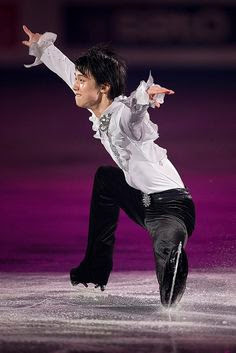
Yuzuru Hanyu's Gift or Extravaganza as a True Gift

"If less is more, just imagine how much more more would be," Frasier tells Niles.

It's a hilarious line. It also has a grain of truth. 

In the series The (Weird) Director Who Buys Me Dinner, the character Min Yum Dam states at one point, "If we're going to charge more for tickets [to a pop idol's concert], we need to do more, so people get their money's worth."

Yuzuru Hanyu's Gift is a great example of making something worth more. I wondered at first how Hanyu had managed 12 programs over 2+ hours without getting worn out (and, in truth, he does get worn out, but his final programs are as impressive as the earlier ones). 

I ordered the DVD from Japan. The version I ordered has no subtitles. However, I had little trouble following the show's concept, which is an emotional autobiography of Hanyu or, rather, his different personas. Between programs, while Hanyu changes and recovers, the arena offers movies with voiceovers, dancers, the Tokyo Philharmonic Orchestra and a separate band that appears to include the composer of works made specifically for Hanyu as well as a number of seriously skilled rock-n-roll guitarists. 

In addition, every program--aside from Hanyu's recreation of a set piece from one of his competitions--uses different costumes, different music, different lighting, different backdrops, and Hanyu's frankly more physical style of skating than what one sees in the official competitions. 

I like it! One reason I wanted to own Gift is because I've often felt, watching the more official pieces, that Hanyu is more captivating--and is having more fun--when he seems to embrace the ice, to sweep low and brush his fingers along it, to almost play with his performances. 

The result with Gift is intense emotional self-disclosure coupled with genius proficiency and high production values, a combination in Japanese art that never fails to slightly unnerve me. (When Americans "disclose," they tend to "disclose" for the Protestant purpose of being personally saved--I told you stuff and now I will go home and cook dinner; the British do it with loads of irony--I told you stuff but don't take any of it seriously; I'm sure Japanese "disclosure" follows its own form, but it always catches me by surprise.) 

In any case, Yuzuru Hanyu's Gift is a gift of MORE! And worth the cost of the DVD. 

Art of Art's Sake: Chariots of Fire

The most heart-felt moment of Chariots of Fire is the voice-over in the final race. 

The character Eric Liddell, in his typical kindly and upfront way, wishes all the other runners well. (The character of Liddell in the movie accords with reports of his character in various biographies.) 

The race then begins. Liddell's sister is watching. In the movie, she is concerned that his passion for racing is distracting him from God (in real life, she was quite supportive of his racing). The finale offers an opportunity for Liddell to express/explain the connection between his racing and his honest passion for God and Christianity. It is a connection echoed by Sister Peters and Tolkien and C.S. Lewis:

"God made me for a purpose--but he also made me fast." 

The statement as spoken by the actor, Ian Charleson, is not a boast but a joyous thankful embracing of his individual self and individual talents. 

As C.S. Lewis stated in The Screwtape Letters, "[God] would rather [a] man thought himself a great architect or a great poet and then forgot about it, than that he should spend much time and pains trying to think himself a bad one."

Don't Give the Audience What It Thinks It Wants

Re-post from 2011.

I recently posted about ignorant characters. I point out problems with such characters. What I don't mention is how the ignorant character is often preferable to the noble, omniscient, triumphant, perfectly good or perfectly evil character. 

The problem with the latter is how often filmmakers and authors do the equivalent of what Plinkett describes below--they make that noble, omniscient, triumphant, perfect character the focus of every prequel

Giving the audience what the audience (supposedly) wants is a mistake.

* * * 

In Plinkett's latest Star Wars' review (which is amusing though not as complete as the others), Plinkett, like always, makes a very cogent point.

Here is the cogent point in my own words:

Just because Darth Vadar became an iconic image of Star Wars doesn't mean the prequels needed to be about him. Just because Darth Vadar is important to us doesn't mean he was important to that universe at that time.
There is a writing conundrum here. Yes, it helps when you are writing a novel/short story/movie/show to use motifs and plot-lines and characters that people actually enjoy and recognize.

However, if all you do is stick together the most common motifs/plot-lines/characters, 9 times out of 10, the product will be a dud--or, at least, remarkably lacking in staying power.

Plinkett does a thorough job proving that, unfortunately, this sticking-togetherness is how Lucas approached the prequels. He took iconic images from IV, V, and VI and simply expanded and rehashed those images in the prequels even when the rehash made no sense.

So, for example, instead of the robe Obi-Wan was wearing in IV simply being the kind of robe people wear on desert planets, suddenly it became the robe ALL Jedi wear.

And instead of the training tools on Han Solo's ship simply being what was at hand, suddenly those tools became the way ALL Jedi are trained.

The result is unimaginative. And irrational.

It also highlights a very important principle. Classic motifs are good. Classic motifs backed by an actual vision are BETTER.

In a large, but not unmerited, segue, C.S. Lewis' Narnia series has been criticized for basically being a collection of every single fairytale/folktale/mythological image/motif C.S. Lewis encountered in the course of his extremely well-read life.

But as many critics, including Lisa Miller of The Magician's Book, have pointed out, it isn't the images and motifs that delight us, it is what Lewis did with them. He wasn't pretending to create new stuff; he was taking what he knew and rearranging it into a new pattern. He had a vision.

Every writer has to have a vision. Without the vision, the writing sags. And should the writer give up that vision to satisfy the audience's supposed desire for an iconic image, the audience will feel the vision dribbling away.

The writers did NOT make
Frasier a repeat of Cheers. 
Which is one reason why writing to satisfy fans doesn't always work. The fans LOVE a couple of minor characters, so the writer(s) make those characters a bigger part of the drama, and, hmm, what do you know, the show is less satisfying.

On the other hand, refusing to give the audience what the audience wants out of sheer "BUT I HAVE TO BE DIFFERENT" perversity isn't too smart either.

The solution is writers who give the audience what the audience wants without losing their vision. This, of course, isn't easy, but I see two solutions:

1. Writers can give the audience what the audience wants without losing their vision when they like what the audience likes.

If you want to write romance novels, it helps if you like romance novels.

2. Writers can give the audience what the audience wants without losing their vision when the writers and the audience agree on what the writers are trying to do.

To clarify this second point, not all novels/stories/movies/shows have to focus on the latest popular topic: vampires, for example. People vary; interests vary. There are a lot of audiences out there to satisfy. I would argue that people want much of the same thing within their separate genres, but that leaves a lot of room for individual creative vision-making.

Hey, there's even room for those people who think that reading stream-of-consciousness profundities about Life in Middle Class America is NEW and DIFFERENT! (Shhh, don't tell them they are being pandered to.) The point is, the writers and audience agree that that is what is going on.

In other words, the rules are agreed to--even when the rules are Monty-Python randomness.

Back to characters--the connection between this repost and characters is that giving the audience the characters they love as ALREADY those characters, despite the movie or book being a prequel, destroys the characters. I found Jill Paton Walsh's The Attenbury Emeralds a disappointment because it presented a young Wimsey as already ahead of everyone else in the mystery. There was no learning curve. He met Charles Parker but didn't learn from Parker, a policeman already. 

In truth, I think filmmakers read into audience engagement something that isn't necessarily there. Yes, we like Gandalf's wise remarks to Pippin. We also like Gandalf's snappishness. And we like his confession to Galadriel that he is afraid. We like the noble, semi-omniscient bloke. But we like the imperfect, struggling bloke as well. 
 
As my obnoxious (but accurate) fifteen-year-old self said, 

"If everyone is special, then no one is special."

If there is no contrast between the character THEN and the character NOW, there is nothing for us to delight in. 


Ngaoi Marsh's Alleyn: The Character Who is Less Obnoxious than How He is Written

Patrick Malahide as Alleyn* 

My first encounter with Ngaoi Marsh's Golden Age mysteries was in college. Whenever I was about to fly home, I would go to the mystery fiction section of the BYU Bookstore and pick out a new Marsh to get me through the plane ride.

My favorite is Killer Dolphin, which introduces one of her best secondary characters, Peregrine Jay. I also quite like Grave Mistake and Singing in the Shrouds, although the murder in the latter is downright daft (and the kind of thing that would ordinarily lead to a detective being called on the carpet).

I have mixed feelings about Marsh herself. She was one of those people back in the day who made snide remarks about poor Sayers falling in love with her hero-detective. What makes this nastiness not only distasteful but bizarre is that Marsh is far more worshipful of Alleyn than Sayers is of Wimsey.

With Lord Peter Wimsey, Sayers may have created her ideal counterpart, but she tackles him with a degree of objectivity missing from Marsh's treatment of Alleyn. Marsh may not be in love with Alleyn, but she treats him like the ultimate cool, overly handsome guy in that really awesome clique that everyone supposedly can't wait to join.

Alleyn is NEVER wrong (even when he IS wrong: in real life, half the passengers from Singing in the Shrouds would have sued Scotland Yard). When he is self-deprecating, other characters rush in to correct his erroneous self-analysis (no, no, you were wonderful!). People who initially sneer at him, end up admiring him. His subordinates adore him. He is constantly impressing people with his knowledge of Shakespeare and his insightful quips. He would be totally irritating if he didn't manage to be a character in his own right. 

A young David Hyde Pierce as Wimsey!

Contrast this with Sayers' Wimsey, who isn't over-the-top handsome (though he has a nice body) and isn't universally beloved. Some people dislike him; others misunderstand him; the occasional murderer loathes him. He does win some people over, but even people who like him--like Charles Parker--remain objective about him. Sayers never forgets that people simply don't react the same way to the same person all the time.

Marsh seems to think that as long as someone is "popular," no one will ever, ever take issue with that someone. It's a startlingly immature perspective that is reflected in some of her comments re: Sayers. Unintentionally or not, Marsh comes across as a cliquey high schooler laughing about that weird girl over there.

Me, I side with the weird girl.

Still, Marsh is a good writer, and the mysteries are fun. And Alleyn manages to exist as a "real" character in his own right. So much of the applause comes from other characters, rather than Alleyn himself, it is possible to admire his detective work (even if I am far less susceptible to the oohing and aahing). 

*I didn't care for Patrick Malahide as Alleyn at first, but now, I quite like him. He is actually much closer to Marsh's description of Alleyn than he appears at first--though he isn't as tall as Alleyn is supposed to be. He is also quite approachable--the actor has decent comedic timing--and is treated with normal respect (not hero-worshiping respect) by his subordinates. He is, in sum, somewhat more likable than the book version. 

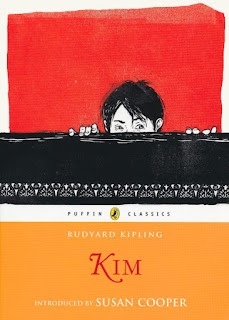
Dean Stockwell's Kim and the New Childhood

[In 2011], I read Kim by Rudyard Kipling for a bookclub and really enjoyed it. I then watched the 1950 film with Dean Stockwell and Errol Flynn.

The movie is fairly good. It was "filmed on location." This means that a bunch of outdoor shots were filmed in India; everything else was done on a sound-stage.

But the movie does have a semi-authentic feel to it (I was worried that it would be like The Ten Commandments, which I enjoy watching but is hokey in the extreme: just watch Joshua organizing the Israelites in his best "Are we ready, boys and girls?" camp counselor manner.)

Kim is surprisingly straightforward and non-hokey, sticking closely to the book up until the last twenty minutes.

At which point it suddenly takes a nose-dive into . . . I don't know. I don't know what they were trying to do. I don't think they knew what they were trying to do.

I have a theory. Up until the last twenty minutes, the film focuses on Kim, played perfectly by Dean Stockwell. At fourteen, Stockwell has the compact, dark exuberance that Kipling ascribes to Kim.

But he isn't quite old enough to play Kim at seventeen (this is a pity; if Stockwell had been only a year older, he could have played Kim's younger and older selves with little difficulty). Consequently, the action from the book is squeezed from approximately five years into 1-1/2. Kim is still a child when he goes to hunt the Russian spies.

Kipling wouldn't have a problem with this. In the book, he continually emphasizes that Kim's controllers want to mold but not break him. They release him from his "English" studies as quickly as possible. They want him educated (and loyal), not disciplined to be a rigid, unimaginative, British officer.
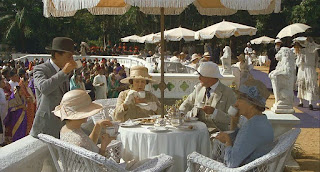
Though very different in their politics, neither Forster nor
Kipling had a high opinion of this version of India.
This approach dovetails nicely with Kipling's beliefs regarding India. He supported the British Empire, but he believed (correctly) that it was badly managed. He believed, for example, that the British administrators in India should NOT be upperclass boys trained in England with no real knowledge of the country or ability to work with the native people. His book Stalky & Co. is basically about the type of boys who should be sent to administer India. Stalky, specifically, is a Kim proto-type.

So Kipling has Kim released from the British system as quickly as possible. He had little to no trouble sending this boy back into a dangerous environment. In fact, he implies that Kim was safer when he was younger and more savvy. Educate him any further, and he'll be too stupid to survive.

This idea was not something that 1950 America could readily stomach. The idea of "childhood" as a pure time of innocence had been growing since the Victorian era; post-WWII, middle-class American parents didn't want their kids being trained to play the "Great Game." They wanted them in college, learning to be businessmen and therapists and school-teachers.

Subsequently, the end of the film Kim turns into a film about Errol Flynn. Errol Flynn must go rescue Kim who has recklessly decided to play "the game" at too young an age. At the very end of the film, it is heavily implied that Kim will go back to school and once he graduates, he won't need to be a spy since all wars will be over.

In fact, there's an interesting contrast (which the writers of the script presented but didn't know what to do with) between the "old school" swashbuckling Flynn, who gets a kick out of killing his enemies, and the "new school" Kim, who gets squeamish out of watching people die.

This is not completely out of keeping with the book. In the book, Kim develops a more complex understanding of morality than he starts out with. The change is necessary since Kim is cocky to the point of arrogance; he is only reined in by his mentor, the extremely pacifistic lama. At the end of the book, the lama--who has obviously been worrying over Kim's participation in "the game"--has a vision which comforts him with the belief that Kim will be able to act as a spy without losing his soul. (At the end of the film, the confused script-writers have the lama die. They obviously couldn't make up their minds whether to be pro-War or pro-pacifism. All they knew is children should have cozy lives.)

In the book, the lama's influence keeps Kim from turning into a little sociopath with no moral sense or direction except the desire to outwit people. In the film, the implication is that the lama represents a nice New Agey way to think for boys who no longer have to make hard choices where people put their lives on the line. 

Wishful, post-WII thinking. And, considering the instant inception of the Cold War, rather naive. But Kim is a child and, as a child, he must be protected!

And the infantilization begins.

The one major factor in the film's favor is Dean Stockwell. It is impossible for a late-20th century product like me not to associate Dean Stockwell-the-child with Dean Stockwell-the-adult. (Especially since at age 14, Stockwell already had that borderline look of amused insolence down pat.) I see Kim and I think . . . Al! From Quantum Leap. And they aren't that different. Kim has that Buddhist edge. But the kindness masked by insouciance coupled with incredible energy is pure Kim/Al. And Stockwell does it very well.

So, Kim didn't grow up to be a businessman (or a monk, as one author postulates). He grew up to work in a top-secret laboratory doing science experiments that result in time-altering adventures.

The last really is much more likely.

More on Characters: Types and Stereotypes

Books on writing often tout that all good writing is character-driven and that all good characters are complex. Complex characters have names and backgrounds and hobbies and tics. If they are angsty/"realistic" characters, they have dark pasts and foibles and unrelenting grief. 

But stories can be told in many different ways.

(1) Good writing can rely on types

(2) Types and stereotypes are not the same. 

(3) Good writing can also rely on stereotypes. 

(1) Tolkien relied on types. Agatha Christie relied on types. Shakespeare relied on types. Tolkien created types. So did Whedon when he invented Buffy (who is actually a deliberate reversal of a "type").

(2) Types are not the same as stereotypes. The difference is the universal quality. Types can move between cultures. Miss Marple is very English, but her type is still recognizable in her descendants, Mme Ramotswe and Mrs. Pollifax (Gilman).

Malahide gives Alleyn nuance.

A stereotype, on the other hand, is a cliche specific to time and place. Ngaio Marsh claimed she was using characters (unlike Christie), not types in her mysteries when actually she was using stereotypes. Don't get me wrong--I enjoy Marsh, but I don't think her characters are transferable beyond a very specific time and place. Alleyn belongs specifically to his upperclass English milieu and there is little of him that survives beyond it. He is a collection of time/place-based cliches: the reticient, fastidious, upperclass British detective working amongst worshipping subordinates in the 1940s to 1950s. 

In 1937 Lost Horizon, Howard
is the Terry character.
(3) Charlotte Perkins Gilman uses stereotypes in Herland. Van is the questioning (good) and progressive intellectual of his day. Jeff is the soft-spoken idealizer of women. Terry is the brash, domineering he-man. They are specific to a utopian polemic and don't need to function much beyond that.

More importantly than types versus stereotypes, Gilman is consistent. She could be more critical of Van (as my Terry is) but once she establishes their characters, she doesn't suddenly change mid-way through the story, forcing them to behave a certain way, so she can achieve an end. Terry's obnoxiousness is grounded in a particular perspective that doesn't vary and isn't inherently conspiring. Terry never lies, and he isn't deliberately scheming. In fact, Van feels some sympathy for Terry, trapped in a world that is outside his comfort level.

I believe that being fair with the reader is 90% of what keeps a story a story, rather than a lecture. I generally dislike "character remembers an important clue from years earlier" moments. But IF the story establishes that such memory retrieval is possible, then having the memory resurface doesn't bother me as much. 

Stereotypes can not only be fair, they can be very funny. In the Monk episode "Employee of the Month," almost all of the characters are stereotypes: the inept stock boys, the weedy manager, the disgruntled retail worker. The stereotypes are so accurate, so right-on, they are hilarious, but they are hilarious within a very specific time, culture, and place. A type, like Monk himself, has more universal qualities. Monk IS the Sherlock Holmes of his time and place and therefore, carries within him the universal qualities that made Sherlock Holmes universal. 

So stereotypes have their place. However, to truly invest in a story, types are more useful in long-run than stereotypes. In my critique/tribute to Herland, I give Terry not only more background but stronger arguments. He doesn't merely stand in for something; he considers what he wants and thinks. 

A human being faced with a new world potentially provides a universal experience. 

Babette's Feast & Infinite Grace

Babette's Feast is an astonishing movie. 

It praises the desire of the true artist to create and, moreover, to reach an audience with that creation: "Through all the world there goes one long cry of the artist: Give me leave to do my utmost."

The movie itself is great art--without being message-loaded or heavy-handed with its themes. 

One major theme is grace, as interpreted by the general--and Martine.

Years ago, the general visited the tiny community, which is comprised of a Calvinist sect and other community members, such as the postmaster/store owner. At the time, the general, Lorens, was a young lieutenant waffling through life. During his visit, he met Martine and fell in love. Yet he was perceptive enough to realize that marriage was more or less out of the question. He returned to court, married a lady-in-waiting, and took his place on the world stage to become a general. 

Years later, he is visiting his aunt, a wealthy woman and patron of the tiny sect. He determines to revisit the group on the birthday of the now-deceased minister, the father of Martine and her sister Philippa. He wants to see if he made the right choice so many years before. 

Unknown to him, Martine and Philippa took in a Frenchwoman, Babette, years earlier when Babette's family was killed during uprisings in Paris in the 1870s. When Babette wins a lottery, she requests the opportunity to prepare a "real French dinner" for the deceased minister's birthday. The sisters don't realize until later that Babette spent all the lottery money (10,000 francs) on the meal (converting historical money is practically impossible but the meal she creates for 12 people is well over $5,000).

From a writing point of view, having the general at the feast provides the viewpoint of an "insider," a connoisseur who knows the value of the wine and caviar, etc. that Babette presents. 

His presence provides a thematic purpose as well. Although Martine is a good religious woman, full of piety as well as fears that the meal will corrupt her deceased father's flock, she is still human and mortal. Although she might dismiss such vain thoughts, having an ex-suitor show up for a simple dinner and coffee would be humiliating. Maybe she shouldn't feel that way, but I dare any person with an ex-lover/suitor/somebody not to feel that way. 

Likewise, if the general had shown up to a simple dinner in a comparative hovel, he likely would have left as conflicted as when he arrived. Should he have abandoned worldly pursuits for a simple life? Wasn't his choice better? Maybe not, but borderline poverty is truly not that attractive. So what did he waste his life on instead? Social climbing? Were there no good options? 

Instead, the general is fed a sumptuous dinner surrounded by simple folk who treat the whole thing as commonplace (to avoid embarrassing the sisters). He is delighted, buoyed up. He brings his worldly knowledge to the banquet, but his worldly knowledge never descends into social posturing. Instead, his approach to the meal inspires others. He focuses on the food, on the company, on the experience. (He also gives Babette a chance to satisfy not only the women she loves and the villagers she cares for but a man who recognizes the brilliance of her creations.)

At the end of the meal, he gives a remarkable speech in which he declares, "Grace is infinite." He came expecting to perform a bargain with his past self. Instead, he concludes "that which is chosen is granted us, and that which we have refused is also and at the same time granted us." The impossible is possible. 

Before he leaves, he declares his love to Martine again--to which she responds. They aren't going to marry, but neither is their love the love of saints or artists (those loves are tackled in the film too). Their love is the romance of lovers, and it is part of all life, all heaven. Why shouldn't it exist as well? 

This is the grace of a God I gladly believe in.  

Dark Christmas: The Nightmare Before Christmas

I confess--I didn't watch this movie until recently. I'm not a huge fan of stop-action animation. And I don't much care for skinny stick figures. 

What is remarkable, however, is how easily Jack's stick figure conveys personality. He is another of those laid-back heroes!

I also consider the problem quite remarkable: Jack's profound desire to do more, to expand, to try out new possibilities, to embrace (as Sally recognizes) a new chance.

Unfortunately, the problem rather gets lost. The end of the movie comes across more as Jack accepting his status/holiday than Jack revitalizing a stale bunch of customs. Or, maybe, it's supposed to be about Jack learning to love his own holiday....? I honestly couldn't tell. The audience is never shown the "new" Halloween filled with fresh ideas. 

The overall point, here, however, is that Christmas has always had this dark side--ghosts, demons, death. 

In some Christian churches, the altar and windows and pews before Easter are draped in black. When Easter arrives, they are unveiled. Christmas and the Winter Solstice achieve a similar effect through natural phenomenons. Although several months of winter are still pending, darkness gives way to the light. 

And changeovers always produce gray areas. Topsy-turvy. Tales about the mischief at Yuletide abound! Burton isn't the first writer to kidnap Santa Clause. Frank L.Baum wrote a similar short story that evokes much the same sense of disorderliness. And in the Chronicles of Narnia, Father Christmas's reappearance indicates that the Queen's "don't step out of line" social order is crumbling in preparation for a far more satisfying and joyous social order.

I don't know if being a musical makes Nightmare less or more topsy-turvy, but horror musicals are also quite common: Repo the Genetic Opera, Sweeney Todd and even the second half of Into the Woods.

In any case, the "sing because you are shouting back against the dark as Nowell thankfully arrives" aspect is entirely in keeping with December holidays. 


Books to Movies: Desolation of Smaug, Lake-Town and Character Investment

The Lake-Town chapters are somewhat different from the same scenes in the Jackson and Rankin films. In the Rankin film, Bard is the captain of the guard; in the book, he leads a group of archers but it is never entirely clear (outside of Tolkien's notes), whether he is an official military commander. In Jackson's film, elements that are implied in the book--the Master is definitely corrupt and self-serving--are fleshed out. In both the book and the movies, the dwarfs are embraced for political reasons; in the book, there is no bungled burglary. And the group isn't split with Fili and Kili and a few other dwarfs remaining behind, as they do in Jackson's film.

I consider all the changes to be smart writing:
 
1. The theme of things getting worse is established early in the trilogy. 
 
Trolls are coming too far south. The Necromancer appears to be gathering forces. The reason Smaug is a worry is because other negative forces are at work. The misery of Lake-Town's citizens is in keeping with the theme.
 
It is also implied by Tolkien that though trade is still brisk, there are increasing problems along the roads. A kind of apathy alongside the Necromancer keeps Lake-Town from expanding. The dwarfs and dragon are treated as folktales, not realities. The Master assumes the dwarfs are frauds--that's how his mind works.
 
2. Placing some of the dwarfs in Lake-Town gives the dwarfs direct investment in Smaug's descent on Lake-Town. 
 
The book does deliver a brilliant example of unintended consequences.  Bilbo does mutter, "What have we done?" as Smaug flies off. It's a fairly heavy reality-check for a kids' book.
 
Jackson's film keeps that reality check but also keeps the audience invested because the characters we have invested in are in Lake-Town. Bard is still new. And Stephen Fry, though hilarious, doesn't invite investment (Fry can do pompous bureaucratic blowhard like nobody's business; I half-expect Rowan Atkinson to wander by; Ryan Gage is a good substitute). We might care in a distant sort of way about the citizens but having known characters actually on-site helps.
 
3. Thorin leaving Kili behind is good psychology. 
 
Thorin's decision is sensible--it is also an indication of Thorin's change in priorities. Thorin is overtaken by dragon-sickness when he enters Erebor. But, like the ring, dragon-sickness works on what is already there. Thorin already had a kind of single-mindedness about the mountain. 
 
However, up till Lake-Town, he focused on the group, the dwarfs and Bilbo. Kili, of course, would have died if Thorin had taken him along. But Thorin's reasoning is no longer "one for all and all for one." Thorin's reasoning has become "my goals no matter what." He has begun to lose sight of his overall purpose. He later nearly leaves Bilbo to face Smaug alone. The psychology is consistent.
 
4. The politics post-Lake-Town's burning explain Bard's advancement. 
 
The politics are equally complex in movie and book. However, in the movie, the Master is killed (in the book, he runs off with gold and dies later). It is great pay-off for a smarmy character and creates a power vacuum. Bard is an unwilling Lord/King of Dale (Bain will be his successor and Bain's son, Brand, will help defend the region during the time of The Lord of the Rings). He mostly steps into the breach because he is the most level-headed person available and has a decent, pro-citizen reputation. He focuses on survival, not on lynching Alfrid, the Master's henchman. (Alfrid later receives a truly gruesome death in the extended version of Five Armies).
 
Thorin reacting to Bard's heritage.
In fact, one of the notable aspects of Desolation and Five Armies is that several people--Thorin, Legolas, Thranduil--respond to Bard in terms of his ancestry. Book/Rankin Bard is more confident in his lineage. Jackson Bard shares many of book Bard's traits but is less prepared for the response of the older (in terms of long-lived) characters. I like the reminder that to the elves and to the dwarfs, Bard has more authority, inherently, than many of the other humans. 

In general, one technique that Jackson uses quite well is to make a scene matter by zeroing in on a character. Lake-Town begins to matter not only because some of the dwarfs we like are there--but also because Bard and his children and their survival have begun to matter.

Books to Movies: The Desolation of Smaug, Mirkwood, More on Pacing, What to Keep, What to Ignore

The Mirkwood scenes keep the fairy-tale dreamlike tone from the book while moving much more quickly. They also link the spiders more directly to Dol Gulder, underscoring Thandruil's failure to act. 

And they introduce the Tauriel/Kili romance. I have mentioned elsewhere why I'm a fan--though I wish the movie had paid the romance off better (not necessarily happier, just better). I will discuss the trilogy's ending more later. 

The Wood Elves are great characters in general: "less wise and more dangerous," as both Beorn (in the movie) and the narrator (in the text) state. The Elf King, Thranduil, played by Lee Pace, is a fantastic damaged leader. 

The conflict between him and Thorin is more direct in the movie than in the book but the dispute over gems is there plus the sense of long-held grievances and lifelong distrust: "Take him away...even if he waits a hundred years...I'm patient. I can wait."

In the book, Thorin and the other dwarfs are separated during their imprisonment. The others don't know what happened to Thorin, and Bilbo carries messages between him and the others. He also reconnoiters over several weeks and waits until the feast to free the dwarfs. 

The movie speeds everything up.

Frankly, the Mirkwood sequence is one of the best in all the films with excellent pacing. It also has one of my favorite "nope, Martin Freeman doesn't need a voice over" scenes when Bilbo realizes he failed to get a barrel for himself. 

Even the chase-chase-chase scene doesn't bother me. The dwarfs escape; the elves chase them; Azog and his people join in to get the dwarfs but end up inviting the elves' ire. The sequence is engaging, has a point, has mini-emotional arcs, and is actually fun to watch. It also brings several plots together, and there's no breakaway until the dwarfs get free. Then, the movie cuts to Gandalf.

Generally speaking, the action from Beorn through to the barrels is some of the best in the trilogy! The choices of what to keep and what to discard and what to speed up are very smart.

In sum, I think there are several reasons for the apparent seamlessness: 

1. What happens next is naturally what would happen next, including Tauriel and Kili's conversations. 

2. The characters' personalities--specifically Thranduil, Thorin, and Bilbo--are well-established enough to explain certain actions and reactions. Everyone behaves believably. 

3. The main characters remain the center without feeling "showcased," so Bilbo's reaction to the ring in Mirkwood--a scene where he is separated again from the others--feels in pace with the rest rather than a breakaway. 

4. The barrel-chase scene, again, highlights personality rather than being just a bunch of people getting felled by axes and falling into water. It even has some humor, as with Bombur's barrel act! 

Consequently, The Desolation of Smaug, extended version, is the one DVD set of Jackson's movies I purchased for myself. I consider the piece fairly high quality as an actual movie.

The Violence of Back to the Future

As many people doubtless remember, one of the objections to the first Back to the Future was that it teaches violence as a solution. I've always considered this a rather petulant objection.

1. The movie isn't about violence. It is about assertiveness. Marty's dad is a wimpy guy who gets some spine and voila, it changes his future. Spielberg carries the theme into the next two films, although he changes it slightly (possibly in answer to the objectors) by making Marty's assertiveness a matter of "Just saying, 'No'." But it's the same idea in different form.

2. However, let's suppose that the film is a kind of Hamlet meets Rambo declaration regarding the uses of violence to improve life...what is the answer? When the bully starts harassing the girl is Marty's dad suppose to call the police, lecture Biff on his non-PC behavior, write a strongly worded article, try a diplomatic solution? And when Biff starts wrenching on his arm, should Marty's dad have called a cease-fire and asked the UN to get involved?

Now, granted, movies set up their own problems or strawmen. Which is why evil capitalist businessmen abound in droves in Hollywood. Set 'em up, kick 'em down, shake your finger a lot. And Biff is an over-the-top villain.

But the basic problem remains. This guy is a bully who pushes people around. A martyr would take it. A Rambo would shoot his head off. In a fantasy, he would be turned into a frog. In a Disney movie, he would fall on his own sword or off a cliff. In an Anne Perry novel, he would suddenly confess and tell you all about his bad relationship with his evil father. Jean Luc Picard would lecture him about free will before blowing up his ship. The Vulcan would have nerve-pinched him. 

But the easiest solution is just to hit the guy. Yet the objectors never seem to stop to think about the problem as an actual problem. Here's a situation: what do you do about it? Which question is, I think, one purpose of fiction.

I suppose what the objectors dislike is that Marty's family benefits from this punch, which, as I've noted in my (1) response kind of misses the point of the punch, or what the punch represents. It's a kind of weird literalness which insists on taking the action literally but subjectifying the result to a bizarre degree. So, the movie was JUST about the punch, but the viewers won't understand that it's JUST about the punch; they will extrapolate the punch for use in their own lives. So viewers are too left-brained to see the punch as symbolic but too right-brained to say, "Hey, this is just a movie."

When, the fact is, standing up for yourself violently can make a difference in the future, good or bad. The whole point of turning the other cheek isn't that the Rambo approach doesn't work. Jesus Christ was advocating an alternative for entirely separate reasons from the effectiveness of violence. He was saying, "Let it go, even though you could take the guy's head off." Which is very different from saying, "Hey, this doesn't work." The Romans believed bulldozing Palestine would solve their problems in that area, and it did (temporarily). It didn't solve them for anybody else, but it certainly solved them for the Romans. (Their particular end-of-the-line came from an entirely different direction.) On the more positive side, the Revolutionary War worked too. Of course, the French Revolution didn't, but Waterloo certainly worked for the British.

I will agree that protestors behaving violently is pointless and chilling. But again, it isn't because violence doesn't work as a statement. A number of academics have complete bought into it, much as they bought into riots during the lockdowns. The question is, Should violence be used? and Is it effective in the long-run? But those questions can only be asked if violence is realistically addressed, not turned into something entirely metaphysical (bad for you but good for me).

Regarding the Futures, I will admit, I think the truck is a bit much. I can well believe that Marty's dad learning to stand up for himself and not get pushed around could result in a slightly nicer home and a better relationship between the parents, a writing career for the dad, and more motivated kids. I don't see how any of that translates into a new truck. After all, a more assertive father might decide that Marty shouldn't have any kind of car ("Pay for it yourself, son. I did when I was your age.").

I will also admit that there is value in Marty's final insight--when faced with Old West Biff, instead of reacting with a gun fight, he throws up his hands and goes, "Are you kidding me?" 

But suppose he had needed to face off Biff in a high-noon situation? Hey, Star Trek: TNG solved that problem with technology! But Worf still shot his gun. 

Sometimes, one does have to handle a physical confrontation. Better to do it well than not.