Showing posts with label Character Analysis. Show all posts

A-Z Characters & Transformation: The Queen Who Transforms Yet Remains Herself

Extreme transformation is attractive--but careful transformation is more believable. In my master's program, New England Studies, Anne Hutchinson may have attracted more attention (Look how she stood up to the patriarchal system!) but I always found Anne Bradstreet more interesting. In truth, I don't think it is that hard to "buck" the system--though it can be unpleasant when the system doesn't budge and a person gets squashed instead (Anne Hutchinson was exiled). 

Survival and adaptation within the system, however, is far more difficult, thoughtful, and ongoing. Anne Bradstreet married and raised kids and led the life of a Puritan woman within her community--and she also wrote poetry and got published. 

Anne Bradstreet reminds me of Queen Elizabeth II in The Queen starring Helen Mirren. The queen doesn't decide half-way through the movie to tout disestablishmentarian. She doesn't abandoned her identity, doesn't give up her royal title. She also doesn't perform one of those classic "yell at everyone for being jerks" scenes. 

She believes in her role and obligations. She believes in the grandeur of the monarchy she represents. She also worries about its possible obsolesce. She adjusts. She adapts to a specific set of circumstances. 

(And she's played by Helen Mirren.)

Consequently, one of my favorite parts of the film is when she returns to Buckingham Palace and forces herself to inspect the flowers for a dead woman who poured scorn on her and her office. 

As she turns to the crowd, a young child extends flowers. Queen Elizabeth assumes they are for the memorial but no, the child replies, they are for the queen. 

As she moves along the row, the woman at the rope courtesy to her, at first mostly older women but, as she proceeds, younger ones too. 

At the same time that she is adjusting to unusual circumstances, she is shown respect for herself, the person who adapts to her times without losing herself. 

The Best Archie Goodwins


I've seen a number of Nero Wolfes. I consider Timothy Hutton and Joe Penny (as Jake in Jake & the Fatman) the best Archies. 

The reason connects to a quote from Jacques Barzun that can be found on the Nero Wolfe Wikipedia page.

 If he had done nothing more than to create Archie Goodwin, Rex Stout would deserve the gratitude of whatever assessors watch over the prosperity of American literature. For surely Archie is one of the folk heroes in which the modern American temper can see itself transfigured. Archie is the lineal descendant of Huck Finn...Archie is spiritually larger than life. That is why his employer and companion had to be made corpulent to match.

Timothy Hutton and Joe Penny capture the Huck Finn quality. They have a rawness, a physical easiness that lies somewhere between suppleness and bruiser-like directness. They are never entirely still. And their quickness of thought comes from brash self-confident experience. 

Lee Horsley opposite William Conrad is too slick and yuppie-like. Pietro Sermonti opposite Francesco Pannofino is better, but he also plays the straight man to Pannofino. Both these Archies lack the brashness, the Archie who can appreciate Wolfe's gourmet dishes but is happiest with pie and milk.

Timothy Hutton and Joe Penny capture that raw talent brashness.   

Give Characters Jobs: Clergy

Speaking of religion...I mention in an earlier post that Jessica Fletcher's job of writer--which gives her a reason to travel around the country and make contacts in settings as diverse as higher academe, the theater, and stockbrokers' offices--is a great boon to a mystery series.

One role that supposedly lends itself to equally diverse settings is clergy

There are several priest and nun detectives in books and shows: Brother Cadfael, Father Brown, Father Dowling, the clergy from Grantchester. 

In truth, I find them a little less believable than Jessica Fletcher. As Dorothy Sayers points out in Nine Tailors, a clergyman who is doing his job, like Venables, is somewhat too busy visiting parishioners and burying people and training/rehearsing the choir/bell-ringers and making emergency preparations and writing sermons and running festivities and keeping in contact with soldiers, sailors, and missionaries, taking care of the church itself and handling issues that are often resolved, these days, by outside agencies...to run around solving mysteries. 

However, doing all the above IS the reason that the clergyman has so many opportunities to ask questions! 

I rather think the Brits manage their mystery-solving clergy better. Father Dowling always puzzled me since so many of the cases end up being gang/mafia-related. Granted, a few decent clergy members in The Closer deal with gangs. They run up against Brenda as they try to deal honestly with the police and protect their parishioners and do right by specific gang members. But again, they are way too busy dealing with those complicated issues to also run an investigation. 

The Brits produce clergy, like Father Brown, who operate as freelancing members of the community. That is, they occupy positions which allow them to stand in and outside the community. (Cadfael, for instance, is a monk who must live by the Order's rules but his work as an apothecary gives him more freedom than his peers.) Since they also tend to live in  villages, their involvement in any event--while implying as large a death toll as Cabot Cove--is instantly excusable. 

My favorite such detective, of course, is the delightful Sister Boniface, played by the delightful Lorna Watson. Her forensic specialty makes her a consultant for the laidback police. The demands of village life bring her into contact with a variety of people, including visitors. The show also doesn't bother to excuse the number of murders. It's England! And there's a lack of angst (unlike early Midsomer Murders, which seasons made me roll my eyes: I mean, come on, talk about angst based on contrived situations!). 

Sister Boniface is simply a ton of fun.     

A-Z Characters & Transformation: Major Houlihan, Great Well-Rounded Female Character

I mention earlier on Votaries that Major Frank Burns had more potential than the writers allowed for. 

Apparently, Loretta Swit objected to her character's ongoing affair with Frank. (Maybe Swit did; maybe she didn't--what gets reported isn't always accurate).  

In any case, I've always considered Major Houlihan one of the great female characters of the 1970s. She doesn't spout off the correct-sounding stuff. She is a full character with layers. And I never had any trouble understanding why the seemingly tough and ambitious Houlihan would have an affair with Frank. 

First, she likely isn't as interested in marriage as she thinks she should be--she is a product of her time period, and a woman in the military is still an outlier. She sees friends getting married and settling down and having kids. She would hate that life, but a part of her thinks she is supposed to love it--until an actual marriage fails her. 

Second, a person can be savvy and hard-headed in one area yet a fool with romance. She marries a jerk--in fact, she acknowledges at one point that Frank was better than her cheating husband, Lt. Colonel Penobscott, who was entirely shallow and fell short of Frank's devotion.

Third, she isn't stupid--the obvious person for her to hook up with his Hawkeye...and they would kill each other in a fortnight (as the episode when they sleep together proves). Hawkeye is too cynical. He is also, work-wise, her mirror. She doesn't need a mirror, and Hawkeye isn't comfortable with one (as the episode with a female surgeon proves). 

Fourth, Houlihan has enough self-knowledge to understand herself regarding Frank. To him, she states, "You were military issue. I got you with my mess kit and khaki girdle."

Consequently, I wouldn't pair Frank with Houlihan in the long run. I would have them become good friends who can confide in each other. But Frank is looking for a wife--and, as stated above, Houlihan isn't necessarily looking for a husband, even if she thinks she is.   

The above analysis is based on the character--what she does, what she says, how she says it. The complexity and strength is there!  

Fantastic character! And excellently acted!  

Buddy Shows: Librarians versus Leverage

Generally speaking, I appreciate a show where the main characters aren't fighting or breaking up every two seconds. 

And yet, I find The Librarians more unbelievable in the buddy-buddy aspect than Leverage

Christian Kane is a member of both. Yet why is Leverage--which relies (in a life versus death, jail versus not-jail way) on the main characters liking each other--a better show than The Librarians--which also relies on the main characters liking each other. 

I think the primary reason is that Leverage, like Bones, allows the characters to (1) be idiosyncratic--strange in their individual ways; (2) have different types of relationships with each other. 

The Librarians uses idiosyncratic characters, but there is a constant need within the script to reaffirm the group's togetherness--which often means treating the idiosyncrasies as entirely positive and understandable. 

In Leverage, Eliot continues to be irritated by Hardison's techno-babble (even when he is willing to die for him). And Parker never stops being very Parker-ish. Likewise, in Bones, everyone acknowledges that Bones is going to do things in Bones's way. 

The Librarians are constantly proclaiming their affection for each other (it does get worse in later seasons). The result is a kind of flattening effect. They are all equal all the time in all the same ways about everything because they are all completely supportive all the time in all the same ways about everything, including (weirdly enough) betrayal of the group. It's rather like Star Trek ships: in the next episode, no matter how much damage the ship got, it's back to pristine condition.

I rather like Star Trek. I don't think the solution is, necessarily, to go the Battlestar Galatica route. But--some actual personality traits and opinions and fears should survive the weekly break!  

In Leverage and in Bones, the characters' ability to work together is considered far more important than what they say to each other in the final scenes. In the meantime, the individual relationships hugely differ. Parker dates Hardison. Eliot relates to Parker on the job because they think the same; he treats Nat very much as a leader, even when he criticizes him. On Bones, Angela is Bones's best friend; Booth is her lover and her husband; everyone else, one gathers, is some form of subordinate, which doesn't mean she doesn't care for them. 

I do find it notable that Christian Kane--even with Angel--seems to be drawn to roles where he acts alongside a group.  

A-Z Characters Who Could Transform: Major Frank Burns Deserved a Better Ending

Larry Linville left MASH when he (correctly) judged that his character, Major Frank Burns, was never going to expand beyond his role as the jerk/butt of jokes. 

I think the writers failed Burns (and Larry Linville). They replaced him with the complex-from-the-start Winchester but truth is, like Howard from Big Bang Theory, Burns had the potential to progress beyond his less palatable behavior. He just needed better writers. 

From the beginning, Linville gave the character a degree of self-knowledge as well as wistfulness at others' irritation. That is, Linville allowed that Burns might be teachable or trainable. 

Here's what I think could have happened:

Frank's wife back home divorces him (she has learned about Houlihan). Frank goes off the deep end when Houlihan gets married to another cheater (another Frank but more shallow). So far, these events follow the show (more or less). 

Unlike in the show, he stays with the 4077. A woman surgeon visits. Frank falls for her 100%. (My personal assessment is that Frank's personality requires a non-abstract relationship for him to improve.) 

Unlike Houlihan, this fellow surgeon not only likes Frank: she knows how to handle him. She demands that he live up to a certain standard. She then leaves, but they stay in contact through letters. Frank goes back to his old ways sometimes. He rises above them other times. 

In other words, Frank becomes very much like Howard and like Eustace from The Silver Chair. A guy whose "better self" is in process. 

I enjoyed David Ogden Stiers' Winchester. But I don't think the problem was that the show required a different character. I think the problem was the writers didn't know how to write themselves out of the useful-for-one-purpose hole they put Frank in.  

A-Z Characters & Transformation: C.S. Lewis's Great Flawed Character, Edmund

C.S. Lewis's Edmund has come up on several A-Z lists. Here he is again to represent a character who transforms. 

In her essay about Edmund, "King Edmund the Cute: Anatomy of a Girlhood Crush," Diane Peterfreund explains why Edmund is her favorite of the Narnian heroes. He's mine too, and I agree with Peterfreund's analysis. She points out that Edmund qualifies as a bad boy, but what makes him appealing is that he is a reformed bad boy: a bad boy who uses his bad boy past to gain insight into himself and others. 

Peterfreund points out, "Edmund...seemed [to me] to have pulled it together. He may have been somewhat graver than Peter, but he was still a cheerful guy, overall." In other words, he isn't a brooder.

Totally!

In terms of writing, Lewis's success with Edmund is three-fold:

1. Edmund's "fall" is very human. 

He isn't a sociopath. He is a normal human with normal resentment. He does betray his family--and that reality is not glossed over or excused by Lewis--but not for Big Bad, Larger-than-Life reasons. He isn't plotting to overthrow the universe. More Spike than Angel, his "fall" is human, rooted in day-to-day behavior (Lewis makes the point that Edmund has been away at a horrible school and has picked up horrible snide habits, again without excusing Edmund). Edmund's salvation is also very human. For instance--

2. Edmund retains his personality.

Edmund repents and recovers. And he gains a reputation of being wise with the ability to make level-headed judgments/assessments. 

He doesn't lose what makes him Edmund, however. In Voyage of the Dawn Treader, when talking to Eustace, he says, "You were only an ass, but I was a traitor." The tone is perfect. Edmund isn't apologetic. He isn't sappy. He isn't whining. He is matter-of-fact and even slightly sardonic. 

And it is notable that Eustace tells his story to Edmund first. Edmund has a practical nature that tackles problems in a practical fashion. The cousins have one characteristic in common.

3. Edmund's repentance or restoration is something he takes seriously. 

He doesn't dwell on his mistakes but he does use them. In Prince Caspian, when the siblings are lost, Edmund takes Lucy's side on where they should go next, precisely because he once let her down.

In sum, Edmund isn't just a bad-boy-reformed. He is a consistent and believable character who has turned his life around. Lewis accomplishes this feat through entirely non-dramatic characterization. 

A-Z Characters & Transformation NOT: Deacon, The Ultimate Sinner

In my current list about characters who transform, I define "transformation" by discussing who I don't include. 

The character here--Deacon from Nine Tailors by Dorothy Sayers--is a great example of character who never transforms.  

Nine Tailors is often considered to be Sayers's best mystery. It has a complicated enough plot that even if one knows some of the background, the mystery remains (What happened to Deacon? Who exactly did the burying of the body in the graveyard?). Moreover, the plot, though complicated, does not rely on implausible time tables (Sayers did a time table mystery with Red Herrings). 

Best of all, the characters are clear and consistent. 

Deacon is one of Sayers's most vile villains, but he isn't serial-killer vile. Rather, he is like someone who belongs in Dante's Inferno, a work that Sayers would translate in the 1940s. 

Deacon's sins not only lead to him hurting others. He ends up leading a far more horrible life than he could have led otherwise--and keeps digging himself in deeper.  

*Spoilers.*  

He engineers the initial theft, then dupes his co-conspirator. He escapes from prison, then kills a soldier and ends up unwittingly on the front. He returns to England much later, then gets recognized. He was going to be returned to France, then ends up in a belfry, where he is killed by the bells. 

That is, like sinners in Dante, Deacon mires himself deeper and deeper in sludge. He is not stupid. He is venial and short-sighted. The short-sightedness is exactly that of a clever man who is always convinced that a better plan is around the corner. He cannot see beyond the sludge. 

Sayers and C.S. Lewis and Dante (and Joseph Smith) resolve the problem of faith and works in a similar way. Grace is freely and constantly offered. Another life, another choice, another direction. The inability to take that grace is directly linked to what the person wants.

None of them argue that bad things don't happen to good people--or, for that matter, that an entirely indifferent awful (a volcano is a fairly indifferent thing) won't happen to good people. Rather, they argue that people create the personal and mental worlds that they then inhabit

In Dante's Inferno, the dead spend more time thinking up excuses and attacking each other (and castigating Virgil and Dante) than in making choices. In fact, in Dante's universe, they can no longer make choices. They have talked themselves into dead ends. They have decided the universe offers nothing but the rage or gluttony or treachery that they have invested themselves in. 

Likewise, Deacon never stops trying to figure out his next "easy" solution. (I'm reminded of research that shows that drug dealers actually pay less than minimum wage to their workers.) The "easy" solution for Deacon is an endless round of misery, not just to others but to himself. 

Deacon ends up in a literal corner. And the community, through the bells, takes revenge. 

In the book, the inscription for the main bell reads,
NINE TAYLERS MAKE A MANNE – 
IN CHRIST IS DETH ATT END IN ADAM YAT BEGANNE

A-Z Characters & Transformation: Dante

Dante's Divine Comedy is truly remarkable. It backs up the belief that people in history were not all that different from us.  

The Divine Comedy in many ways is a medieval piece. Yet at the same time, it is utterly modern. The poetry is a bit daunting. But Dante's approach to characterization feels like something out of Joseph Conrad. 

For one, the story is told almost ruthlessly through a single perspective. That observation may seem obvious since Dante uses first-person. But in truth, ancient writers weren't averse to the royal "we" as well as the omniscient "we." For that matter, "I" in ancient verse is often relating a story that gives way to another person's story. People speak. They don't necessarily relate. 

And yet Dante the narrator not only controls the narration but what readers see is only ever within his knowledge and experience. He rarely breaks the fourth wall to instruct the reader or to leap ahead in time. He is limited

And, amazingly enough, he undergoes change. 

Heroes and heroines from ancient epics do undergo change. But in truth, most of that change is external. Homer's Ulysses never fundamentally alters. He is always the same guy, no matter what occurs. Medieval heroes are not quite as unaltering--self-enlightenment or self-knowledge has entered folktales--but they often change quite abruptly from one emotional state to another. 

Yet here is Dante the narrator subtly changing over the course of the Comedy from a scared guy who faints a lot and gets somewhat querulous and clings to his guide to bit by bit, a courageous fellow who asks courteous questions and is able to see his guide, Virgil, as a whole person with his own idiosyncrasies. 

Granted, part of Dante's change is that Virgil represents in his entire being the power of rationality. Dante the writer will ultimately argue that rationality and humanism are not enough to get a person into direct contact with God. They can get a person very far. They are necessary, even. But they can't bring that gap of faith. 

Paul's magnanimity. Christ's bread of life. Grace. Not all the "I know"s in the universe can leap the highest point of Purgatory into Paradise. The foolish virgins can't collect enough oil, especially since they set aside meeting the Bridegroom, however ill-prepared they were, for the equivalent of collecting points. The Bridegroom doesn't say, "You don't have enough." He states, "I don't recognize you." 

So Dante is making a point. Remarkably, he does it in a non-allegorical way. Virgil isn't a symbol or even, as in many allegories, the holder of a single trait. He's a guy. He gets exasperated with Dante, protective, pleased. He chides him, lectures him (not as the Man Who Should Lecture but from within his personality). He shows great courage as he attempts to resolve issues, despite being occasionally rebuffed. Dante the narrator goes from nearly worshiping him to treating him like a favorite if odd yet still respected and deserving of respect uncle. 

Dante the narrator grows and changes in his behavior and in his understanding. He is relatable to us moderns.  

Give Characters Jobs: Being Santa

I'm a big fan of giving characters jobs--the characters can then talk about something other than the problem of the week. (In Bones, interestingly, the job of parenting and marriage become the secondary topic for Bones and Booth to discuss during cases.) 

A number of shows produce working Santas. Bones, for instance, produces a Santa who may, in fact, be the REAL Kris Kringle. Bones and Booth then have to deal with other working Santas, including their bells. 

Castle produces a dead Santa; he was trying to fix a past mistake that happened in a previous job.  

In MASH, Hawkeye--in a Santa outfit--has to go off suddenly to the front. A soldier in a foxhole is amazed to see that Santa is...real! 

And in Frasier, Roz falls for hottie Dean Cain, but only when he is working as Santa. 

There are many, many more examples. 

The working aspects of Santa's life can be fodder for mystery and sitcom plots as much as the lore of Santa.  

Give Characters Job: Mandy as Business Owner

I'm a big fan of characters having jobs. From a writing perspective, jobs give the characters things to talk about, care about, focus on (as opposed to the "problem of the week"). How they handle jobs exhibits their personalities, and if the jobs can connect to the plot, even better!

The three sisters in Last Man Standing all have jobs. Mandy's is especially intelligent. Eve is focused on figuring herself out. The oldest sister, Kristin, is more focused on the job of being a wife and mother--though some of the best episodes do deal with her job as the restaurant manager at the Outdoor Man Grill. 

But Mandy's job is truly inspired. She starts out as the entertainment-oriented, not-so-great-at-school, popular sister, and in the early episodes, when Mandy and Eve are still in high school, that "job" works. But after she enters college, the writers have her start her own business. The daughter who seems the least like her father turns out to be the most like him.  

She and Mike have opportunities to discuss stock, advertising, taxes, trial-and-error, not giving up on a plan, retail versus online sales, pricing...

Mandy also develops and learns. Although she initially walks away from college to start her business, she decides that taking classes on "businessing" is a good idea. 

And Mandy's business gives other characters a chance to reveal aspects of herself. Vanessa wants Mike to help Mandy and convince her to continue because she sees herself as a negative reflection: she didn't realize that she wanted to teach geology until she already spent years in corporations being less than satisfied. I actually find this approach to Vanessa quite satisfying--I think that people can undergo quite a "crooked" road (as Joe versus the Volcano would say) that eventually takes them to what they truly want.

Mandy's job leads to more ideas and more insights. Incredibly smart writing!  

Why Jessica Fletcher is a Great Way to Write a Detective

One of the problems with any detective is How do they encounter the mystery? Truth is, most of us don't encounter dead murdered bodies on a regular basis--if at all. Encountering one is usually more than enough. 

One solution, of course, is to make the person a police officer. Another is to make the person a doctor. Another is to make the person a lawyer. 

All of those professions, however, come with a shelf-life. In fact, as Sheriff Metzger points out to Jessica, police do not encounter murder as often as television suggests. Neither do doctors. A lawyer like Matlock might encounter it more but not, of course, as often as once every week. (Boston Legal, for all its flaws, makes the correct point that many lawyers don't go to court and those cases that do go to court and involve murder are high profile.)

What makes Jessica Fletcher so workable is that she is so mobile. She is going to lots and lots of places: literary conventions, family weddings, radio shows, college campuses. Her age also gives her contact with numerous people from her past as well as her extended family, her husband's extended family, neighbors (people who lived in Cabot Cove and then moved away), and so on. Her status gives her cache, even in the United States Senate!

She also has multiple reasons for getting involved. She rarely investigates just for the fun of investigating--she is willing to let the police operate if she believes they are competent--but she finds a reason if a family member is in trouble, a neighbor asks for help, a strange event occurs that puts someone she cares about in jeopardy, someone hands her information, she is a witness, she overhears a plan...

Granted, Jessica Fletcher's contact with so many dead bodies has led to the tongue-in-cheek suggestion by fans that she is actually a serial killer. 

But her wide-ranging experiences and contacts means that she isn't spending every episode defending, say, her nephew Brady from a false accusation. She has multiple reasons to be in multiple places.

It's very, very smart writing--and one reason, I suggest, that Murder She Wrote was such a hit.

When is a Bad Character Too Bad?

Literature Devil points out that Stan Lee deliberately
made Tony Stark someone his readers would dislike.

Literature Devil discusses "Can a Racist be a Hero?"

One problem with this question, of course, is that racism can be personal and chronologically relative. In Quantum Leap, Sam gets upset when the child of the man he is currently representing uses a racial epithet. He has a visceral negative reaction, but the boy doesn't perceive the term as loaded and certainly isn't evil. In one of Jackie North's novels, protagonists react negatively to the main character using a proper term according to OUR time. To the people of the past,  however, his comment appears the product of prejudice.

Literature Devil's point is not that language is not the best guide to determining goodness or badness. Rather, characters who struggle against their own weaknesses are more interesting than characters who are already perfect. The video is well-worth watching. It concentrates on the need to create character-driven drama in which characters struggle.

I, however, am more interested in the bigger issue: How much weakness and bad behavior will readers/viewers tolerate? When does the hero stop being complex and start becoming awful?

From the "T" author list is Josephine Tey's Alan Grant. Grant is not an entirely likable guy, and that characterization doesn't appear to be a mistake. At one point, in The Singing Sands, Tey has Grant entirely miss the fact that his cousin has tried to set him up with a very nice, intelligent, and level-headed woman. He is a little narrow-minded in various matters, having certain blind-spots. Yet he is a decent investigator. 

I like Grant in part because he isn't broody, and I find the unending number of broody British detectives rather exhausting, mostly because their broodiness is NOT presented as a weakness. A better example of another good, flawed detective is Poirot, whose real flaw behind all the idiosyncrasies--his lack of humility--is what makes him memorable.

The line for when readers start to dislike a character can be quite personal. Overall, I suggest that too-bad-to-be-liked characters don't care about the harm caused to others and never acknowledge the harm. As with King John and Richard III and Edmund from King Lear, courageous if conniving kings and sons can actually be somewhat likable or, at least, interesting. But a lack of self-awareness crosses the line. Spike as Spike was always more likable than Angel as Angelus.   

And the bad behavior doesn't have to be extreme.  

So a character with massive self-doubt can be relatable. A character with massive self-doubt who turns the entire world on end to serve the character's needs is not, especially if that character remains convinced "but my needs DO outweigh all others' needs." 

A rogue like Nick is likable and defendable--he's never really going to hurt anyone, and he faces his choices. A rogue like Wickham--who never stops playacting and grifting others--is not. 

Héra: Lots of Action Doesn't Equate to a Deep Character

Apparently, the writers or producers or someone connected to the War of the Rohirrim believes that their main female character is a cut above all those other Tolkien female characters because she is a full character.

She isn't. 

Héra must be one of the most boring female characters I've ever watched. I kept the movie going but lost interest about 1/2 hour into the movie. It likely didn't help that I had just finished listening to Andy Serkis read The Simarillion, a tome that produces seriously complex villains and protagonists (and Tolkien accomplished this complexity despite focusing mostly on the mythic elements). The characters of War are lacking in complexity. 

Since I knew that the movie's writers and producers thought they had conquered some milestone with Hera, I had to ask myself, "Why? How could any decent writer not perceive how bland her character is?" 

Victorian explorer.
Remarkable personality!
I decided that far too many writers and producers mistake a character doing lots of things with a character having a personality. 

In the previous post, I comment that HOW Denethor and Theoden handle their despair reveals their character. 

In comparison, Hera spends the movie behaving like the good girl at the high school prom. 

Sure, she occasionally says, "Oh, no, should I really?" but she says it two seconds before she does it. The implication is that her strength comes not from facing and conquering challenges but from knowing exactly what to do when...

Uh, sorry writers of War of the Rohirrim but upperclass Victorian women trained in etiquette knew the same stuff (some of them had fascinating lives anyway!).

This "I always respond as I should" attitude is MILES away from Eowyn feeling trapped between her royal responsibilities and her warrior desires with the prior position having more merit in many ways. (In the book, Eowyn is left to rule over the king's people when he rides out to battle; she is put in charge of protecting the equivalent of the country's capital.) 

I think Arwen is a more static character. Jackson does a better job with Tauriel, who is also trapped between choices. Tolkien gives us Luthien who takes personal (not just daring) risks during her adventures. 

And even Arwen (of the film trilogy) is faced with despair and chooses to return and to hope in reaction to that despair. She appears to make choices, not to already know what all the choices are.

In comparison *sigh* Hera does stuff: this and then this and then this and then this. And then this. And then this. 

Stuff is important. But if the character doesn't have an underlying personality that determines HOW they do that stuff and why they struggle over doing it...

Doing lots of stuff doesn't equal a strong character. 

Rex Stout's Nero Wolfe: Objectivity as True Kindness

Many people have attempted to capture Nero Wolfe's personality. Among them are William Conrad, Francesco Pannofino, and Maury Chaukin. 

William Conrad plays Nero as a gruff guy with a heart of gold and even a sentimental streak. I'm not sure Conrad is capable of playing someone like Wolfe any other way, even if the director demanded otherwise. I watched Rex Stout's Nero Wolfe with Conrad's personality in mind and quite enjoyed the early episodes. However, I never entirely warmed to Lee Horsley as Archie. 

Jake and the Fatman is more or less the same relationship in modern (for the time) L.A. (then Hawaii, then L.A. again). I consider Jake and the Fatman more accurate to the Nero Wolfe universe, especially Jake as Archie: the raw, hands-on, physical guy who exhibits both respect and a certain irreverence for "the Fatman." 

Francesco Pannofino and Pietro Sermonti in the MHZ Nero Wolfe have decent chemistry as Nero and Archie. Pannofino also plays Wolfe as having a heart of gold, but the heart of gold is more buried than with Conrad. I quite like the MHZ production, in part because I love the house and also because the chef, as in the A&E production, is given equal screen time. Nero Wolfe's household is replicated, not merely his personality and cases.

However, Maury Chaykin--directed by Timothy Hutton--captures the Nero Wolfe of the books best. Wolfe is not (merely) a gruff smart guy. And he is not a snarky, one-liner quip machine (see Sherlock and House). He is passionate and romantic, stating at one point that he gained weight to inure himself to that side of his character. 

More than anything else, he has a underlying belief system that makes him appear cold and uncaring but is, in truth, inexorably honest and right. He is more like Sherlock from Elementary, who points out to Kitty that letting people pay for crimes they didn't commit--however emotionally satisfying--is not in the long run good for anyone, including society. 

Ethics is the reason Wolfe refuses to let the spoiled heiress simply park herself in his home. He has let plenty of young women park themselves in his home when needs warranted. But Wolfe doesn't lie or play games or forget the long-term consequences of any act. He tells her the truth, even though he could have massaged the situation to give emotional satisfaction and still claim an award.

He exhibits true respect for principles. To Debra Monk, playing the wife of a murdered man, he states, "[The woman who got killed] is the one who asked for your promise. So the responsibility [for that promise and her death] was hers." He relieves the burden on the wife's mind--he later honors the dead woman's purpose in requesting the promise.

Again, the behavior may seem uncaring. But in fact, it is ultimately more fair, honorable, and human than any outsized emotional response. 

Archie--more impulsive than Wolfe--often disagrees with his boss. Overall, however, he is more likely to see things from Wolfe's point of view than not. In a Venn diagram of life, they see life through the same honorable lens. 

Dean Stockwell's Kim and the New Childhood

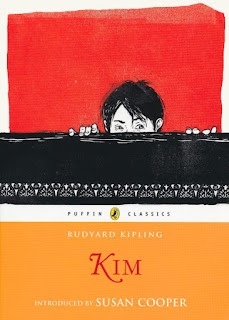
[In 2011], I read Kim by Rudyard Kipling for a bookclub and really enjoyed it. I then watched the 1950 film with Dean Stockwell and Errol Flynn.

The movie is fairly good. It was "filmed on location." This means that a bunch of outdoor shots were filmed in India; everything else was done on a sound-stage.

But the movie does have a semi-authentic feel to it (I was worried that it would be like The Ten Commandments, which I enjoy watching but is hokey in the extreme: just watch Joshua organizing the Israelites in his best "Are we ready, boys and girls?" camp counselor manner.)

Kim is surprisingly straightforward and non-hokey, sticking closely to the book up until the last twenty minutes.

At which point it suddenly takes a nose-dive into . . . I don't know. I don't know what they were trying to do. I don't think they knew what they were trying to do.

I have a theory. Up until the last twenty minutes, the film focuses on Kim, played perfectly by Dean Stockwell. At fourteen, Stockwell has the compact, dark exuberance that Kipling ascribes to Kim.

But he isn't quite old enough to play Kim at seventeen (this is a pity; if Stockwell had been only a year older, he could have played Kim's younger and older selves with little difficulty). Consequently, the action from the book is squeezed from approximately five years into 1-1/2. Kim is still a child when he goes to hunt the Russian spies.

Kipling wouldn't have a problem with this. In the book, he continually emphasizes that Kim's controllers want to mold but not break him. They release him from his "English" studies as quickly as possible. They want him educated (and loyal), not disciplined to be a rigid, unimaginative, British officer.
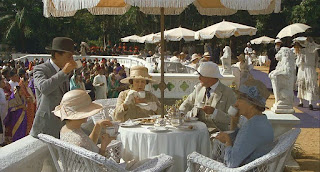
Though very different in their politics, neither Forster nor
Kipling had a high opinion of this version of India.
This approach dovetails nicely with Kipling's beliefs regarding India. He supported the British Empire, but he believed (correctly) that it was badly managed. He believed, for example, that the British administrators in India should NOT be upperclass boys trained in England with no real knowledge of the country or ability to work with the native people. His book Stalky & Co. is basically about the type of boys who should be sent to administer India. Stalky, specifically, is a Kim proto-type.

So Kipling has Kim released from the British system as quickly as possible. He had little to no trouble sending this boy back into a dangerous environment. In fact, he implies that Kim was safer when he was younger and more savvy. Educate him any further, and he'll be too stupid to survive.

This idea was not something that 1950 America could readily stomach. The idea of "childhood" as a pure time of innocence had been growing since the Victorian era; post-WWII, middle-class American parents didn't want their kids being trained to play the "Great Game." They wanted them in college, learning to be businessmen and therapists and school-teachers.

Subsequently, the end of the film Kim turns into a film about Errol Flynn. Errol Flynn must go rescue Kim who has recklessly decided to play "the game" at too young an age. At the very end of the film, it is heavily implied that Kim will go back to school and once he graduates, he won't need to be a spy since all wars will be over.

In fact, there's an interesting contrast (which the writers of the script presented but didn't know what to do with) between the "old school" swashbuckling Flynn, who gets a kick out of killing his enemies, and the "new school" Kim, who gets squeamish out of watching people die.

This is not completely out of keeping with the book. In the book, Kim develops a more complex understanding of morality than he starts out with. The change is necessary since Kim is cocky to the point of arrogance; he is only reined in by his mentor, the extremely pacifistic lama. At the end of the book, the lama--who has obviously been worrying over Kim's participation in "the game"--has a vision which comforts him with the belief that Kim will be able to act as a spy without losing his soul. (At the end of the film, the confused script-writers have the lama die. They obviously couldn't make up their minds whether to be pro-War or pro-pacifism. All they knew is children should have cozy lives.)

In the book, the lama's influence keeps Kim from turning into a little sociopath with no moral sense or direction except the desire to outwit people. In the film, the implication is that the lama represents a nice New Agey way to think for boys who no longer have to make hard choices where people put their lives on the line. 

Wishful, post-WII thinking. And, considering the instant inception of the Cold War, rather naive. But Kim is a child and, as a child, he must be protected!

And the infantilization begins.

The one major factor in the film's favor is Dean Stockwell. It is impossible for a late-20th century product like me not to associate Dean Stockwell-the-child with Dean Stockwell-the-adult. (Especially since at age 14, Stockwell already had that borderline look of amused insolence down pat.) I see Kim and I think . . . Al! From Quantum Leap. And they aren't that different. Kim has that Buddhist edge. But the kindness masked by insouciance coupled with incredible energy is pure Kim/Al. And Stockwell does it very well.

So, Kim didn't grow up to be a businessman (or a monk, as one author postulates). He grew up to work in a top-secret laboratory doing science experiments that result in time-altering adventures.

The last really is much more likely.