Showing posts with label Writing. Show all posts

Latest Publication: The Merman in Hiding

Merman in Hiding is now available on Amazon. 

Priest-detectives Rhys and Lider are currently on Earth. A family of Siphons or merpeople need them to locate a young man, Brae. The family believes Brae was kidnapped by another Siphon family to forcibly resolve a breach of promise suit.

As Rhys and Lider interrogate religious disciples, pharmaceutical representatives, and ex-lovers, they come to believe that Brae's disappearance encompasses something more  irrevocable than a broken heart. 

Rhys and Lider must discover Brae's whereabouts quickly since they are faced with an irrevocable choice of their own--and their future together.

Merman in Hiding is Book 3 in the Myths Endure on Mars Rhys & Lider Detective series. Anubis on Mars and Saint of Mars are available in one volume. The Wolf Boy Returns from Space is currently available as a single book.

The books follow a chronology. They do not have to be read in order.

I thank my brother Eugene here for his sci-fi suggestions. Any "good" science in these novellas (which are mostly story) is due to Eugene. Any dumb science is all on me. 
 
I also want to thank my brother Joe for discussing the philosophical and practical arguments that crop up in the final confrontation scenes at the end of the novella (think nutty psychologists in the early 20th century carrying out entirely unethical experiments). As with Eugene, any of the stronger arguments are due to Joe. Any "holes" in the arguments are mostly due to my characters (since certain characters would make certain kinds of arguments).     

Latest Publication: Hermes and the Hunt for Enkidu

Hermes and the Hunt for Enkidu is now available on Amazon. 

In an attached world controlled by gods, the head gods compete with the gods of agriculture over who should control the rules of death. Hermes works for both sets of gods. When Zeus and Hera order him to find members of a Wild Hunt, he must deliver a solution that satisfies all parties.

An opportunist with no particular moral code--he thinks--Hermes discovers a possible solution in Enkidu, wild man of Sumer. Enkidu would solve all Hermes's problems--except Enkidu is under the guardianship of a ruthless ex-god. Worse, Enkidu would upset Hermes's careful plans, including Hermes's beliefs about himself.  

Hermes and the Hunt for Enkidu is Book 3 of Myths Endure in Maine, a contemporary fantasy series set in a god-controlled world connected to Portland, Maine. The books follow a chronology. They do not have to be read in order.

The first two books--Kouros Underground and Cupid in Captivity--were republished along with Hermes and the Hunt for Enkidu. 

A-Z Characters & Transformation: C.S. Lewis's Great Flawed Character, Edmund

C.S. Lewis's Edmund has come up on several A-Z lists. Here he is again to represent a character who transforms. 

In her essay about Edmund, "King Edmund the Cute: Anatomy of a Girlhood Crush," Diane Peterfreund explains why Edmund is her favorite of the Narnian heroes. He's mine too, and I agree with Peterfreund's analysis. She points out that Edmund qualifies as a bad boy, but what makes him appealing is that he is a reformed bad boy: a bad boy who uses his bad boy past to gain insight into himself and others. 

Peterfreund points out, "Edmund...seemed [to me] to have pulled it together. He may have been somewhat graver than Peter, but he was still a cheerful guy, overall." In other words, he isn't a brooder.

Totally!

In terms of writing, Lewis's success with Edmund is three-fold:

1. Edmund's "fall" is very human. 

He isn't a sociopath. He is a normal human with normal resentment. He does betray his family--and that reality is not glossed over or excused by Lewis--but not for Big Bad, Larger-than-Life reasons. He isn't plotting to overthrow the universe. More Spike than Angel, his "fall" is human, rooted in day-to-day behavior (Lewis makes the point that Edmund has been away at a horrible school and has picked up horrible snide habits, again without excusing Edmund). Edmund's salvation is also very human. For instance--

2. Edmund retains his personality.

Edmund repents and recovers. And he gains a reputation of being wise with the ability to make level-headed judgments/assessments. 

He doesn't lose what makes him Edmund, however. In Voyage of the Dawn Treader, when talking to Eustace, he says, "You were only an ass, but I was a traitor." The tone is perfect. Edmund isn't apologetic. He isn't sappy. He isn't whining. He is matter-of-fact and even slightly sardonic. 

And it is notable that Eustace tells his story to Edmund first. Edmund has a practical nature that tackles problems in a practical fashion. The cousins have one characteristic in common.

3. Edmund's repentance or restoration is something he takes seriously. 

He doesn't dwell on his mistakes but he does use them. In Prince Caspian, when the siblings are lost, Edmund takes Lucy's side on where they should go next, precisely because he once let her down.

In sum, Edmund isn't just a bad-boy-reformed. He is a consistent and believable character who has turned his life around. Lewis accomplishes this feat through entirely non-dramatic characterization. 

The Heroes Forget in The Dark is Rising Series: How Tedious

One common variation on the "it was all a dream" trope is when the protagonists forget the fantasy/dangerous world they inhabited. The Narnia books sort of do this (but not entirely). The children revert to childhood and are not sure what they experienced. However, by the final book, if they choose to remember Narnia, they do. (As has been stated elsewhere, there is no reason to suppose that Susan won't come back to remembering Narnia.) 

In my fantasy Olympus series, gods and humans who leave Olympus forget--but only in their short-term memory. Their habits and skills remain. They are still drawn to Olympian matters. And they retain a kind of memory of the place in their dreams. 

However, if I ever figure out a way not to do the above (without taking the books off-topic), I will drop the idea.  

Because the forgetting trope in fantasy fiction strikes me as rather pointless. 

I read The Dark is Rising and Over Sea, Under Stone when I was growing up. I recently finished the remaining books in the series. And I was somewhat disappointed. 

*Spoilers* 

Unlike the Narnia books and my Olympus series, the fantasy action of The Dark is Rising takes place in our world. It slides back and forth between other planes of existences and other times. Otherwise, the action is based in the world of Will, the last of the Old Ones. 

He has helpers. But at the end, everyone else leaves or forgets. 

On the one hand, though I didn't find the last two books all that interesting, they are beautifully written with haunting scenes full of mythical motifs. The individual hero left alone to carry the burden of knowledge is in line with those motifs. 

On the other...I think human beings are fully capable of adjusting to new information. In truth, I don't bother to have people remember in my Olympus series because most of the action takes place on Olympus (the main characters all retain their acquired knowledge). And, too, I wanted citizens and gods to pay some price for leaving. 

However, I have Alima from His in Herland (related world) remember because, again, I think human beings are surprisingly, alarmingly, ready to adapt. Take AI: once something supposedly Terminator-like arrived, people simply shrugged and started new businesses. 

Barney and a bad guy
I suppose an "okay, we had a grand adventure--let's have a reunion!" reaction would be too prosaic for a grand saga (though C.S. Lewis pulled it off). But the "we are having you forget for your own good, so you will have no regrets" explanation is incredibly condescending, especially when aimed at main characters. And I don't buy it. 

I wrote a short story years ago ("Untainted") in which a character who chose to forget a particular event digs it back up again out of sheer (to borrow from the Brits) bloody-mindedness. 

In my fan-fiction for The Dark is Rising, I have Barney, the most insouciant of the characters, figure out who Will must have been. He tracks him down to become his boon companion because, hey, the guy needs someone!  

Lesson from the Ms: Make It Personal

Her rage is personal.
Less noble. More interesting.
Perusing so many fiction books, I've been reminded of how much human beings love stories. They love them for many reasons, including C.S. Lewis and Tolkien's belief that in creating story, human beings are trying to emulate their creator. 

Here, I suggest that stories allow us to zero in on the personal. Out of all the complications within life, we can focus on an individual. Through that individual, the complications sometimes come into focus.  

I wrote a story many years ago based on Sleeping Beauty, only my "Sleeping Beauty" was a prince who was cursed with unending sleep if he should ever pick up a sword (rather than a spindle). And I put him in a warrior-type culture; here's a guy who can't relate to any of the male figures in his society, not to mention he has nothing to do all day, and he's really brassed off about it all.

The witch was young and sophisticated and rather ruthless. She was one of the first female characters I created who wasn't just me dressed up in someone else's clothes (I was about 20 at the time). Her motivation for cursing the prince was her hatred of war.

Even at the tender age of 20, I wasn't much of an anti-warmonger, but that didn't matter because the character wasn't me. The problem with giving the witch an abstract reason wasn't my lack of empathy; it was that the abstraction got boring and generalized.  

I realized that to make the story work as a story, I had to change her motivation. That is, I had to make the reason for her behavior personal. She hated war, but she hated war because it killed off her lovers. She wants one lover who will stick around for more than a couple of months. So, she curses the prince, and, since witches don't die and don't get old, as soon as he gets old enough, she takes him for her own. A sort of Chia Pet homegrown boyfriend!

The story wasn't a statement about war. It was about an individual's free will--how much the prince has or doesn't have. And for the story to work, the witch's motivation had to become something close and personal, rather than abstract and faraway. 

Along the same lines...

Every time I watch early X-Files, I am impressed again by how complete Mulder and Scully are as characters. One writing aspect the show got spot on was making Mulder's quest personal. He has a back-up group of conspiracy theorists, the Lone Gun Men, and although I believe one of them has a personal story behind his obsession, they are mostly obsessed for the sake of being obsessed--the abstract motivation: The Truth is Out There. And they make fine minor characters. But for a major character, abstract motivation isn't enough. 

By making Mulder's obsession personal (his sister) and then giving him Scully as a sounding board, the creators of X-Files gave the show the kind of relationship and existential grit that every show since has tried to copy. Scully becomes Mulder's safety net. He can allow himself to go crazy because he knows he has this cautious voice-of-reason to hold him down.

In terms of plot, I never did get the whole "Scully was given to Mulder to discredit his work and Mulder is allowed to continue to keep him from becoming a martyr" explanation since, as far as I'm concerned, dead men tell no tales. Mulder dead would be less of a problem to the bad guys than Mulder with Scully. I agree with Phil Farrand that Cigarette Smoking man is Mulder's dad; he came up with all that "can't make him a martyr" crap to keep Mulder alive. 

And that relationship at the personal level has grit. 

At its best, the show explored attitudes and complexities of belief. But it did it through focusing on the personal, not the abstract.

Spoofs Allow for More Possibilities: Thank You, Shakespeare!

One of the positive of "spoofs" is that they allows the givens to remain givens, so the writers don't have to keep excusing themselves.

I came upon this thought when I considered the problem of updating/modernizing/making superheroes supposedly more progressive. Literature Devil does a thorough job proving that Stan Lee was always more interested in story than in politics. However, writers run the risk of being criticized no matter what they do--hence, growing reader interest in manga, which still focuses primarily on story. 

My suggested solution is to "pay tribute to" a classic, which is code for, Use the classic characters and plots but switch people around.

In a recent viewing of The Hollow Crown, I realized, Shakespeare allows for such tributes! Shakespeare is the preeminent example of using and reusing basic plots-- which Shakespeare somehow encapsulated better than everyone else--to achieve numerous ends. 

So one of the main characters of Henry VI is Margaret, the bulldozer of a political powerhouse who marries the inept Henry VI. Some critics believe that the three plays that make up Henry VI are really about her, rather like how huge chunks of Henry IV are mostly about Falstaff and his cronies. (The plays are named for their kings, not necessarily their plots.) 

And I realized that Sophie Okonedo is able to play Margaret--and play her magnificently--without automatically being labeled misogynistic BECAUSE the play is Shakespeare. 

Shakespeare is endlessly usable--one reason, perhaps, that he has remained such a seminal figure in literature. His plays can be modernized or spoofed (see Trevor Nun's spoof of, and tribute to, the itself-a-spoof-play Comedy of Errors). Shakespeare's plays can be cut to focus on different plots and characters. They can be set in different countries and even in space--or animation! 

Okonedo becomes the powerful and complex Margaret and excels--without apology.

Thank you, Shakespeare!  

Lessons from All the Ms: What to Do with So Many Characters

I have discovered in reading the first few pages of books by M authors that despite a wide range of writing styles and topics and tones (there truly is something out there for everyone!), specific writing choices consistently cause problems. 

One of those problems is too many characters. 

I recently read (in March 2025) an "M" author book in which so many characters were thrown at my head at once, I immediately lost interest. 

So...how does one produce a book with a "cast of thousands" without overwhelming the reader? Fiction, after all, to a large extent, is about investment in the individual. If I want to read about large groups of people doing stuff, I'll read the encyclopedia. 

I suggest two methods characterize the writers who manage to successfully present a complex story with multiple characters: 

1. Stick to a single POV. 

The single POV explains the great success of Cherryh's Foreigner Series. It is an exceedingly complex series with multiple political "sides" occupied by strong personalities. Yet Cherryh has managed to keep all personalities distinct. To a huge extent, the non-confusing nature of the story (despite overlapping political/social/scientific worlds) is due to the third-person limited voice of Bren Cameron (main character) and Cajeiri (heir apparent to the main political body). Because we, the audience, see everything through their eyes, the things they see make a great deal of sense.

2. Avoid the "in-joke."

In my "M" reading, the book I encountered that turned me off was a mystery in which the author wanted to mention every single character in a previously established English village. It reminded me of romances in which the authors wants to bring back every single couple from previous books, sometimes in a single chapter. 

I understand the impulse: writers fall in love with characters and want to give them cameos. And this approach can be quite successful with established readers, who enjoy the cameos.

But a cameo is a cameo, not a plot.  

Hollywood's Murder on the Orient Express (1974) versus Death on the Nile (1978) is a good example. Murder on the Orient Express is, quite frankly, a series of cameos. But they have a purpose. The actors play their classic roles with such skill, several were nominated for their performances. The mystery, not the cameos, runs the movie.

Death on the Nile (1978), however, is about the cameos BEING cameos. Ha ha ha. Isn't it sooo clever to see THAT star acting so over-the-top? (Granted, Ustinov is rather like that anyway; he does far better in the TV movies.)

In one romance series, the need to bring back so many characters resulted in the main characters utterly changing personalities. I have mentioned elsewhere that one of the few reasons I'll give up on an author isn't politics or bad writing but, rather, the betrayal of a character. In this particular case, I thoroughly adored the Jon-Donovan novels up to the last book in which suddenly the mature intelligent main characters who exhibited nuanced reactions to the world started throwing around clever put-downs about all the people they didn't like. The book wasn't a story; it was a series of Tweets. 

Pulling in characters for the sake of showing them off often, unfortunately, results in characters being a series of Tweets.

Fiction truly ultimately is about investing in individual people. (Which is why fiction simply for itself is such a threat to totalitarian states and mindsets.)  

Thoughts on First-Person in Fiction and Essays

A unique Bones episode told from
the point of view of a dead boy.
I have mixed feelings about first-person in fiction. It is ubiquitous; these days, I read far more of it than I used to. But I'm always somewhat wary of it. Like with fiction based on letters, I can't drop the sneaky suspicion that it is too easy. Oh, just write a memoir already. 

Additionally, I have formed the uneasy impression in the last few years--I read a great many small press books on my Kindle, and I enjoy many of them--that first-person is a kind of fall-back position for being able to quickly establish character, except it doesn't always work. I sometimes develop less feel for the characters than I do with third-person texts. Everything is being discussed out of the perspective of a single mind, but I can't see the person or sense how that person interacts with others: what makes that person unique. The stream-of-consciousness stuff begins to blend together.  

I think good first-person is so difficult because it requires enormous control. As someone once remarked to me about The Curious Incident of the Boy in the Nighttime, "By the time the book was over, I wanted to get out of the boy's head." 

And the reader admired the book! For that matter, I consider Blossom Culp, the narrator of Ghosts I Have Been, to have a fantastic voice. 

But. Still. 

I use Terry and Alim as first-person narrators in His in Herland because the original text is in first-person. I used the god of love as a first-person narrator in my take on Northanger Abbey because I didn't trust that I could pull off Austen's omniscient narrator (I did the next best thing). In both cases, I tried to remember that THIS narrator would use particular references and vocabulary. Terry is hard-headed, pragmatic, and little wry. Alim, who is looking back on events, is more philosophical. Ven, the god of love, is "what have I signed up for?!" off-the-cuff-smoking-pot-behind-the-convenience-store guy. 

I thankfully returned to third-person in my other books. 

The one entirely valid reason to use first-person is for the reason listed below: the first-person narrator is able to supply a first-hand account.

* * * 

Re-post from 2008 with tweaks:

From Ohio Northern University
I occasionally get students who believe they should never use first-person in an essay, especially a research essay. Once upon a time, one of their teachers forbade the use of first-person, and the students took it to heart. The reasoning is that by banning first-person, the teacher will prevent students using non-credible evidence. 

Considering the number of my students who use [the equivalent of A.I.] and still fail their essays, the banning of first-person bears no relationship to the ability of students to think critically.

There's a lot of ridiculous non-first-person evidence out there which has no more credibility than a teenage driver claiming, "I never speed." A claim, introduced with an "I" or not, is still a claim, and any claim is disputable (as is all evidence).

I've seen the results of this logical fallacy in my students' writing; they confuse claims with support, thinking any statement without "I" is evidence (there's a huge difference between arguing, "Cats make great pets" and proving that cats make great pets). They also confuse claims with facts, thinking any statement without "I" is a fact: The United States is having a recession. Newsweek says so. I can use this "evidence" in my paper!

All evidence/claims are testable, both personal evidence ("I experienced") and non-personal evidence. Determining credible evidence has nothing to do with first-person and everything to do with the credibility of the speaker/researcher/study/source.

In a well-intention desire to prevent excessive grandstanding, teachers who ban first-person are confusing cause with effect. A superfluity of "I think that..." "I believe that..." "I must be right because..." may be the result of a me-centered culture (and can get annoying), but it has little to nothing to do with whether the speaker can actually be trusted or whether the speaker's evidence is meritorious. I often tell my students, "Personal evidence is the strongest evidence you have; it just isn't enough except to your parents and your friends." 

But to say that personal evidence carries no weight at all is such an obvious untruth that students are liable to follow the teacher's instructions while missing the point. 

Here's a claim: Non-credible arguments in the college environment will not go away until students are forced to be intelligent (but not cynical) about all information. And...[2025 update]...A.I. doesn't help. Or at least, it rather troublingly enforces how gullible students actually can be. The Internet says it (without "I"!) so it must be true.

Thankfully, I can report that there are students out there who get the problem. They do prefer to think for themselves, which, of course, makes them in the long-run, more objective.

More About Giving Audiences What They Want: Great Quote

Church
I write in Don't Give Audiences What They Think They Want that authors run the risk of putting out stories with beloved tropes and then...ending up with dissatisfied audiences since viewers/readers want those tropes but they also want more.

(When Tolkien became hugely popular in America in the 1960s, a great many fantasy series by others followed. Some were quite good. Some...feel like a wizard, small person, dwarf, elf, and king were shaken up together in a bag!)

Scene from Murdoch Mysteries
I suggest that the best writers have a vision and that the best visions are by authors who love what they are writing. In American Visions by Robert Hughes, Hughes makes this point regarding painting and Frederick Edwin Church:

Like Dickens, indeed like any artist who becomes both great and popular, he hadn't reach this position [of being America's 'national artist'] by figuring out what the public wanted and then giving it to them. He wanted what the public wanted, and was rewarded by its unstinting gratitude.

Hollywood, like Google Search, often come across as unbearably cynical because they seem to think they have "figured out" the public. 

But only a willing member of the public can truly succeed at capturing a zeitgeist.  

Don't Give the Audience What It Thinks It Wants

Re-post from 2011.

I recently posted about ignorant characters. I point out problems with such characters. What I don't mention is how the ignorant character is often preferable to the noble, omniscient, triumphant, perfectly good or perfectly evil character. 

The problem with the latter is how often filmmakers and authors do the equivalent of what Plinkett describes below--they make that noble, omniscient, triumphant, perfect character the focus of every prequel. 

Giving the audience what the audience (supposedly) wants is a mistake.

* * * 

In Plinkett's latest Star Wars' review (which is amusing though not as complete as the others), Plinkett, like always, makes a very cogent point.

Here is the cogent point in my own words:

Just because Darth Vadar became an iconic image of Star Wars doesn't mean the prequels needed to be about him. Just because Darth Vadar is important to us doesn't mean he was important to that universe at that time.
There is a writing conundrum here. Yes, it helps when you are writing a novel/short story/movie/show to use motifs and plot-lines and characters that people actually enjoy and recognize.

However, if all you do is stick together the most common motifs/plot-lines/characters, 9 times out of 10, the product will be a dud--or, at least, remarkably lacking in staying power.

Plinkett does a thorough job proving that, unfortunately, this sticking-togetherness is how Lucas approached the prequels. He took iconic images from IV, V, and VI and simply expanded and rehashed those images in the prequels even when the rehash made no sense.

So, for example, instead of the robe Obi-Wan was wearing in IV simply being the kind of robe people wear on desert planets, suddenly it became the robe ALL Jedi wear.

And instead of the training tools on Han Solo's ship simply being what was at hand, suddenly those tools became the way ALL Jedi are trained.

The result is unimaginative. And irrational.

It also highlights a very important principle. Classic motifs are good. Classic motifs backed by an actual vision are BETTER.

In a large, but not unmerited, segue, C.S. Lewis' Narnia series has been criticized for basically being a collection of every single fairytale/folktale/mythological image/motif C.S. Lewis encountered in the course of his extremely well-read life.

But as many critics, including Lisa Miller of The Magician's Book, have pointed out, it isn't the images and motifs that delight us, it is what Lewis did with them. He wasn't pretending to create new stuff; he was taking what he knew and rearranging it into a new pattern. He had a vision.

Every writer has to have a vision. Without the vision, the writing sags. And should the writer give up that vision to satisfy the audience's supposed desire for an iconic image, the audience will feel the vision dribbling away.

The writers did NOT make
Frasier a repeat of Cheers. 
Which is one reason why writing to satisfy fans doesn't always work. The fans LOVE a couple of minor characters, so the writer(s) make those characters a bigger part of the drama, and, hmm, what do you know, the show is less satisfying.

On the other hand, refusing to give the audience what the audience wants out of sheer "BUT I HAVE TO BE DIFFERENT" perversity isn't too smart either.

The solution is writers who give the audience what the audience wants without losing their vision. This, of course, isn't easy, but I see two solutions:

1. Writers can give the audience what the audience wants without losing their vision when they like what the audience likes.

If you want to write romance novels, it helps if you like romance novels.

2. Writers can give the audience what the audience wants without losing their vision when the writers and the audience agree on what the writers are trying to do.

To clarify this second point, not all novels/stories/movies/shows have to focus on the latest popular topic: vampires, for example. People vary; interests vary. There are a lot of audiences out there to satisfy. I would argue that people want much of the same thing within their separate genres, but that leaves a lot of room for individual creative vision-making.

Hey, there's even room for those people who think that reading stream-of-consciousness profundities about Life in Middle Class America is NEW and DIFFERENT! (Shhh, don't tell them they are being pandered to.) The point is, the writers and audience agree that that is what is going on.

In other words, the rules are agreed to--even when the rules are Monty-Python randomness.

Back to characters--the connection between this repost and characters is that giving the audience the characters they love as ALREADY those characters, despite the movie or book being a prequel, destroys the characters. I found Jill Paton Walsh's The Attenbury Emeralds a disappointment because it presented a young Wimsey as already ahead of everyone else in the mystery. There was no learning curve. He met Charles Parker but didn't learn from Parker, a policeman already. 

In truth, I think filmmakers read into audience engagement something that isn't necessarily there. Yes, we like Gandalf's wise remarks to Pippin. We also like Gandalf's snappishness. And we like his confession to Galadriel that he is afraid. We like the noble, semi-omniscient bloke. But we like the imperfect, struggling bloke as well. 
 
As my obnoxious (but accurate) fifteen-year-old self said, 

"If everyone is special, then no one is special."

If there is no contrast between the character THEN and the character NOW, there is nothing for us to delight in. 


All the Ms: How Deep Does Culture Go?

In a previous post on the Ms (the A-Z List where I try out all the fiction books in the "M" section of the library--try out as in, I read the first chapter or first 10 pages), I comment that "[s]o-called great authors are as much slaves to trends as anyone else."

The issue here is a fascinating one. It is also one that I change my mind about every time I reflect on the issue:

How much are artists a product of their time periods and how much do they transcend those time periods due to their imaginations? 

On the one hand, Shakespeare definitely reflects not only the tropes and plot ideas of contemporary (to himself) artists, Shakespeare also reflects his own culture. He reflects political and historical matters that interested his audiences and would have been common conversational gambits in the streets and taverns. And he uses the language of his world. His mindset or perspective reflects the beliefs of that time. 

On the other hand, audiences still enjoy Shakespeare today--despite changes (some changes) in customs and language and interests. His plays are remarkably translatable--not only into other languages but between mediums. Idioms and characters from Shakespeare are common fodder in many cultures. One possible reason is that people adapt easily to a variety of art forms. Another possible reason is that Shakespeare captures eternal aspects of the human condition, experiences that transcend Elizabethan and Jacobean England. 

This past semester, I distributed an article about Dickens and Poe to my Literature students. Was Dickens influenced in the writing of David Copperfield by meeting Poe? Did he use aspects of Poe's life in the creation of the character of David Copperfield? 

I chose this article for three reason:

1. To underscore that true understanding/knowledge of an author can not be AI-derived since AI does little more than perpetuate stereotypes. The author of the article, Harry Lee Poe, points out that many scholars connect Dickens to David Copperfield. However--

Jane Smiley has observed that Dickens loved David Copperfield 'as if it were his autobiography', then added insightfully in contrast or defiance of the prevailing view, 'but in fact the incidents of the novel and the incidents of Dickens' early life were quite different.' Smiley goes on to argue that David Copperfield evokes Dickens' life without relating it. (my emphasis)

2. To underscore that the author of the article is only able to argue that David Copperfield closely resembles Edgar Allan Poe by KNOWING specific information about both Dickens and Poe. Dickens and Poe did meet; in addition, Poe reviewed Dickens' work (positively!); and Dickens and Poe corresponded. Dickens later visited Poe's mother-in-law. The end of the article presents 16 points of biographical information about Poe's life. 

3. To underscore that the biography-argument approach to literature (authors are the product of their times and upbringing) is not a given. As the author states, 

Though David Copperfield has flashes of autobiographical moments, as all of Dickens's novels do, it succeeds as a novel because it is not about Dickens. He has the necessary distance from the character of David Copperfield to create a work of art - of imagination. The imagination collects up a great storehouse of experiences from which the artist creates a work of fiction. Source criticism provides a fascinating insight into the world from which a writer fashions fiction. (my emphasis)

The passage reminds me of a quote I use to begin Chapter 4 in my thesis. In Ngaio Marsh's When in Rome, Alleyn reflects:

The Van der Veghels broke into excited comment. Grant, they warmly informed him, had based the whole complex of imagery in his book upon [the well]. "As the deeper reaches of Simon's personality were explored--" on and on they went, explaining the work to its author. Alleyn, who admired the book, thought they were probably right but laid far too much insistence on an essentially delicate process of thought.

I would substitute "delicate" with "ambiguous" or "multifaceted." LOTS of conscious and unconscious elements go into forming a brain that produces a piece of art or writing, from genetics to culture to upbringing to other artists to personality to choices and, yes, imagination. 

The article about Dickens and Poe:

 Poe, Harry Lee. "Poe, Dickens, and David Copperfield: Biography – but Whose?" The Dickensian 115.509 (2019): 272. ProQuest. 

Give Characters Jobs: Numb3rs

In a commentary on Numb3rs, Rob Morrow complains about shots that position an actor at one point in the room, just to have the actor  start walking as the camera begins to roll. 

Why are they coming from that direction? What are they doing? Why? 

Either Morrow or another actor comments that directors prefer to have characters do stuff, not simply stand around waiting to deliver their lines. In an early episode of Numb3rs, Alan Eppes (Judd Hirsch) is feeding a bird while he talks to his sons rather than simply standing (conveniently) in the same room. 

I'm a big fan of characters having jobs, and I've always liked the fact that Numb3rs gave its guest experts stuff to do (other than being the Big Bad of the week). Chris Bauer as Professor Galuski, for example, is a useful character. He bridges the two worlds of academe and FBI since he visits locations with agents; discusses speed and velocity and other matters with Charlie; and gives Alan a bosom buddy, someone who takes a less intellectual, more hands-on approach to engineering problems. 

Themes naturally arise from these interactions, such as understanding based on abstract theory versus understanding based on experience. 

Give a character a task--all kinds of positive writing possibilities will follow!

Great Family Characters: The Melendys

One of my favorite series to write has been the Donna Howard series (which I hope to republish in 2026). I created two families--one of three brothers--one of one sister, Donna, and two brothers. They meet over a case (Coin) and continue to interact. 

It is one of my favorite series because the siblings are so distinct. 

Here's the truth: writers tend to return to the same themes and characters and even, to an extent, plots over and over again (Agatha Christie's Adriane Oliver, her fictional version of herself, makes very funny comments about repeated plots). 

When I am working on a novel, I use the Homer technique to keep my characters distinct. Homer is known for attaching adjectives to characters to remind us of their attributes: gray-eyed Athena, swift-footed Hermes. Although I believe in show-not-tell, I think this descriptive approach is an entirely valid technique, in part because--as a reader--I don't enjoy books where I can't tell the characters apart. 

I also change dialog depending on a character's personality. That is, I ask myself, "Would this character be this blunt? Or this funny? Or this philosophical? Or this whimsical? I like that line--but would my character actually say it?"

The Donna Howard novels were such fun to write because the characterizations were relatively easy and remained stable over the series: wry, critical thinker Sammy; insouciant "que sera sera" Chester, and practical everywoman Donna could be thrown into a scene and have the most interesting conversations! (I love to read and write bantering dialog.)  

Character stability isn't always so easy. Consequently, I greatly admire writers who can pull it off. Elizabeth Enright's Melendy siblings are a great example. The characterizations and stability of those characterizations appears to be effortless. Randy is dreamy and friendly; Mona is practical and worldly (in a positive sense); Rush is ironic and dramatic with the emotional intuitive leaps of a musical hotshot; Oliver is industrious and quiet in a "become an engineer or biologist someday" way; Mark is cautious and quiet and intense in a "become an army commander beloved by his soldiers someday" way. 

Enright uses the techniques I mention above. She also uses a game that my family played when I was growing up--I don't know if the game was common to my parents' childhood (1940s) or if we got the game from Enright. It is a kind of 20 questions game but the answer is always a person, and the person has to be compared to animals or a piece of furniture. So, regarding Mark...

Mark turned out to be good Golden Bantam corn, a setter dog, a meadow lark, a maple tree, and many other pleasant reasonable things...Cuffy [the housekeeper and second mother] was like a pigeon...and a pearl...and a big healthy cabbage rose.

Enright KNOWS her characters, and that facility, perhaps, is the best place for a writer to start.

The Character Who Others See Differently: The Excellent Bren Cameron

One of the few ongoing very long series that I read is C.J. Cherryh's Foreigner series. The main character, Bren Cameron, starts as a kind of ambassador whose primary job is to "translate" human culture into the atevi culture of the planet where the humans landed generations earlier. Eventually, Bren becomes the ambassador for the primary atevi leader who maintains a precarious political dominance over most of the other clans. 

It is a fascinating series. The summary above doesn't do it justice.

Bren is a great character. He is tall by human standards though by atevi standards, he is about the height of a young teenage boy. By the beginning of the first book, he has reached the point where he thinks in terms of the atevi language; he is also beginning to think of terms of the culture, to think like an atevi. 

He is well-aware that he is human. The wiring is not the same. Yet he is also aware, to a degree, that he appears almost foreign to many humans. His facial expressions and attitudes and ways of assessing problems take him outside human culture. Because he is brilliant, he is able to constantly evaluate any decision or problem in terms of a dozen different scenarios from an outsider's perspective--to both Atevi and humans. 

And he doesn't realize he is brilliant. Or he does and doesn't think his brilliance is enough. In one book, the human spaceship--whose return in the first book sets Bren's future career in motion--takes Bren and several others to a human space station to unravel the political situation there. In one scene, Bren behaves in a very human way with a human he doesn't trust. The act is a ruse though in the moment Bren is thinking on his feet. He isn't aware of his own genius in handling the situation. 

And the author doesn't call attention to his genius (unlike Ngaio Marsh, who is always reminding readers how intelligent and unique and socially adept Inspector Alleyn is). In fact, it is entirely possible that the author sees Bren has just one more smart human among many. Since so much of what we see and experience is through Bren's head, it is easy to accept his evaluation of himself, to go along with his self-castigations when he thinks he has made errors in judgment. 

The approach here isn't easy for a writer to maintain--to allow characters to perceive themselves as different from how other characters perceive them. The writing issue isn't the same as the unlikable character who is justified. In that case, the justification is often quite blunt. Justifying the witch or Grendel or Dracula is part of the text.

In this case, action and occasional dialog have to communicate: 

The character thinks, This is who I am, but....

History Notes: Dissenters and Atheists in the Eighteenth Century

Non-Conformists
In 1700s England/Britain (the terms were often conflated), religious conflicts were less between Protestants and Catholics and more between established Protestants--Anglicans--and Dissenters/Non-conformists, i.e. Puritans and Evangelicals.

Pamela from Richardson's Pamela is a non-conformist in spirit although she attends/supports the Anglican Church. Her religious feelings/convictions are crucial to the story since they motivate her continual resistance of Mr. B. She does not resist him because she is revolted by sex or afraid of disobeying her parish priest. She resists him because she believes that her status before God is not contingent on her status as a servant. Her master may appoint clergymen; that doesn't give him rights to her soul.

In my novel Mr. B Speaks! Pamela's gainsayers entirely fail to understand the nature and reality of her religious attitudes, falling back instead on cliches about "religious people"; I based these scenes on my own experience in  academe. Academic critics quite often fail to appreciate non-political/non-sociological factors in general, resulting in the rather bizarre black-hole that dogs much literary criticism.

William Wilberforce
Aristocratic gainsayers of Richardson's novel at the time felt the same way. During the 1700s, becoming an Evangelical or Dissenter or Methodist was most common amongst the rising merchant class. In response, the wealthy intelligentsia/upper-classes considered so much religious enthusiasm rather crass and embarrassing. When William Wilberforce converted to evangelicalism in the 1780s, he was (initially) extremely careful not to make his interests widely known and even wondered if a Parliamentary career was out of the question. He was convinced by friends that he would do more good in Parliament than out of it, and of course, he was hugely instrumental in the abolition of the slave-trade by British merchants.

As a member of the wealthy upper-class--though not the intelligentsia--Mr. B has little interest in personal conversion (at least in the first book). However, he would not have endorsed atheism. Although atheism was bandied about eighteenth century English literary circles, belief in the supernatural was too strong for atheism to have any lasting impact. (I am referring specifically to atheism as the deliberate proposal that there is no god or gods rather than as a challenge to orthodoxy/state religion; the second was common in the eighteenth century while the first was practically unheard of; the term "atheist" was sometimes applied to both positions.) The average intellectual was more likely to be a deist than an atheist. It would take another 100 years for atheism to become "cool."

Sir Humphrey laying down the
unwritten rules of society.
In general, Mr. B's attitude can be summed up by a quote from BBC's Yes, Prime Minister. When funds to the arts are challenged, Sir Humphrey is scandalized. When Bernard points out that nobody actually listens to government-funded radio, Sir Humphrey replies, "Well, neither do I! But it's vital to know that it's there!"

This pretty much encapsulates the eighteenth-century, upper-class attitude towards the Church of England: "I may not believe or go or care, but it's vital to know that it's there! (Now please stop harping on and on about it.)"

Give Characters Jobs: Blue Bloods

One of my arguments with fiction is that main characters need jobs. 

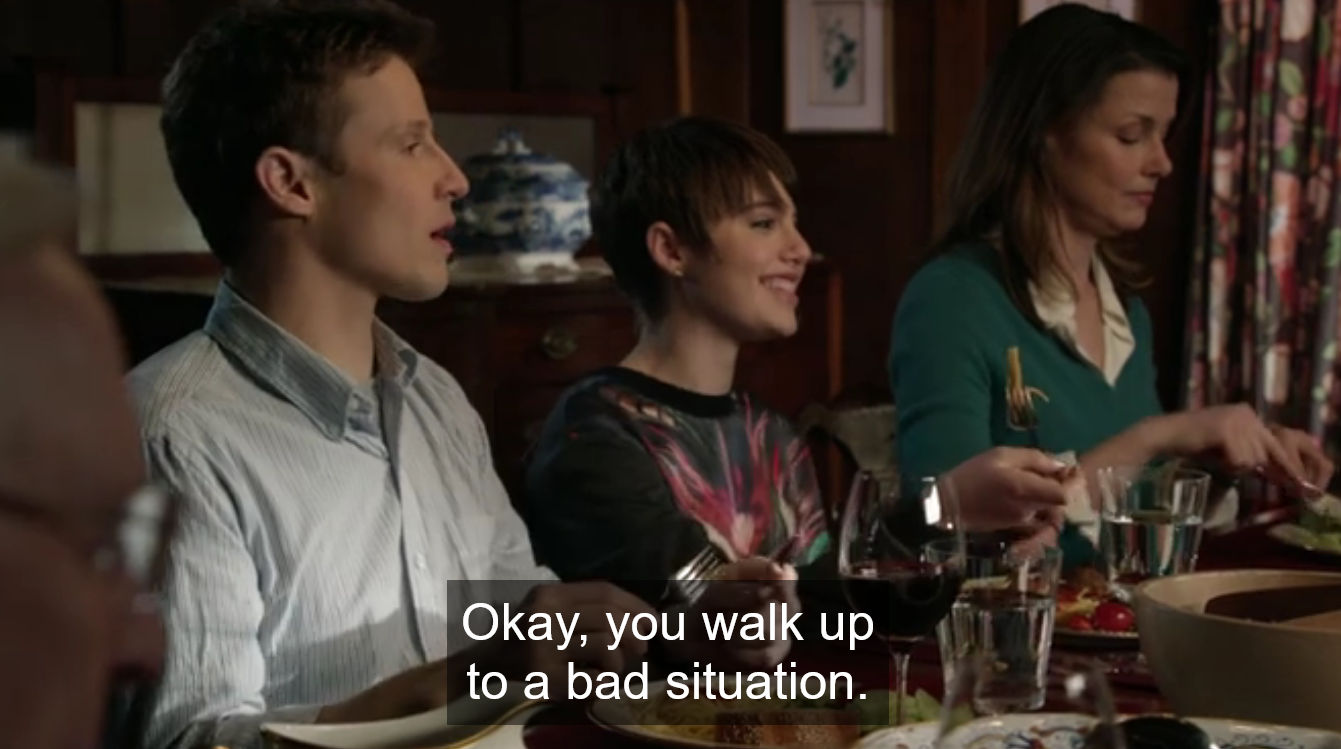
Blue Bloods demonstrates this truth excellently. Although many of the family dinner conversations are about relationships and school and friendships, nearly all of them deal in some manner with the "family business." 

Crime. Detection. Loss. Punishment. Fairness. 

Granted, the ganging up on Erin gets tiresome (sure, she can hold her own; it still gets tiresome). But some of the absolute best dialog emerges when people in the family try to thrash out a problem. I've mention elsewhere Jamie's great scene at the dinner table after he gets beaten up and family members share memories of stuff he swallowed as a kid. 

On the crime side, I like the scene in "Payback" when Jamie and Erin exchange views on the problem of "he said-she said." 

"Like trying to deconstruct a milkshake," Erin says in exasperation.

Frank and Henry then make the wonderful point that a cop can be a gentleman. 

If you are a writer and suffering from a lack of decent dialog...give your characters WORK! Some of the best dialog I've written--and the most fun--was people arguing over what belongs in museums and what doesn't, precisely because one character assessed pieces for museums. The conversation was the natural result of people discussing what they do and care about and have invested themselves in.  

Don't Entail Smentail, Me! The Difficulty of Entails in Persuasion and Persuadable

Money plays a big role in classic English literature, from Austen to Trollope. And it matters. Money may be about greed. It is primarily about survival, marriage prospects, and identity. In addition, money isn't a simplistic matter since money matters are complicated by debt, inheritance, financial opportunities, financial risk, and entails.

The ending of my book Persuadable is a rebuttal to the ending of the Persuasion (2007) film.

At the end of Persuasion (2007), Captain Wentworth buys Anne's family home. The film correctly indicates that part of Anne's attraction to Mr. Elliot, or at least her attraction to marrying him, is that she will be able to live in her family home. By buying her family home, Captain Wentworth resolves that dilemma (Anne doesn't have to give up anything for love!).

Unfortunately, having Captain Wentworth buy Kellynch Hall makes mincemeat of the plot.

If selling Kellynch Hall was this easy, why didn't Sir Walter sell it to begin with? That would be the easiest way to clear his debts.

An argument could be made that Sir Walter's vanity won't allow him to give up the manor; the solution still begs the question: Why would he suddenly be willing to sell at the end of Persuasion (2007)? (There is a possible explanation; the film just never supplies it.)

A possible Kellynch Hall from JASA.
In Austen's tome, Mr. Elliot wants Kellynch Hall because he is tired of being "Mr." and wants to try out being "Sir." He will be "Sir" without Kellynch Hall, but not to the same degree. And, in the book at least, there's no financial reason for him to give up the hall.

To explain Mr. Elliot's behavior, many movies make him (relatively) poor/in need of funds. This, of course, begs the question of why a poor Mr. Elliot would be chasing after women with small dowries and an estate encumbered with debt. However, even if we assume that Kellynch Hall, unencumbered, could bring in a decent income, there is still an underlying problem:
 
THE ENTAIL

Sir Walter's vanity is not the sole block to a sale anymore than Mr. Bennet's passivity is the sole block to his disposing of Longbourn. Both estates are entailed; they can only be passed on to the nearest living male relative: Mr. Elliot or Mr. Collins. And entails in the 19th century were rather difficult to break.

They can be broken, which the passage below discusses in some detail. However, Persuasion (2007) makes no effort to explain how the entail was broken, leaving the viewer to wonder what everyone has been fussing about for 120 minutes. Captain Wentworth just, you know, walked into an estate office one day and, like, said, like, "Oh, hey, I'll buy that."

My primary problem with Persuasion (2007)--which does have some redeeming points--is this assumption of dumbness by viewers. The writers come across as people writing for Austen fans, not as fans themselves: Oh, those Austen fans are silly airheads who only read Austen for the cutesy romance and the girl-talk and don't pick up on anything else.

Sites like The Republic of Pemberley and JASA (above) disprove this cynical painting of such fans. Jane Austen fans (and romance writers/readers) are remarkably well-informed.

I would have preferred Persuasion (2007) to have been written by true fans rather than by people-trying-to-make-the-fans-happy.

Setting aside the film, if you want to know how to really break an entail, read the following passage from Persuadable!
Captain Wentworth eyed [Will and Penelope] as they entered [the drawing room of their house]. Anne curtsied; Penelope responded quickly. Will returned Captain Wentworth’s curt bow, then stood behind Penelope’s chair. His stance mirrored Captain Wentworth’s. His use of mimicry, Penelope had learned in the last three years, was a protection against outsiders. She was an insider.

“You received my letter,” Captain Wentworth said to Will.

“You wish to discuss breaking the entail to the Kellynch Hall property.”

“Sir Walter’s health is failing. He has moved permanently to Bath. He is willing to break the entail for his daughter’s sake.”

Penelope scarcely believed it—the man’s self-love was so bound up in his ancestry—but then she realized that his self-love had always been as much for the form as for the substance. All said and done, Kellynch Hall was a means to an end.

Besides, attempting to break the entail would spite Will: Better his daughter in Kellynch Hall than the despised cousin.

“Are you committed to inheriting Kellynch Hall?” Captain Wentworth asked Will.

“It’s a pleasant area,” Will said.

“You don’t strike me as a countryman,” Captain Wentworth said.
No. Will was no countryman. After all, Penelope remembered, Captain Wentworth manages men on his ship; he isn’t lacking in perception.
Captain Wentworth continued: “Are you sure you would be accepted in Kellynch?”

His eyes didn’t flicker towards Penelope, but Will said sharply, “I believe the populace would be well-satisfied with the Hall’s lord and lady.”

Across from Penelope, Anne tilted her head. For the first time in their acquaintance, she looked at Penelope with real interest. Her eyes drifted to Will who had slouched to a half-seat on the arm of Penelope’s chair. So, her gaze seemed to say, you are not just opportunists.

Penelope said smoothly, “Town life certainly has more to offer.”

“We are country-folk,” Captain Wentworth said and settled into one of the armchairs. Apparently, he had decided that Penelope and Will were sensible people who would listen to reason. “Once I leave the navy, my wife and I would prefer a country residence. Kellynch Hall would be very much to our taste. We want to acquire it.”

Penelope silently applauded Captain Wentworth. Any other husband of a baronet’s daughter would have kept up the pretense of a friendly, non-financial visit for hours. The horror of appearing vulgar!

Captain Wentworth continued, “Since the entail has to be renewed in your lifetime, Mr. Elliot, this is a chance to review your options. And since renewal may not be possible—”

Because Will and Penelope currently had no son, and Jennie [Will and Penelope's daughter] could not inherit. The Wentworths weren’t fools; they were going to press their advantage now, even if it meant dancing around their dislike of Will and Penelope. At least, Captain Wentworth disliked them. Anne seemed more curious than disgusted.

“My husband will not give up the title,” Penelope said.

She felt Will’s bright gaze on her, but she didn’t look away from Captain Wentworth’s speculative stare.

“Do you think of yourself as a baronet?” Captain Wentworth said to Will in a tone that suggested he didn’t think Will merited any title, including “captain.”

“Of course Sir Walter’s cousin should inherit the title,” Anne said quickly. “You are my father’s heir, Mr. Elliot.”

To give the Wentworths credit, Penelope doubted they cared about the title. In the City, however, a title could open doors for Will. And Penelope saw no reason why he should give up what was rightfully his.

Will said, “Penelope’s father, Mr. Shepherd, should be kept on as manager.”

“He’s too good to let go,” Captain Wentworth said. His tone added: Despite his daughter’s scandalous behavior.

Penelope resisted rolling her eyes. She knew how to play this game. Everyone brought deficiencies to the table and every deficiency had a cost. My scandalous behavior versus Anne’s non-male gender. Anne’s lack of maleness cost her more than scandalous behavior ever cost Penelope; Penelope didn’t see why she should allow anyone to forget that.

She said, “Since only my husband can break this entail, we expect to be compensated. The property is nearly disencumbered of debt. It will make a tidy profit in a few years’ time.”

Anne leaned forward, her eyes filled with the quiet speculation that marked this middle Elliot daughter. Anne knew that Penelope had no real tie to or love for Kellynch; Anne would remember how quickly Penelope left it behind the first time.

For Will, Penelope might endure it. But Will had no interest in playing squire. However much he liked the idea of a country estate, he’d never bother with the day-to-day. He would hire a qualified agent (who only skimmed slightly off the accounts) and move on to another endeavor.

Penelope could direct his energies better elsewhere. The Wentworths would get all the unpleasant noblesse oblige of being estate landlords while Will and Penelope stayed in London and watched its neighborhoods grow. The Wentworths would thrive, Penelope assumed. Kellynch Hall was their type of place.

She thought fiercely: I want Will to thrive.

She turned back to Anne. Anne, still leaning forward, gave her a seraphic smile, and Penelope realized, Sir Walter’s unappreciated daughter is getting everything she wanted. Well, well, Miss Anne Elliot. Good for you.

Captain Wentworth said, “It is still encumbered, however. That should be a consideration.”

Will laughed. He tapped Penelope’s shoulder, rose, crossed to the decanter, and poured himself a glass. He held out another to Captain Wentworth who took it after only a slight pause.
Détente.