Showing posts with label Austen. Show all posts

Darcy's Possibly Happy Childhood

Because Darcy is glum and untalkative, some fan fiction tries to suggest that he has trauma.

I don't agree (and neither does Darcy, actually).

Austen siblings often have close relationships.
Henry & Eleanor Tilney protect each other,  
& their rakish brother, against their father.

It is customary to give heroes and heroines difficult family relationships. After all, it is more dramatic! And, to be fair, a number of Austen's characters do have dysfunctional home lives: Anne Elliot, Henry Tilney, Edmund Bertram, and Elizabeth herself. On the other hand, Catherine Morland, the Musgroves, Elinor's immediate family, and Emma all have good relationships with their families.

Even those without good relationships rarely spend time agonizing over their family issues--not a lot of Freudians in this crowd!

Darcy is one of Austen's characters who had a very happy childhood. His own description follows:
As a child I was taught what was right, but I was not taught to correct my temper. I was given good principles, but left to follow them in pride and conceit. Unfortunately an only son (for many years an only child), I was spoilt by my parents, who, though good themselves (my father, particularly, all that was benevolent and amiable), allowed, encouraged, almost taught me to be selfish and overbearing; to care for none beyond my own family circle; to think meanly of all the rest of the world; to wish at least to think meanly of their sense and worth compared with my own.
In other words, Darcy's pride though partly the result of how he was raised is not in any way the result of poor treatment: neglect or abuse.

Not only is Darcy's pride not the result of poor treatment; it isn't even the result of deliberate brainwashing: "Son, you are better than anyone else; don't you forget it!" Darcy's pride is actually much closer to that described by C.S. Lewis in The Screwtape Letters. In a letter to Wormwood, Screwtape suggests how to exacerbate (spiritual) pride:
[She makes the] quite untroubled assumption that the outsiders who do not share [her beliefs] are really too stupid and ridiculous...it is not, in fact, very different from the conviction she would have felt at the age of ten that the kind of fish knives used in her father's house were the proper or normal or "real" kind, while those the neighboring families were "not real fish knives" at all. Now the element of ignorance and naivete in all this is large...

Screwtape then goes on to discuss how Wormwood can use this perspective to push the cliquey idea of "us versus them."

The attraction of a clique or set to someone like Darcy is not the attraction of being superior to others ("We are so much more beautiful, successful, likable than you"), which is the Crawfords' type of pride in Mansfield Park. For Darcy the attraction of the clique lies in MY family, MY friends, MY people versus Mrs. Bennet, Mr. Collins, Lady Catherine, etc. etc. etc. 

Darcy's "MY" extends from his happy childhood.

J is for Janeites: Some Fan Fiction by Kate!

What I read: Darcy's Passions by Regina Jeffers

Darcy's Passions is the story of Pride & Prejudice from Darcy's point of view (mostly). There are dozens of these books on the market (including mine!). Part of the problem with writing an Austen tribute is the writing itself; part of the problem is the characterization of Darcy--which brings us back to the writing.

First, the writing: many tribute authors try to sound Austenian but end up sounding either ultra-modern or unsure. The 18th/19th century voice is terrifically difficult to pull off. The only contemporary writer who comes close is Susanna Clarke (Jonathan Strange & Mr. Norrell), and she is magnificent.

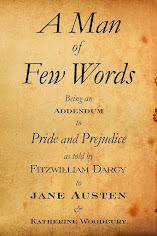
The best solution is to just write in a normal voice. I'm not saying Austen wrote in a "normal" voice—I personally think Austen's authorial voice was cultivated. But it was normal for her. Jeffers' attempt at Austen is better than many, but the switch in viewpoint doesn't sound omniscient and humorous (as it does with Austen); it sounds confused. (With A Man of Few Words, I stuck to limited third-person; I know when I'm out-mastered!)

Like in A Man of Few Words, Darcy's Passions is added dialog/exposition to already existent text. Jeffers' additions paint Darcy as the typical Alpha romantic male. He is overwhelmed by Elizabeth. He is impressed by her wit and anxious to exchange witticisms with her. He despises Miss Bingley. He is confused when the text absolutely requires him to be confused. He is masterly and insightful all the rest of the time.

But Darcy as typical Alpha romantic male is completely inconsistent with Austen's text. (To her credit, Jeffers is one of the few tribute writers whose add-ons include Darcy's knowledge of land management.)

I personally go along with Phyllis Ferguson Bottomer's argument in So Odd a Mixture that Darcy is borderline autistic. Her delineation of Darcy's character is one of the most accurate and delightful on record. She recognizes what few interpretations do: namely, Darcy is accused of pride in Hertfordshire for reasons that have nothing to do with familial or class pride.

Most tributes to Pride & Prejudice concentrate on Darcy's supposedly prideful thoughts, making him the standard aristocratic jerk; they fail to acknowledge, as my mother did long before Bottomer, that all of Darcy's problems in Hertfordshire stem from his behavior, not from his beliefs about himself (which beliefs he never communicates to anyone but Elizabeth anyway). He is perceived as proud because he won't dance or talk, not because he boasts about his position or even because he gives anyone the "cut direct." He doesn't even cut poor Mr. Collins.
In other words, Darcy is accused of pride for the wrong reasons—and the accusations rest NOT on Darcy's sense of superior class (which he does, in fact, feel) but on Darcy's anti-social behavior. In other words, what Darcy thinks of as "pride" and what Hertfordshire and Elizabeth, to a degree, think of as "pride" is not the same thing. This results in the fascinating argument about their faults between Elizabeth and Darcy at Netherfield; they clash partly because they are talking about two different things. Elizabeth is quicker than Darcy at picking up on the communication gap, but, as Bottomer points out, Elizabeth continues to assume reasons for Darcy's behavior that are actually inaccurate; it doesn't occur to Elizabeth that Darcy is shy or uncomfortable. It did, however, occur to Austen, Colin Firth, my mom, and to Bottomer.

And me. Using this interpretation, I created my own version of P&P from Darcy's point of view. In my version, I do NOT have Darcy perceive Elizabeth's positive attributes (or any of her attributes) right away. I argue instead that Darcy is clueless because, let's face it, so many people are.

To give Jeffers credit, her Darcy is kind of clueless; he thinks Elizabeth likes him because she is playful in her rejections: she flirts, ergo, she loves me! Still, Jeffers has Darcy deliberately provoking Elizabeth, so he can exchange witty repartee with her. I don't think this interpretation is in keeping with the original text. Darcy doesn't do repartee. His remarks are almost always literal and straightforward. Elizabeth's triumph is not that Darcy loves bantering with her, but that she so often provokes him into saying what he thinks; what he thinks isn't witty or covered with savoir faire. Actually, most of the time, what he thinks is kind of rude.

2023: My tributes to Austen's texts now include Persuadable, a tribute to Persuasion told from the so-called villains' point of view. And Catherine Morland & The Matchmaker, based on one of Austen's funniest books, Northanger Abbey, told from the matchmaker's point of view. 
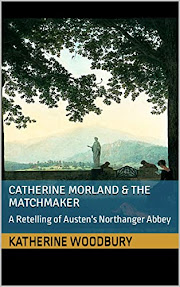
Although I generally try to avoid Austen's omniscient voice, deeming it too much of a challenge, I decided to give it a try in the latest novel by having the narrator--or matchmaker--be a literal semi-omniscient god, the god of love in a god-controlled off-shoot of our universe. 

The first chapter introduces the narrator. For this post, I present an Austen-inspired passage, namely Catherine and Henry's first meeting. Ven, the god of love, is speaking. 

And I had someone for Catherine to meet: Paul Henry Thebley. 

I spotted Catherine halfway through the evening, looking rather low-spirited. My guess: she was used to hometown social events where she knew everyone and could relax. At Aphrodisia, she was the “new girl” in the midst of cliques who had already spent several seasons together on the peninsula.

I don’t approve of cliques but some social behaviors are inevitable. Mrs. Allen, for one, was chattering away about how much she wished Catherine knew someone in the “crush.” Chatter. Chatter. Chatter. No action.

I got pulled away to resolve a question about engagement gifts. No, I don’t think an animal is suitable. Let’s avoid the implication of calculating dowries with livestock, shall we?

Issue resolved, I tracked down Paul Henry Thebley, a tallish twenty-two-year-old with aquiline features and thick dirty blond hair, the kind of guy who looks good in glasses. And Paul Henry is every self-conscious semi-intellectual young man since the beginning of time. He is perceptive and clever enough to be aware of his self-consciousness, so he takes refuge in irony. In my life in the other world, these were the guys who watched lots and lots of Monty Python.

And yeah, I was one of them.

I introduced him to Catherine as “Henry” (he prefers his middle name). She perked up. Henry bowed and immediately started making an ass of himself.

“I’m supposed to ask you the required meet-and-greet questions,” he told her and raised a single eyebrow. “Should I? Tell me, young lady, are you enjoying your time here? Have you been to all the temples? Did you offer a flower to Kouros? A poem to Apollo?”

Catherine responded eagerly. She stated that she was in good spirits. She hadn’t been to all the temples. What type of flowers should she offer? Did Apollo expect an original poem?

Henry isn’t much of an artist or writer. He moved on to the season’s calendar.

“No doubt you’ve been told which celebrations you absolutely must attend. And you’ll write about each of them in your journal, including a list of the people you’ve met. When you write about me, will you call me a goofball or simply a strange young man?”

Catherine assured him she wouldn’t write anything so unkind. Entirely guileless. She didn’t even mock his efforts at mockery, which is why I introduced them.

“Maybe I don’t keep a journal,” I heard Catherine say as I wandered away.

She was trying to be arch, bless her, and I gave her credit for continuing the conversation.

Henry, of course, insisted that she owned a pink, flower-covered journal with a lock. Despite the cliché, he was probably right.

I learned later that he managed to impress Mrs. Allen by complimenting not only her outfit but the outfit’s seamstress So Henry was in good form.

I want to go on record: Henry was not my first choice for a husband for Catherine.

I could easily claim, I knew they were perfect for each other from the beginning! Truth: I simply wanted Catherine to have a not-horrible time at Aphrodisia.

Still--I would never have introduced her to the Thorpes.

The Awful Elliots in Persuasion and Persuadable

Speaking of villains...

In Persuasion by Jane Austen, the Elliots have to rent--or retrench (cut their budget)--because they are in debt. This does not mean that they are poor. But it does mean that they are living in the red.

This state of affairs has come about due to gross overspending by Sir Walter and Elizabeth. Of the family, however, only Anne appreciates what her father and sister have done. Even Lady Russell is more concerned with the Elliots' prestige than with the consequences of their actions. But the consequences of their actions to their community are huge.

Basically, Sir Walter and Elizabeth have created a state of affairs where they can no longer put money back into the estate; that is, as landlords, they can no longer repair their tenants' cottages, hire extra workers, or invest in any new technologies, developments, or expansions. 

Based on Austen's original text, there is reason to believe that Mr. Shepherd has at least prevented Sir Walter from raising rents. Even so, the Kellynch tenants--who would have far less control over their livelihoods and employment than people do today--are now stuck working for the equivalent of a bankrupt company. The 1995 Persuasion film does an excellent job capturing the unimpressed faces of those tenants as Sir Walter and Elizabeth regally ride off to Bath.

Consider Pride & Prejudice when Elizabeth visits Pemberley and hears how much Darcy's tenants respect him; these glowing positive reviews means a good deal more than that Darcy is a nice guy. It means he is a good boss, a wise manager, a smart investor, an up-to-date farmer, etc. Darcy is the kind of estate owner that tenants want to get.

Mr. Shepherd, Sir Walter's estate attorney, and Mrs. Clay, Mr. Shepherd's daughter, are well-aware of Sir Walter and Elizabeth's perfidy. Although Mr. Shepherd and his family are members of the growing middle-class--and fundamentally town or city people--they are in a better position even than Anne to see and hear how the Kellynch estate affects their neighbors. When the main source of income for a community--agriculture--is materially damaged, everybody pays.

Consequently, Mrs. Clay in my tribute Persuadable has little pity for Sir Walter and his so-called problems. (The possible ambiguity of Mrs. Clay's remark about sailors' and workers' looks exists in the original text.)

Penelope [Clay] felt no sympathy for Sir Walter’s desperate financial straits, which had steadily worsened in the last few years (“Sir Walter is not a, ah, moderate man,” Penelope’s father had explained on the carriage ride over.) Why should she feel sympathy when the gold watch Sir Walter currently handled could pay several weeks of board and room and the bracelet on his daughter Elizabeth's wrist could pay a month’s worth of butcher’s bills? Only his middle daughter Anne dressed like a person who knew the value of a disappearing pound.

Penelope watched Kellynch Hall’s residents through half-lidded eyes. Sir Walter was an easy man to sway emotionally. Praise made him preen. Mockery of others made him puff out his chest. If she could tackle him absent his family and neighbors, she would have him to the altar in a fortnight.

Unfortunately, the friends and family were never absent. Penelope could handle Elizabeth, but she’d noticed a growing wariness from Anne: long, sideways glances when Penelope complimented Sir Walter; knit brows when Penelope extolled the beauties of Kellynch Hall.

In addition, the family’s great friend Lady Russell continued to treat Penelope like a clod of dirt tracked into a clean parlor.

This will be a long campaign, Penelope counseled herself. I should regard this as a chance to become acquainted with Sir Walter’s moods before marriage.

Currently, Sir Walter was blustering about having to rent Kellynch Hall while he and his daughters removed to Bath.

“The alternative is to retrench,” her father pointed out for the sixth or seventh time. Retrenching would mean staying at Kellynch Hall but seriously cutting expenses—no more four-horse carriage; fewer sponsored balls; no extraneous purchases. The entire neighborhood would witness Sir Walter’s and his daughters’ humiliation.

Sir Walter sighed and looked profoundly troubled. Sir Walter never stopped appearing astonished by the vagaries of life. It struck Penelope as an exhausting way to approach the world; luckily, being Sir Walter’s wife wouldn’t mean adopting his world-view.

“And there are currently many naval officers returning to England who would greatly appreciate a house like this.”

“A naval officer!” Sir Walter was aghast. Apparently, he was unaware that the navy had won the last war. “Such a man wouldn’t know how to behave in a manor like Kellynch Hall.”

“He would look over the premises and bless his good fortune,” Penelope said.

She caught a faintly resigned look on Anne’s face and smiled to herself. Anne disliked sycophancy.

“But,” Penelope continued, “I quite agree with my father that a sailor would be a desirable tenant. They are so neat and careful in their ways.”

“Perhaps. Perhaps. But the navy has brought persons of obscure birth into undue distinction. And life on the open seas terribly ravages the features.”

Sir Walter, in his mid-fifties, could justify a comparison based on appearance. He had straight shoulders and a patrician head that was only marred by a more button than beak-like nose. He was handsome, even if Penelope found his features rather dull—there was nothing memorable about so much regularity.

Elizabeth was nodding agreement with Sir Walter’s vapid criticisms. Elizabeth’s features were even more regular. The youngest daughter Mary was pretty in a shallow way. Only Anne, the middle daughter, made a person look and look again: puzzled by her seeming plainness, caught by the fineness of her bones.

But of course a woman like Anne was far more difficult to flatter.

“We are not all born to be handsome,” Penelope said to stop Sir Walter’s insipid, cruel comments about sailors’ looks. “All professions make their mark whether the physical labor of a soldier or the mental stresses of a lawyer. Only those of property continue to look personable after the flush of youth.”

Sir Walter beamed. Elizabeth nodded. Penelope’s father shook his head and rustled his papers. Only Anne gave Penelope a long bemused look. There had been as much criticism as praise in those words: what were Sir Walter’s cares and concerns (despite the horror of renting Kellynch Hall) compared to those of real working men?

The Troubles of Biographers: A is for Austen

I recently reached "H" in my review of picture books, A-Z list 5. I will continue to review picture books, all the way to Z! 

In the meantime, I am beginning a new A-Z list focused on biographies.

Biographies are a subset of non-fiction about which I have mixed feelings.

I often want to like them more than I do. I find some of them fatally flawed--and some downright boring. Is the biography boring due to the biographee (it's a word!)? Or the author's approach?

Each review will tackle a problem with biographies (taking a person's life into our hands) alongside, usually, a particular biography.

Trouble 1: Insisting on direct correlations between personality/achievements and biographical material is fun but ultimately, weak reasoning.

Biographers get to know their biographees very well. And it is tempting, as it is for the rest of us in our own lives, to insist that an uncovered fact has enormous bearing on the biographee's personality and achievements. 

Except, of course, that it may not. 

Several biographies of Jane Austen make this mistake. Every personal experience, the biographers claim, must inform her novels! Years ago, I encountered an exceedingly condescending biography in which the female biographer insisted that when Austen wrote Mansfield Park, she was trying very, very hard to "be a good girl." 

Another (female) biographer was equally shocked that Austen could create a fictional scandal surrounding a play when she and her family put on plays at Steventon! 

The argument that a writer's writing must reflect her personal experiences falls to pieces when one realizes how much Austen left out of her novels. She was, in fact, surrounded by people who indulged in scandals, tug-of-wars over the same woman, financial disputes, accusations of government corruption, possible adultery, an arrest for shoplifting and subsequent trial, death from a carriage accident, multiple deaths from childbirth, military sea battles, a possible spy (truly!), political fall-out from the French Revolution, the rise and defeat of Napoleon, and family infighting.

And okay, the family infighting made it into her books. But Richard Jenkyns is correct when he argues that Austen willingly and artistically restricted herself to a "fine brush of ivory" in order to create novels with precise artistic visions. She was, in fact, motivated by creative desires. "My answer [to the criticism that Jane Austen lost her way]," Jenkyns writes about Mansfield Park, "is that she simply chose to write a different kind of book" (108). William Deresiewicz likewise defends Austen as an artist, pointing out that with Mansfield Park, she pushed herself beyond the relatively easy Pride & Prejudice, which is arguably Austen at her freshest and most witty, to do something different and difficult. 

As Claire Tomalin writes, "[Austen] was too inventive and too interested in the techniques of fiction to settle in any one mode" (157).

Claire Tomalin's biography Jane Austen: A Life does a notable job recognizing possible influences on Jane Austen while also judiciously allowing, This is an artist. Her thought process may not work as literally as EVENT = OUTCOME. Even when Tomalin speculates, she retains an objective tone. 

For instance, she points out the gap in time between when Austen wrote her first three novels (age 20 for Pride & Prejudice) and when they were published (age 37 for Pride & Prejudice), adding, "You can have fun speculating whether she was nineteen or twenty-one, or thirty-five when she wrote a particular passage, but proving anything is like trying to carve a solid shape out of jelly" (156). 

This willingness to say, "I don't know," to allow for gaps in our knowledge of an individual, is enormously refreshing. Tomalin even willingly combats the automatic assumption that Elizabeth Bennet is Jane Austen. To Tomalin, Elizabeth is Jane's creation. There is a difference. "She did not draw from life," Tomalin states emphatically, "or write down the stories of her friends and families...The world of her imagination was separate and distinct from the world she inhabited" (170). 

This is not to say that Austen the writer wasn't affected by life--like many writers, she closely observed the world around her. And her apparent 10-year gap in writing was likely the impact of leaving Steventon for Bath, a move--as Tomalin convincingly illustrates--Austen did not favor.

My only dissension from Tomalin is when she queries why Jane Austen was not friendlier with a neighbor who appears to have shared her interests and wit. Keep in mind, Tomalin occupies a god-like position here, able to peer into letters and diary entries of the Austen family's contemporaries from a removal of several generations. But interests and wit do not equate to tone or personality or even sincerity. And Jane Austen, I would argue, was not one to make friends with a "gloss" of behavior. 

Otherwise, Tomalin does a superb job presenting Jane Austen's life and her work with only occasional excursions into assertions that a single event resulted in a single outcome--and even there, Tomalin nobly checks herself. 

Works

Deresiewicz, William. A Jane Austen Education. Penguin, 2011. 

Jenkyns, Richard. A Fine Brush of Ivory. Oxford University Press, 2004. 

Tomalin, Claire. Jane Austen: A Life. 1997. Vintage, 1999.


Stupid Politics in Literature

Generally speaking, I don't mind apolitical literature. I despise politics and believe that current-day American society has allowed itself to be high-jacked by the notion that politics is the end-all-be-all of existence, so . . .

Most of the time, I say, the less politics the better.

I can't help but get irritated, however, when a story presents a political situation that doesn't take reality into account.

For instance . . .

I recently read a short novel based on Hans Christian Andersen's "The Little Mermaid," only with a happy ending. I rather adore sea fantasy/mermaid/merman literature, and truthfully, I'll probably keep this short novel on my Kindle despite finding it rather frustrating.

The frustrating part: the novel postulates that human beings have messy politics because human beings are so controlling and nasty and toxic and power hungry. Merfolk's politics, on the other hand, aren't like that at all. Their king and queen are super nice, more like supervisors, ya know, than actual dictators. All that messy human stuff never happens to them.

The reader is supposed to buy into this despite the fact that one of the ongoing issues in the novel is that the king and queen don't want their youngest son, or any merfolk really, to go to the surface. It's dangerous and puts the merfolk at risk. National security, ya know.

Let's think about this.

If the king and queen--who awesomely enough function out of Maine waters--are localized, then there must be other mer kings and queens throughout the world. Do they all agree that fraternizing with humans or land folk is a bad idea? Really? Does that type of total agreement seem likely for any sentient species? For all of them to absolutely agree on a single issue without exceptions or caveats or yes-buts? As if they were robots--and not the fun Asimov kind?

Both Nesbit and Lewis provide their
merfolk with complicated motivations.
Since it highly unlikely that they would all agree, what do the localized king and queen do when a king and queen from, say, Scandinavian waters decides, "Hey, we need/want to trade with humans." Do all the kings and queens get together for an international summit? What if the summit fails? Do they go to war? How important is security, keeping merfolk safe?

Perhaps this king and queen control--eh hem, sorry--supervise all merfolk throughout the world. So how exactly do they prevent their supervisees from meeting up with humans? How much security do they have operating at any given moment? The son is fairly closely guarded in the days after he returns from seeing his land-based lover. Does this apply to all merfolk?

It's hard to believe that a king and queen in Maine could control/supervise a bunch of merfolk around, say, Australia without a massive standing army. Doesn't a massive standing army betoken a huge infrastructure that costs somebody somewhere an awesome amount of fish or gold or whatever merfolk work for?

Or maybe they don't work. Maybe they float around all day. But in that case, do the security guards and sentries (which exist in the story) volunteer? Is it really possible to get sentient beings to volunteer for things like guard duty? Even if it is a National Service kind of thing?

What if the security guards don't agree with the king and queen? What if they also fall in love with land folk? Who is going to keep them in line? Do security guards and sentries get punished? By whom? Where do they go if they get punished? If they don't go to prison, are they also closely supervised? Wouldn't that involve MORE sentries and security guards?

Do merfolk mind being constantly watched? If not, how are all these sentient merfolk being culturally indoctrinated to believe that constant supervision isn't tedious and infantilizing? Or maybe they are rewarded for spying on each other--but with what? And who decides how they are rewarded?

Or maybe they are cowed into upholding an ideology that they don't entirely agree with. Who is doing the cowing? Do merfolk go to rallies? Under the Sea Political Conventions?

Perhaps, we are supposed to believe that all merfolk are so happy that the prince is a kind of anomaly. That weirdo, going off to want to be with land people. If so, isn't that prejudice? Or at the very least, a stigma?

Maybe the prince wanting to be with a land person is somehow more offensive or dangerous than it is for ordinary citizen merfolk--this argument (coming from the king and queen) would actually make sense, but that would mean that merfolk care about things like reputations and examples and role models. It would suggest that certain individuals, such as royalty, have more sway than ordinary civilians, and the book is at pains to deny this.

Worse: perhaps the prince wanting to be with a land person is consider a special case--because he is so unique and advanced and what-not. In other words, all the other merfolk are drones who only care about robotically obeying their king and queen. The prince is a kind of advanced uberspecies who thinks outside the box.

Sound elitest? So much for the merfolk not having a power-based (however intellectual) hierarchy. (To be fair, the book denies this possibility--other merfolk do fall in love with land folk. But ooooh, the questions that raises.)

I honestly don't think the author thought this far ahead about any of these issues. She is a skilled enough writer to provide enough motivation in the day-to-day interactions of both the prince and his lover to compensate for the senseless political labels.

I find the lack of political commonsense tiresome, anyway.

Writers: simply declaring that one group is bad and power-hungry and awful and another group is wonderful and lovely and sweet doesn't really work if you don't know how the differences could actually be sustained.

So stop doing it already. There's a reason Jane Austen stuck to the day-to-day. She wasn't being parochial when she didn't deliver diatribes on the Napoleonic Wars in her novels. She was being smart. 

The Obliging Dead: An Unbelievable Trope

A common theme or plot in literature is mourning for a dead spouse/partner/family member/friend. The living spouse/partner/family member/friend struggles with the need to move on, mainly survivor's guilt.

The internal conflict is resolved when the living spouse/partner/family member/friend determines that the dead spouse/partner/family member/friend would want them to be happy. The dead want the living to move on, marry again, change careers...to do, in fact, everything that the living are planning to do anyway.

My reaction to these novels is always "Really?".

I have the same reaction when the living spouse/partner/family member/friend determines that the dead spouse/partner/family member/friend has fully embraced being dead, is at peace, has entirely let go grudges regarding the past, etc. etc. 

I think Supernatural (as well as various religions and mythologies) are more accurate: the dead that hang around are not forgiving and happy and self-sacrificing. Their irritation at being dead eventually becomes fury followed by madness.

I agree with C.S. Lewis that the dead who do move on are probably more indifferent to our concerns than makes us completely comfortable (they've got other things to worry about). If they do have an opinion, it may be more acerbic and objective than the living are ready to cope with.

However, it is terribly difficult to convince the living that perhaps they aren't the center of (even) the world of the dead.

Take reactions to Persuasion by Jane Austen. When Captain Wentworth visits Uppercross, Mrs. Musgrove
corners him with eulogies to her dead son:
"Poor dear fellow!" continued Mrs Musgrove; "he was grown so steady, and such an excellent correspondent, while he was under your care! Ah! it would have been a happy thing, if he had never left you. I assure you, Captain Wentworth, we are very sorry he ever left you."

There was a momentary expression in Captain Wentworth's face at this speech, a certain glance of his bright eye, and curl of his handsome mouth, which convinced Anne, that instead of sharing in Mrs Musgrove's kind wishes, as to her son, he had probably been at some pains to get rid of him...Captain Wentworth should be allowed some credit for the self-command with which he attended to her large fat sighings over the destiny of a son, whom alive nobody had cared for. 
Some literary critics, male and female, are appalled--I say, appalled!--by Jane Austen's callousness. They sniffily write things like, "It's hard to explain Austen's cruelty here. It must be because she wasn't a wife and mother."

Except wife and mother Agatha Christie echoes Austen's sentiment in one of her mysteries. To
paraphrase:
"Oh, if only Roger had lived," the woman exclaimed. The narrator reflected that the woman might feel differently if Roger had lived. How easy it is to sanctify and sacralize the memory of the dead--to remember them as entirely different from how they actually were.
No matter how unacceptable, the dead are more than sentimental figures. How much more interesting they become in literature when they are not simply bolsters of living people's wants. Make them scary, horrific, amusing, ironic, odd, boring, ill-remembered. Anything except a kind of pep rally squad for the living. 

Manga and Austen: Types of Romance Heroes and Heroines

Thanks to my niece Kezia for this
graphic novel.
Eugene's post about Kimi Ni Todoke got me thinking. Many manga series present a strong, silent hero (Sano from Hana-Kimi, for instance) who is wooed and falls heavily for the somewhat more extroverted heroine (Mizuki).

Ah, Darcy and Elizabeth!

So, I pondered, to what Austen couple would a comparatively extroverted (but still introverted) hero like Shota and a far more introverted heroine like Sawako equate?  

Captain Wentworth and Anne, of course!

That takes care of Pride & Prejudice and Persuasion. What about the rest?

Dr. Umeda
Northanger Abbey: an impressionable, imaginative young woman and a slightly older, slightly awkward guy who uses clever quips to get through social situations?

Usagi from Tail in the Moon and Mizuki from Hana-Kimi qualify for the heroine role while the vulnerable young man who uses quips to hide his insecurity is best captured by Yoh of High School Debut.

A number of supporting characters also use snarky quips to hide insecurity, such as Dr. Umeda (Hana-Kimi), Juta (Otomen) and, flipping genders, Asako in Library Wars.

Emma: a bossy, interfering chick and an exasperated, older hero?

High School Debut
This is difficult because NOBODY in Japanese literature compares to Emma. Emma is a woman who imagines what is best for people and then goes and tries to make it happen from behind-the-scenes without checking her facts. Most manga heroes and heroines spend far more time mulling over whether or not to even get involved.

In High School Debut, for example, the madcap heroine is more concerned about living up to what she thinks a girlfriend is supposed to be like than trying to boss other people around while in Hana-Kimi, Mizuki--who always wants to help--frets for several issues over whether or not to speak to Sano about his father.

Library Wars (Dojo scowls a lot :)
Library Wars possibly works since the heroine, Kasahara, is quite impulsive, and the hero, Dojo, gets exasperated while remaining fascinated. And Kasahara does take action. Still, she isn't a behind-the-scenes type.

Neither (switching genders) is Ran of Flower in a Storm, a cute manga (in the over-the-top, too-much-sugar sense of "cute"). Despite being too direct, Ran's unrepentant interference makes him a decent Emma while exasperated Riko makes a good Mr. Knightly.

Usagi in Tail in the Moon comes the closest although her trouble is more too-much imagination (see above) and "rushing in where angels fear to tread" than a deliberate desire to force events to a certain end. Still,  like Emma, her "rushings in" cause more problems than solutions. And patient, lecturing Hanzo does qualify for the part of Emma's hero, Mr. Knightly

Mansfield Park: a heroine who lives-in-her-head while observing others and a hero who hasn't a clue what he wants until the very, very, very end.

I failed here. Most manga heroes know what they want by the 2nd volume, even if, as Eugene states, "he's not going to broach the subject with someone he knows isn't going to broach it either. As I mentioned, this can get annoying fast."

Kira of Mars makes a great Fanny (heroine of Mansfield)--she has that core toughness--but Rei is far too aggressive to make a believable Edmund (hero). In general--I'm inappropriately speaking for all women here--a novel where the guy frets over another woman for most chapters isn't terribly romantic. But then, hey, I'm the kind of woman who thinks Eponine of Les Miserables should let Cosette have Marius and focus on someone with more backbone.

Perhaps (flipping genders) . . . Asako and Tezuka (Library Wars) . . . 

Impressive novel! Less fun romance. 

Books to Movies, Part II: The Faithful Interpretation


1995 Darcy is extremely introverted. I recently watched
Victoria and Albert, starring Colin Firth's brother, Jonathan.
He delivers a flawless performance of Albert as intensely
introverted. Either the Firth brothers ARE introverts or
they have an excellent role model upon which to draw.
Interpretation is the second of my five categories. To be precise, I will be addressing faithful interpretations.

Faithful interpretations stick to the plot and characters of the original text. Unlike strict renderings, however, they deliver the plot and characters through a specific understanding. This is not only necessary but one of the truly lovely things about interpretations.

One can, for example, watch multiple versions of Jane Eyre or Pride & Prejudice or Shakespeare or (some) Agatha Christie and come away with a new perspective not because the plot has changed (assuming that all comparable versions are faithful interpretations) but because the vision/ worldview of the movie-maker* is so distinct.

Without this vision, a film will be clunky, confused, and out of focus (metaphorically--although some directors go in for that sort of thing literally as well).
1980  Darcy, played by David Rintoul, is more aloof and
arrogant than 1995's. 1983 Elizabeth is witty and
observant while 1995 Elizabeth is witty and direct

Jane Eyre (1983) focuses on the mental integrity of Jane; Jane Eyre (2006) focuses on her desire to be loved. Both issues are in the book, and both film versions bring up the conjoining issue but never at the expense of each series's main interpretation. The thread of "sight" (the thing the director wants us to see for ourselves) holds the piece together.

Granted, many times, artists--including movie-makers--are unaware of their thread. Writers, poets, painters: very few of them are George Bernard Shaws, interpreting their own work before and after the fact (one reason why commentary by directors is rarely as good as expected; even self-aware directors like Whedon and Branagh spend more time focusing on technicalities--the HOW of creation--than the meaning).

Yet a movie without that thread fails to carry its plot--much like Star Wars I, II, and III.

And 1940 Darcy is practically an extrovert! He is
also suave and debonair, displaying little of the discomfort,
shame, and confusion of 1980 and 1995 Darcys.
Consequently, Hamlet (Mel Gibson), Hamlet (David Tennant), and Hamlet (Branagh) become not competing visions (what would be the fun in that?) but complementary visions whereby each carries its own insights into Shakespeare's masterpiece. Likewise, although I greatly prefer Pride & Prejudice (1995) to BBC Pride & Prejudice (1980), I still enjoy aspects of the 1980 interpretation (in general, 80s BBC Austens fall into the strict rendering category).

As for Pride & Prejudice (1940): I would call it an interpretation plus make-a-place-for-something else, "something else" in this instance being Gone With the Wind (as far as I can tell). It's a good movie, just far easier to appreciate if one ignores the title (and connection to the book).

In comparison, Jane Eyre (1943), though massively cut, is a faithful interpretation, even if Joan Fontaine is depressingly miscast.

Other faithful interpretations include the following:
  • Anne of Green Gables (1985): Jonathan Crombie sadly recently died.
  • The Little Princess (1986): excellent television series.
  • Shawshank Redemption, oddly enough (the tone is totally different, but the plot is faithfully interpreted). 
  • To Kill a Mockingbird (1962): Interestingly enough, this film also retains, to an extraordinary degree, the point of view of the book. I will address viewpoint in more detail in my next post.
*I refer to the director as the author throughout these posts, simply because it is easier. However, as with a play, movies are the result of multiple authors. War & Peace is Tolstoy. But Henry V (1989) is Shakespeare (naturally), Branagh (to a huge extent) as director, scriptwriter and actor plus the other actors  (Judi Dench's stunning soliloquy on the stairs) plus the costume director (won an Academy Award!) plus Patrick Doyle and his haunting music plus the film's editor.

In fact, the recent movie Hitchcock argues, rightly or wrongly, that without Alma's editing, Psycho would have been a flop! While some books benefit greatly from an editor, the product is two authors at most--plus, perhaps, a famous illustrator like E.H. Shepard for A.A. Milne. Every movie, however, no matter how self-important the director, has many, many hands. One of the pleasures of listening to Whedon is that he is fully aware of this and will tell you how other people contributed to the film, including the actors.

The Complications of Wickham in Death Comes to Pemberley

The excellent Matthew Rhys as Darcy
reacting to Wickham's trial.
I recently watched P.D. James' Death Comes to Pemberley. All of my comments refer to the script since I have not read the novel.

The script is fairly standard Austen lite fare--I say that fondly since I have myself produced Austen lite fare! The romance in the household centers on Georgiana, but Elizabeth and Darcy suffer through a marriage crisis that doesn't differ substantially from their pre-engagement crisis. Whether or not a rehash of previous fears and misunderstandings is likely to occur 6 years into a marriage, I'll leave to the therapists.

I found the miniseries (3 episodes equaling a total of 3 hours) engaging although the mystery itself was kind of blah.

What I liked best was the treatment of Wickham.

He's the same guy as in the original. That guy: the one who meanders through life doing whatever he wants and then being shocked, shocked! when he runs out of money and gets threatened by creditors. He has all the moral comprehension of a weasel. Though maybe that's unfair to weasels.

Death Comes to Pemberley captures this aspect of Wickham perfectly. Although I greatly admire Longbourn, I think the Wickham of Jo Baker's imagination is too vile. Wickham isn't evil. He's just the "natural man" in a waistcoat.

At the beginning of Death, when Wickham is accused of murder, Darcy's knee-jerk, automatic reaction is, "But Wickham isn't violent." Darcy knows Wickham. He knows him better than any of the Bennetts. If one needs expert advice regarding Wickham's character, Darcy is--whether he likes it or not--the best person to provide that advice. 

In fact, Death illustrates a fundamental point that I feel is often missed, especially in lite fare: Wickham was and always will be Darcy's problem. Elizabeth blames herself for involving Darcy with Wickham. But Elizabeth didn't grow up with Wickham. Darcy did.

Darcy is often painted wholly heroically: the knight in shining armor who rides to the rescue and conquers the dragon (Wickham) out of disinterested magnanimity.

In truth, as an early nineteenth century landlord, Darcy has always been responsible for Wickham. He doesn't want to be. He tries desperately to break with Wickham completely. But the guy is never going to go away--and wouldn't have even if he'd married someone other than Lydia.

Matthew Goode as Wickham reacting to Darcy.
Another interesting aspect of Wickham that appears in Death is his comment to Darcy about why he keeps returning to Pemberley's grounds. Darcy accuses him of skulking about. Throughout their conversation, Wickham has behaved per usual--blithely shrugging off his circumstances, talking ironically about his wife--but at Darcy's accusation, he abruptly turns and snaps, "It's the only place I was ever happy."

I found this believable. Utterly lacking in introspection, Wickham has no idea how to recreate the life he had when he was young. All he knows is that once upon a time, he wasn't in trouble with (1) Darcy; (2) the army; (3) creditors; (4) his extended family, etc. etc. etc. The only person who doesn't give him grief is Lydia (who is portrayed quite well in Death), and she's a tad flighty (however, she is still more loyal and less critical than anyone else in his life, so he tolerates her, which I also found believable).

There will probably always be a part of Wickham that wishes he could get back to the life he had as a kid, when all he had to do was run around a huge estate with another kid.

Of course, Wickham probably hightailed it to London as soon as he hit late adolescence ("Pemberley is  SOO boring!"), but there's no reason those two realities--I couldn't wait to get away. I can't wait to get back.--can't exist at the same time in the same person.

People are complicated, even someone as apparently shallow as Wickham.

It's Okay to Write About Marriage and Domestic Problems--Persuadable's Take on Mrs. Smith: Chapter 12

1995 Mrs. Smith--she does an excellent job
conveying Mrs. Smith's pleasure in life.
In Chapter 12 of Persuadable, Will Elliot visits Mrs. Smith.

Mrs. Smith is one of Austen's most interesting minor characters. She is a resilient widow whose once well-off late husband lost all his money to extravagance. Although her husband owned property in the West Indies, which could give Mrs. Smith a respectable income, that property is "encumbered" (used to pay off debts), and Mrs. Smith can't touch the "rents."

Based on this slim information, some literary analysts have criticized the Mrs. Smith character for her willingness to live off the slave trade (the West Indies property would likely use slaves); Jane Austen herself was not a supporter of slavery, and I was tempted to give Mr. Elliot noble reasons for not helping Mrs. Smith recover the property.

West Indies Map
That approach, however, would have been something of a cheat. One, Mr. Elliot is not the type of guy to invest himself in abstract causes overseas (anymore than he is the type of guy to lay out cash for what he considers an iffy proposition at best); two, Austen's text makes clear that Mrs. Smith's purpose is to convey information to Anne, not stand as a symbol of colonialism.

Of course, this brings up the issue of Austen's supposed ignorance of political and social issues. Frankly, this is such a stupid criticism of the writer that I have difficulty taking it even momentarily seriously; plus, at the risk of sounding like a ticked-off feminist, it is not an argument one often hears about male writers who focus on domestic plots. In any case, excellent biographies of Jane Austen, including Paula Bryne's The Real Jane Austen, have effectively disputed this characterization. Jane Austen was not only well-aware of currently political and social issues, she had immediate familial investments in many of them.

Setting aside the obvious refutation that fiction is deliberate creation and writers will focus how and where they choose, why do such analysts suppose wars and revolutions are carried out? Despite the unnerving and tunnel-vision attitudes of many activists, they are generally NOT carried out for the sake of more wars and revolutions. Rightly or wrongly, they are usually carried out to create a better life somewhere for someone. In other words, they are carried out so people can get married and not have to worry about soldiers cluttering up their living rooms.

In any case, I have always considered literary analysis that insists that all literature have an IMPORTANT MESSAGE to be trite to the nth degree. Well-fashioned prose has done more to keep the world turning than any so-called IMPORTANT bumper sticker.

A passage from Mr. B Speaks! addresses this issue from another perspective. An excerpt from Persuadable, Chapter 12 can be found on the Persuadable homepage
Gary (the literary analyst) rolled his eyes. “And, of course, romance novels always have perfect weddings.”

“Of course.”

“This whole novel [Pamela] is nothing but trite and shallow pandering,” Gary declaimed. “What about death, disease, poverty, slavery, racism—all the terrible issues of the eighteenth century? Hmm? I mean women couldn’t even vote! But no, we’re fixated on watching an inconsequential couple tie the knot.”

The judge glanced towards the characters’ table. Mr. B was still smiling faintly. He hadn’t flinched at being called “inconsequential.” Presumably, people of the eighteenth century were less obsessed with getting their “day in court” than people of the twenty-first.

The judge reminded himself not to chuckle at his own pun.

“People hid their heads in the sand,” Gary was still declaiming. “Just like they do today.”

The romance writer reviewer, Deborah, said, “That sounds like the end of a lecture,” and Gary reddened.

She was probably right—the man certainly loved to carp about stuff—but the judge didn’t want audience members giving the Committee for Literary Fairness any (more) reason to complain.

He said pacifically, “Different novels cover different topics.”

Leslie Quinn, the writer of popular non-fiction, agreed, “People in the eighteenth century still had to work, love, have children, get along. Those topics never go away.”

Dr. Matchel (another literary analyst) said, “But romance novels don’t deal with real domestic problems. They end with the wedding, giving readers the false impression that married life will be eternally happy. Escapist literature!”

"This novel doesn't end with the wedding," Mr. B's attorney pointed out, muttering, “What’s wrong with escapism?”

Deborah added, “Dark and depressing isn’t automatically profound.”

Darcy & Lady Catherine: Chapter 11

Chapter 11 of A Man of Few Words includes the famous scene between Elizabeth and Lady Catherine where Elizabeth provides the impressive retort, "In marrying your nephew, I should not consider myself as quitting that sphere. He is a gentleman; I am a gentleman's daughter; so far we are equal."

Of course A Man of Few Words doesn't show this scene directly; rather, it is related to Darcy by Lady Catherine.

Lady Catherine reporting Elizabeth's behavior
and giving her consent to the match.
The question I had to answer was why on earth would Lady Catherine rush off to tell Darcy exactly what Elizabeth said to her? Geez, is the woman so obtuse she doesn't realize she is simply tossing oil onto flames, exciting Darcy's already excited interest?

The 1940 film solved this problem by having Lady Catherine be one of those crusty sharp-tongue old ladies who secretly adore outspoken girls like Elizabeth. This is a classic type and can be used to good purpose. The 1940 film does use it to good purpose although the first time I watched it with my mother, she (a fan of the book) couldn't resist leaning over and saying, "Lady Catherine does not do this in the book."

What the original text makes clear is that Lady Catherine possesses a substantial degree of cluelessness. Her cluelessness isn't rooted in stupidity but rather in her entirely subjective version of reality. After all, only Lady Catherine could continue to tout a potential marriage between Darcy and her daughter Anne when no one, including Darcy and Anne, imagines this will ever happen.

In A Man of Few Words, I portray Darcy as not even realizing that anyone thought it would happen:
"Can you believe it?" Lady Catherine said. "[Miss Elizabeth] knows that such a connection would be improper, but she refused to deny the rumor. Yes, I can see that astonishes you." Darcy had risen and was gaping at his aunt. "An obvious falsehood, yet she refused to admit it. I explained about Anne--"

Darcy blinked, head cocked. What about Anne?

Lady Catherine coughed and waved a hand. "And she still refused to acknowledge that there is no attachment between you . . ."

But then Lady Catherine is this type of woman: enough of a hard-headed realist to avoid spouting pure fantasies but too far invested in her view of the world to invite too much challenge to those fantasies. Truth is, Mr. Collins is the best possible clergyman for such a patron!

Why It Matters That Elizabeth Likes Pemberley: Chapter 7

Chapter 7 in A Man of Few Words is the Pemberley chapter--ah, yes, that part in the BBC series where Darcy goes swimming.

Unlike the ridiculous statues in the latest movie, I consider the BBC swimming scene plausible. It does not occur in the original text, and I did not use it in A Man of Few Words. What I did try to convey--as the BBC series conveys--is how comfortable Darcy is on his own property.

Mr. Darcy shows off Pemberley.
This is so in-line with his overall behavior that whether Austen was working off observation or pure instinct, she deserves major major kudos for understanding how someone Darcy could be stiff and uncommunicative at the assembly ball and downright friendly and outgoing on his home turf.

Austen uses the housekeeper and Pemberley's grounds to clarify this; the BBC series uses the housekeeper, the swimming scene, and Darcy wandering about Pemberley with his dogs. I used Darcy doing his job as a landowner, the housekeeper, and my dad.

I've mentioned before that my dad, an introvert, is a prototype for Darcy. When Darcy and Elizabeth are waiting for the carriage to take her plus her aunt and uncle back to Lambton, my Darcy goes through the following:
"Would you like to step in?" Darcy asked, thinking he could show her the improvements he'd made to the flue in the drawing room fireplace, the latest expansion to the library. But she had already seen the house and declined. So Darcy stood beside her under the glowing summer sky and thought how marvelous it was that Elizabeth liked Pemberley.
Every time my mom reads the part about "show her the improvements," she busts out laughing.

After I wrote it, though, it did occur to me that I was making Darcy sound rather like Mr. Collins bragging about shelves in his closets; when Elizabeth visits Hunsford, Mr. Collins also shows off his house.

Mr. Collins' shelves in the closet.
And then it occurred to me that Austen never makes mistakes. Darcy does show off Pemberley just as Mr. Collins shows off the parsonage. Is Austen making a statement about men generally or is she making the comparison to tell us more about Darcy?

I think she is telling us more about Darcy. Although Elizabeth is half-joking when she says that she began to fall in love with Darcy at Pemberley, she half-isn't. As many critics have pointed out, Pemberley is Darcy. Everything and everyone about Pemberley has thrived due to Darcy's involvement, his character.

Compare this to Mr. Collins who uses his house not to illustrate his good sense (which he doesn't have) or his wife's good sense (which he doesn't appreciate) but his relationship to Lady Catherine. He also wants to make Elizabeth feel bad for "what she had lost in refusing him."

On the other hand, Darcy--who has also been rejected by Elizabeth at this point--uses the opportunity to rebuild his relationship with Elizabeth. I use the word "show off" about Darcy; it would be more accurate to say that Darcy puts his house/lands at the disposal of others. He suggests that Mr. Gardiner come and fish; he invites Elizabeth and the Gardiners in for refreshments; he eventually encourages Georgiana to invite them all for dinner. Pemberley is a place of interest and ease; it also exists in its own right as an entity. It is not there simply to bolster up Darcy's ego, something Mr. Collins would not understand.

(Male?) Communication Through the Physical: Chapter 5

In Chapter 5 of A Man of Few Words, Darcy decides to propose to Elizabeth.

This is at Rosings. In Pride & Prejudice, almost all of this section is told entirely from Elizabeth's point of view. The reader is given little internal reason to suspect Darcy's growing affection.

However, Austen has given us plenty of external hints based on Darcy's physical behavior.

One of many 10-sentence conversations at the parsonage.
I recently read an appraisal of Persuasion which argues that it is the most physical of Austen's novels--that in this final novel, Austen was finally coming around to the Bronte way of thinking in which emotion and touch carry as much weight as objective judgment.

This is sort of true but mostly not. Austen was a consistent novelist both in her vision and in her themes. And the use of the physical is used to enormous effect in Pride & Prejudice.

Take these examples of Darcy's interest that Elizabeth misses (but the reader can catch):
  • Darcy and Colonel Fitzwilliam come to see Elizabeth, etc. soon after their arrival at Rosings (Charlotte correctly surmises that they would not have come so quickly if not for Elizabeth's presence).
  • Darcy watches Elizabeth while she is speaking to Colonel Fitzwilliam.
  • Darcy looks ashamed when Lady Catherine is rude to Elizabeth.
  • Darcy leaves Lady Catherine to walk over to Elizabeth while she is playing.
  • Darcy visits Elizabeth without the colonel (though he does expect Charlotte to be present).
  • Darcy returns to the parsonage several times although "he frequently sat there ten minutes together without opening his lips; and when he did speak, it seemed the effect of necessity rather than of choice".
  • Darcy keeps visiting the same part of the park as Elizabeth.
How deftly Austen indicates our hero and heroine's complete lack of understanding! From Darcy's point of view, he might as well be standing on a roof-top, screaming, "I'm totally 100% captivated by you!!" From Elizabeth's point of view, he's acting, well, kind of weird. 

They are both intelligent, well-meaning people. One surmises that after several years of marriage, Elizabeth will learn to appreciate Darcy sitting in the same room as her mother for more than 5 seconds as a sign of enormous affection. And Darcy will learn to actually say that he thinks Elizabeth did a good job with her gifts to the servants rather than just looking appreciative.

Darcy's Friendship with Bingley: Chapter 3

Chapter 3 of A Man of Few Words, in The Gentleman the Rake, tackles Elizabeth's visit to Netherfield. I used this chapter to poke some good-natured fun at Darcy and Bingley.

Thomas Gibson as Greg:
He even looks like Darcy!

There's an episode of Dharma & Greg in which Greg plans a romantic weekend in "snow" country for Dharma, who has never seen snow. Their romantic get-away consists of him carefully planning exactly how long it will take them to reach their destination, so they can arrive in time for a romantic sunset. This means NO STOPPING. Although Dharma evinces interest in several passing sites--"Oh, that one looked good!"--Greg focuses on the road: "We have to keep to a schedule!"

Woodbury Sibs at a Site: Niagara Falls
Needless to say, this is Darcy. This is also my dad. Our road trips from New York State to California when I was growing up were carefully planned to allow for certain sites and excursions but never at the expense of our nightly reservations. I graduated high school believing that people never traveled any other way. When I planned my own cross-country trip in my early twenties, it never occurred to me to simply drive as much as I could on any given day, stop, and stay at the most convenient hostelry. One does not travel that way. One examines maps, measures distances, calculates miles per day, and makes reservations at least two months in advance.

And, truthfully, I would probably do the same thing now.

But it's still amusing.

Bingley, of course, is the exact opposite. Austen makes clear that Bingley rented Netherfield because that's what his friends--eh hem, Darcy--do: they live on big estates passed down from their parents. Austen also makes clear that Bingley doesn't have a clue what to do with a big estate.

This, however, doesn't bother Bingley in the least. Bingley is one of those annoying yet endearing people who takes life completely as it comes--"Hey, I rented Netherfield; wow, that was a riot"--yet always seems to land on his feet.  Or maybe it is just that people like Bingley take the ensuing consequences so good-naturedly that they come out seemingly unscathed.

And in all fairness, one of the nicer things about Bingley is how completely confident and content he is with himself. Bingley can brag about writing letters quickly, and Darcy can question, "What is laudable in a precipitance which must leave very necessary business undone?" and Bingley can laugh and change the subject: "I assure you, that if Darcy were not such a great tall fellow, in comparison with myself, I should not pay him half so much deference."

There's no snideness in this last remark, by the way. Bingley is the ultimate guileless man.

For a worrier like Darcy, a friend like Bingley is enormously relaxing. For a living-in-the-present guy like Bingley, Darcy is a necessary point of stability (as Jane will also be).

It is a very believeable, and lightly drawn, relationship, proving that Austen could create strong male as well as female characters, though she did concentrate more on the latter.