Showing posts with label Interpreting Tolkien. Show all posts

Books to Movies: The Hobbit Trilogy and a Movie's Pay-offs

"The Return Journey"

The final sequences in The Hobbit trilogy are quite lovely.
 
And WAY too short.
 
I think Jackson may have been worried about the "Han Solo" problem: too many "little Aragorn" moments being used to segue to the next trilogy.
 
Han Solo problem or not, I think Jackson should have provided more bridges to The Lord of the Rings. 
 
More problematically, I think The Hobbit trilogy suffers from a lack of wrap-ups. It doesn't pay off all of its set-ups.
 
When a scriptwriter/director "translates" a book to film, I allow that the scriptwriter/director will/should add in stuff.
 
But if stuff is added in, it needs to be addressed.
 
Take the live action Little Mermaid. The script adds in some really interesting hints--that Eric, the prince, is adopted. That he washed ashore. That he may have some connection in his childhood to the sea.
 
And then...nothing. Those hints are never paid off. It's just additional information to explain him, I suppose.
 
Kili and Tauriel are the same. I pretty much figured that Jackson would keep in Kili's death (he and Fili also die in the book). But I was a little startled at the abruptness. We don't even learn what Tauriel does next. She and the king exchange words; he tells Legolas to find Aragorn and then...
 
Eh?
 
Paying off Tauriel could have been done in any number of interesting ways:
  • She goes to Moria with Balin to honor Kili's memory. 
  • She takes Kili's stone back to his mum. 
  • She carries Kili's stone with her to the Undying Lands.
  • She marries Beorn, who goes on in Tolkien's universe to either gather a community or produce kids (the Beornings) though he has no followers or mate or kids in the book.
  • She marries Bard since they have both lost someone and she gets along with his kids. She becomes the de facto queen of Dale.
The need to pay off Tauriel isn't about romance. It's about storytelling. 
 
Set something up--pay something off.
 
Granted, there are a lot of threads to pay off here. But I would have favored less time on the very boring war and more time on the ending, including a few more relaxed scenes to slow the action down and leave the narrative on a high note. 
 
In the book, for instance, a few dwarfs come to visit Bilbo at the end. Such a scene still could have segued to older Bilbo sitting on the bench smoking his pipe. 
 
Despite my criticisms, I'm a fan of Jackson's. I've mentioned elsewhere that I enjoy viewing multiple interpretations of a text. I get irritated when a movie merely uses the title of a text (that's a lot of wasted money) or (as with Agatha Christie) gets taken over by writers who think they can "improve" on classic ideas. 
 
But I appreciate movies where the creators obviously love the material and have invested in that material. And I love the raw, uneven nature of Jackson's trilogies. They are big and wild and imperfect and absolutely wonderful.
 
On to the next trilogy!
 

Books to Movies: The Battle of the Five Armies, Boring War Bits, and How to Make a Scene Memorable

"The Gathering of the Clouds"

The politics of Thorin being unwilling to open up his property to suddenly needy neighbors is very intelligent. Does he owe Bard? Yes. Does he owe the Elvenking? Not really but Bilbo is right that there is plenty to go around. Is he afraid of exposing himself up to scavengers when his own position is still insecure? Yes. 
 
Thorin has legitimate fears though his obsession and refusal to negotiate (Bard is being entirely rational) doesn't help matters. It's very smart writing, and Jackson--using Tolkien's material almost directly--prepares us for Thorin's intransigence. He also gives Thorin relatively powerful arguments--"Why should we barter our birthright?"--while still underscoring Thorin's mistakes. Richard Armitage as Thorin and Luke Evans as Bard are two of the strongest characters in the two trilogies, and their exchange at the gate of Erebor is impressive.
 
The book does use more lore and mythic tropes in this section, such as talking birds. Jackson was wise not to. Again, set-up equals pay-off. Once you've got one talking bird...
 
Even Jackson's eagles don't talk, which I've always rather liked: they are forces of nature, not partners.
 
"The Clouds Burst"
 
is the war chapter. One chapter! In the movie, it is nearly 40 minutes long. I don't see the point. 
 
I've said it before, I'll say it again: the bomb in Die Hard is seriously still the best action sequence in all action movies.
 
One major difference between the book and movie--other than the length of the battle sequences--is that Bilbo in the book observes but doesn't participate. In the movie, he gets to the top of Ravenhill to warn Thorin and is present when Thorin is killed (as well as Kili and Fili). It's actual a decent pay-off for Bilbo having the ring, so I approve, even if the war sequence is way too long. 

Granted, the final scene and lines between Thorin and Bilbo are fantastic and memorable in both book and movie. 

I will maintain, however, that they would be more memorable if the battle sequences didn't go on QUITE so long and if so many deaths weren't already piling up. Thorin and Bilbo by this point are competing with Fili and Kili's deaths. 
 
In the book, those deaths are mentioned, but herein lies the conundrum of film. In the book, the brothers die and we feel sad but in a distant sort of way. In the movie, we have learned to care about Kili and Fili for themselves (and needed to). Subsequently, their deaths in the movie might have overshadowed Thorin's if not for the impressive acting of the leads.
 
It's the same problem as Bilbo leaving the Mountain. Has the scene been given enough weight? Too much? 
 
The battle sequences in Five Armies fail because everything has weight. Every scene feels like something in a video game. This, then this, then this, then this. There's so many "astonishing" moments when really, there should be three: 
  • Thorin emerging with his group from the Mountain
  • The eagles
  • Thorin's death.
Eliminating all the extra-special astonishing moments helps the one or two important astonishing moments shine!
 
In fairness, I find war sequences boring in general. I prefer war movies like The Guns of Navarone that are about getting to the objective. The first half of the Five Armies movie is quite good and captivating. From that point on, I start to do things like clean my nails and feed my cats. However, since I don't find war sequences-or the game of Risk--that engaging, it isn't entirely fair for me to assess them.


Books to Movies: The Arkenstone & Getting Characters from Point A to Point B

The Arkenstone
 
Smaug: "I am almost tempted to let you 
take it." Bilbo remembers Smaug's words.
In "Not At Home," Bilbo finds the Arkenstone. It is an interesting example of how books and movies differ. The book can mention the Arkenstone relatively late--it comes up in the Lonely Mountain chapters--but Jackson was absolutely right to start mentioning the Arkenstone far earlier. In the book, it is simply a treasure Thorin values and connects to the Mountain. In the movie, it is a signal of leadership. 
 
The politics of Thorin reclaiming his heritage dovetail with Saruman's dismissal of Gandalf's fears, Thranduil's cynical isolationism, and Bard's ancestry as well as, on the bad guy side, the Master's greed and Lake-Town's police state, Azog's desire for revenge and the Necromancer's call to the Nine. That is, there is a consistent issue (implied in the book and used directly by Jackson) of determining how the social order should function. Who is in charge? Why? How? For what reason? What will be the outcome? 
 
"A Thief in the Night"
 
The decision that Bilbo makes regarding the Arkenstone receives equal weight in movie and book. However, I wish the movie had spent more time on Bilbo's actual departure from the Mountain.
 
Bilbo scaling the wall.
There's a strange issue here--how much time a writer or director should spend moving people from point A to point B. Too much "then they walked down the street and turned the corner and waited at the light" smacks of letters my mom used to write about all the chores she completed and neighbors she spoke to and errands she ran, as if her letters were a diary. (Uh, Mom, who are these people?)
 
Too little "show," however, and it seems like characters just magically transported themselves from, say, Maine to New York. (Driving never takes as long as it should on shows like Bones.) House famously had its doctors walk around hospital corridors as they spouted off dialog: they're moving from points A to B and moving the plot forward!
 
Tolkien was very aware of distances and never makes mistakes in terms of how long a journey would actually take. In fact, during a recent rereading of The Hobbit and The Lord of the Rings, I noted how scrupulously he maintains points on the compass (without being overly and tediously committed to the equivalent of railway times tables). He details exactly how Bilbo gets away from the Mountain and how he is taken in by Elvish guards. 
 
In the movie, Bilbo shows up suddenly at Thranduil's tent.
 
He then produces one of my favorite moments in the trilogy--and another of those moments that highlight Freeman's everyman ability to respond in very human ways to dramatic moments.
 
After all, that particular scene is occupied by McKellen, Pace, and Evans effortlessly acting at the top of their game. And here is the amazing Martin Freeman, saying, "Er, yeees." 
 
I suppose by shortening how long it takes Bilbo to get to the tent, Jackson was leaving more time for the battle scenes and...he didn't need to. I find those scenes mostly tedious.
 
To be continued...

Books to Movies: Desolation of Smaug, the Dragon, Pay-Offs, and the Dragon's Treasure

"Inside Information"

Bilbo's discussion with Smaug is more direct in Jackson's film, person-to-dragon. The ring is only partly effectual, which makes sense IF Smaug is one of Sauron's minions or at least sympathetic to his cause. Sauron--the Necromancer--is waking up/drawing to himself orcs and wargs and spiders and other bad stuff. Consequently, the ring works around Smaug only to a limited extent. The "rules" here are consistent within Jackson's universe. (The use of the ring in the book also makes sense since the Necromancer is occupied with returning to power and Smaug is more of an independent villain; however, in truth, Tolkien was likely still figuring out the ring's "rules" in The Hobbit.)

I do regret that Bilbo doesn't play a stronger role in bringing down Smaug. In the book, Bilbo spots the gap in Smaug's underarmor. He reports the event to the dwarfs. A thrush overhears and tells Bard.
 
However, again, regarding rules--Jackson does a decent job creating a background/set-up for Bard and the arrow that will bring down Smaug (whilst throwing in a William Tell moment). In a playwriting course in college, I learned that one of the primary rules of play and movie scripts is pay-offs: pay-off your set-ups. Jackson understands this rule. If Bard matters, then Bard knows the story of his ancestor. If Bard knows the story of his ancestor, then Bard feels an obligation to finish that ancestor's job. If Bard is going to finish the ancestor's job, he needs a way to do it: an arrow and knowledge.

Back to Bilbo and Smaug, Smaug is the supreme example of "the devil lies by speaking half-truths." His conversations with Bilbo are excellently used by Jackson. Bilbo has good reason in book and movie to distrust that the dwarfs will keep their word. They have sent him alone into danger on more than one occasion. Thorin is becoming increasingly self-serving. Smaug's words increase his distrust, which unfortunately dovetails with his own observations.

Inherent hobbit toughness and indifference to power give Bilbo an objectivity that only the late-arriving dwarfs retain. Thorin is increasingly not himself. 

"Not At Home"

The difference between movie and book here reminds me of the book War of the Worlds, where a great change has occurred but the narrator does not yet know why. Bilbo and the dwarfs explore the mountain before they realize Smaug is dead. 

I like the chapter and the limited perspective. However, very few action movies can handle such narrow points of view effectively. Even War of the Worlds (1953) opts for an aerial, omniscient point of view near the end. Independence Day resolves the problem in a clever way by having the Big Bad looked at by several limited points of view. Die Hard gives several perspectives but never forgets exactly what John McClane knows and doesn't know at any given moment (fantastic movie!). Bourne Supremacy keeps the points of view narrow so that Bourne's knowledge mostly runs the narrative (by necessity).
 
So, the narrow perspective can be done. World fantasy and a narrow third-person perspective is far more difficult.

One huge difference between book and Jackson's movies, of course, is that in the book, the dwarfs and Bilbo inadvertently send Smaug to Lake-Town--they don't first try to outwit and contain him. (As Tolkien says, Smaug has a rather "overwhelming personality").

Smaug at the forges.
Their efforts to fight him make them more heroic in the movie than in the book--and indicate that Thorin's noble and warrior nature lurks beneath all the self-justifications--but the outcome is the same. 
 
The book is so strong, I would argue, because it is realistic about human nature and politics. Any action--however justified--will have inadvertent consequences. Smaug needed to be handled. There was simply no way that Smaug could be handled without fairly devastating fallout. Tolkien doesn't retreat to "but it's the heroes--they can't do anything wrong!" territory, and neither does Jackson, though Jackson has them try a little harder not to force the problem elsewhere.
 
The Treasure in General

One great thing about Jackson's sets, especially the dragon hoard, is that they look as impressive as they ought to look.
 
While watching Treasure Island with Christian Bale, a movie I otherwise quite like, I was disappointed that the treasure when discovered seemed...kind of lame. In truth, it is realistically impressive. BUT it doesn't live up to all that waiting and wondering.
 
Jackson gives viewers what a movie and a half has prepared them for--the visual does equal the anticipation.
 
Visual = anticipation is a difficult problem in film, in part because, well, money! Humans can always imagine bigger than what can be delivered. The good movie attempts to deliver. 
 

Books to Movies: Desolation of Smaug, Lake-Town and Character Investment

The Lake-Town chapters are somewhat different from the same scenes in the Jackson and Rankin films. In the Rankin film, Bard is the captain of the guard; in the book, he leads a group of archers but it is never entirely clear (outside of Tolkien's notes), whether he is an official military commander. In Jackson's film, elements that are implied in the book--the Master is definitely corrupt and self-serving--are fleshed out. In both the book and the movies, the dwarfs are embraced for political reasons; in the book, there is no bungled burglary. And the group isn't split with Fili and Kili and a few other dwarfs remaining behind, as they do in Jackson's film.

I consider all the changes to be smart writing:
 
1. The theme of things getting worse is established early in the trilogy. 
 
Trolls are coming too far south. The Necromancer appears to be gathering forces. The reason Smaug is a worry is because other negative forces are at work. The misery of Lake-Town's citizens is in keeping with the theme.
 
It is also implied by Tolkien that though trade is still brisk, there are increasing problems along the roads. A kind of apathy alongside the Necromancer keeps Lake-Town from expanding. The dwarfs and dragon are treated as folktales, not realities. The Master assumes the dwarfs are frauds--that's how his mind works.
 
2. Placing some of the dwarfs in Lake-Town gives the dwarfs direct investment in Smaug's descent on Lake-Town. 
 
The book does deliver a brilliant example of unintended consequences.  Bilbo does mutter, "What have we done?" as Smaug flies off. It's a fairly heavy reality-check for a kids' book.
 
Jackson's film keeps that reality check but also keeps the audience invested because the characters we have invested in are in Lake-Town. Bard is still new. And Stephen Fry, though hilarious, doesn't invite investment (Fry can do pompous bureaucratic blowhard like nobody's business; I half-expect Rowan Atkinson to wander by; Ryan Gage is a good substitute). We might care in a distant sort of way about the citizens but having known characters actually on-site helps.
 
3. Thorin leaving Kili behind is good psychology. 
 
Thorin's decision is sensible--it is also an indication of Thorin's change in priorities. Thorin is overtaken by dragon-sickness when he enters Erebor. But, like the ring, dragon-sickness works on what is already there. Thorin already had a kind of single-mindedness about the mountain. 
 
However, up till Lake-Town, he focused on the group, the dwarfs and Bilbo. Kili, of course, would have died if Thorin had taken him along. But Thorin's reasoning is no longer "one for all and all for one." Thorin's reasoning has become "my goals no matter what." He has begun to lose sight of his overall purpose. He later nearly leaves Bilbo to face Smaug alone. The psychology is consistent.
 
4. The politics post-Lake-Town's burning explain Bard's advancement. 
 
The politics are equally complex in movie and book. However, in the movie, the Master is killed (in the book, he runs off with gold and dies later). It is great pay-off for a smarmy character and creates a power vacuum. Bard is an unwilling Lord/King of Dale (Bain will be his successor and Bain's son, Brand, will help defend the region during the time of The Lord of the Rings). He mostly steps into the breach because he is the most level-headed person available and has a decent, pro-citizen reputation. He focuses on survival, not on lynching Alfrid, the Master's henchman. (Alfrid later receives a truly gruesome death in the extended version of Five Armies).
 
Thorin reacting to Bard's heritage.
In fact, one of the notable aspects of Desolation and Five Armies is that several people--Thorin, Legolas, Thranduil--respond to Bard in terms of his ancestry. Book/Rankin Bard is more confident in his lineage. Jackson Bard shares many of book Bard's traits but is less prepared for the response of the older (in terms of long-lived) characters. I like the reminder that to the elves and to the dwarfs, Bard has more authority, inherently, than many of the other humans. 

In general, one technique that Jackson uses quite well is to make a scene matter by zeroing in on a character. Lake-Town begins to matter not only because some of the dwarfs we like are there--but also because Bard and his children and their survival have begun to matter.

Books to Movies: The Desolation of Smaug, Sometimes the Movie Can Explain Things

Jane Espenson supplies a great piece of commentary during an Angel episode: she notes a continuity error and then says something to the effect of "oh, well, the fans will explain it away."

The beginning of The Desolation of Smaug explains a great deal. For one, it establishes a more political subtext for the dwarfs' return to Erebor than occurs in the book (though political subtexts are implied in the book)--as well as the need for the Arkenstone. And quite frankly, the movie additions make more sense than Tolkien's "uh, we're going to get some treasure" quest. A burglar was never going to steal 14-people's worth of stuff! But a burglar could retrieve a jewel representing kingship.

Arguably, Tolkien didn't need to explain the quest in the book. As Tanith Lee points out in The Dragon Hoard, going to face down a dragon and recover treasure is as much a given as looking for a pirate hoard. The book is about Bilbo going on an adventure in which expected (and well-crafted) fairy tale tropes appear. 

Regarding those fairy tale tropes, I get the impression that Tolkien enjoyed writing Beorn and his house and his folktale persona more than just about every other part of The Hobbit. He spends a fair amount of time on Beorn, just as he spends a fair amount of time on the folk/mythical character Tom Bombadil in Fellowship.

Jackson skips Bombadil. He keeps Beorn, for good reason. Great character! In addition, in the movie, this character furthers Jackson's plot points. Beorn helps the dwarfs. He also gives Gandalf information that increases Gandalf's worries about Azog and the Necromancer, who is directly linked to Azog. Gandalf's necessary departure from the dwarfs and Bilbo is established. 

A book can spend more time exploring the world rather than moving through it. A movie needs to quickly establish WHY the moving-through-it needs to occur.  

What are the stakes?

Books to Movies: Out of the Frying Pan, Into the Fire, or, The Non-Mary Sue Makes Choices

I consider the entire goblin-warg-trees sequence in The Hobbit somewhat random, both in the book and in the movie. However, if one is Jackson, one certainly wouldn't remove it! 

And I think Jackson uses it well to create character growth (as opposed to a bunch of action moments strung together). Specifically...

Thorin faces down Azog and fails. Kudos! Thorin is not a Mary Sue, and Azog needs to be worthy of all the hand-wringing. 

Literature Devil correctly presents the Mary Sue as a character that has no flaws and doesn't learn or grow or change. Everything is simply handed the Mary Sue. The universe bends to the Mary Sue's convenience.

My personal definition of a Mary Sue is that a Mary Sue resists taking risks that could result in unforeseen outcomes. That is, part of the allure of the Mary Sue--I'm guessing--is the non-risk, the desire for a character to have everything and to not have to live with decisions that will, in reality, cut off other avenues (if I live in Portland on the non-Old Port side, I'm not living on the waterfront or in the center of Boston--not with the kind of money I make in the profession I choose to pursue). 

From a narrative point of view, the Mary Sue is a waste of a viewer/reader's time. A character that doesn't choose, who simply goes along with the "correct way of thinking," who never has to back a position and maintain it without accolades...that character is boring and not truly a character. 

Jackson, a decent storyteller, gives Bilbo several defining moments, times when he chooses to act. The moments increase in difficulty, problem-solving, and consequences. Not killing Gollum and helping Thorin are good ones. They are also mostly emotional and instinctual. Later, Bilbo will make more thoughtful choices, leading eventually to the troubling ethical choice to take the Arkenstone. 

A well-crafted character makes choices and lives with them. 

Bilbo owns his decisions, so in LOTR, he apologizes to Frodo for choices he made over 50 years earlier. From an objective point of view, not only was Bilbo justified in his decisions regarding Gollum, Gandalf implies that Bilbo was "meant to find the ring." 

But the justifications and theological implications don't matter. (Nothing is gained by blaming God.) And that perspective comes from Tolkien (as well as Jackson). Tolkien continually underscores the lack of sure knowledge in his texts. Even people like Gandalf and Galadriel cannot see into the future. Belief does NOT equal instant answers and "I've got it all pegged" ideologies. Nothing is certain. Nothing is set. Nobody can guess the end. 

The most anyone can do is the best they can manage in the moment. The subsequent decisions might be right. They might be wrong. They might be best. They might be mistakes. The point is not that the decisions are PERFECT because the character is PERFECT. The point is, a well-crafted character takes responsibility (or learns to take responsibility) for those decisions. "These are mine."

Bilbo's decision in the goblin-warg-trees movie scene, right or wrong, resolves the Bilbo-Thorin conflict that underscores the first movie of The Hobbit trilogy. A resolution of some type must occur--not simply the end of the first leg of the journey--since the audience needs to be sent away feeling that the movie accomplished something. Bilbo and the dwarfs are now a united group, and the dwarfs have proven they are a fighting force (they seemed a bit rusty before). In addition, Thorin will now trust Bilbo's assessments--until the final movie.

On to the second movie!

Books to Movies: Riddles in the Dark and More on Pacing

"Riddles in the Dark"

In the movie, Bilbo is both more aware of Gollum's murderous nature and more aware that he is taking/stealing Gollum's ring. 

Bilbo's sense of guilt exists in all the books. To an extent, that guilt informs his willingness to give the ring "back" or, at least, away in Fellowship (LOTR).

There is more obvious continuity regarding the Ring between Jackson's The Hobbit and LOTR. In The Desolation of Smaug, Bilbo begins to experience the negative influence of the ring. The ill-effects take longer to exert themselves in the books (after all, Sauron has just been temporarily banished, sent packing back to Mordor).
 
The slight change to how Gollum loses the ring makes an important change to the pacing in the film, as in, it speeds up the action. In the book, Gollum goes to find the ring and then returns while Bilbo is waiting for him. In the film, he goes after Bilbo as soon as he makes the intuitive leap to what Bilbo carries.
 
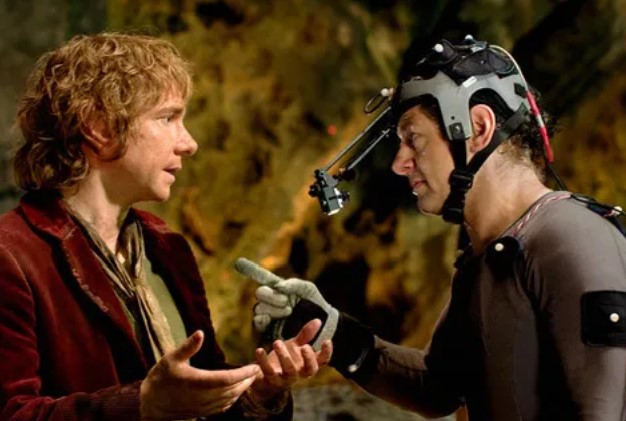
The exchange between Gollum and Bilbo, Serkis and Freeman, two ultimate Everymen, is fantastic, of course, with strong comedic timing, and it captures something that Gandalf mentions in LOTR: that for all their antagonism, Gollum and Bilbo understand each other quite well, including the riddles they exchange.
 
The pacing does strike me as odd, however. The surrounding scenes are CHASE CHASE CHASE. Without knowing the importance of the ring, the scenes between Bilbo and Gollum might seem out of sync. But since, as mentioned earlier, I find chases generally tedious, I don't mind the change in pace (despite finding it odd).
 
And the scenes are lovingly and exactly rendered, including Bilbo's decision not to kill Gollum, which, again, is expressed entirely through excellent body language--just as Gollum's painful loneliness is expressed entirely through excellently rendered body language. 
 
I've often wondered what the film would look like if it was massively cut to mostly only Freeman's scenes. I don't demand such a cut--I like all the extras, even the parts I ignore--but it would be an interesting exercise in editing. It would also create a narrative approach that I enjoy: a point of view that is restricted to a single character. 
 
That is, rather than seeing the dwarfs being chased, we would see only Bilbo. He would then escape. He would then be surprised to encounter the dwarfs. The viewer would THEN be told what happened. 
 
I don't hold it against Jackson that he didn't take this approach. For one, Bilbo encountering the dwarfs after the fact would entail either lots of dialog or a flashback and flashbacks can disrupt pacing even more than cuts between quiet confrontations and action sequences. 
 
And action sequences do satisfy those people who like CHASE-CHASE-CHASE.  

Books to Movies: Over Hill and Under Hill, Internal Character Arcs, and Chase Scenes

"Over Hill and Under Hill"

In the book, Bilbo does not consider leaving the company, either before or after the adventures around and in the Misty Mountains. He often wishes he was back in Rivendell or Bag End. He never actually considers making his way back alone. 

However, in a trilogy, each movie needs its own character arc. In The Fellowship of the Ring, Aragorn actively lets Frodo go at the end of the first movie, indicating the end of an internal battle that in the book, he underwent years earlier. But the moment of choice in the film works since it pays off all the characters, including Boromir. 

Bilbo's internal arc for the first Hobbit movie is resolved when he joins the dwarfs on the other side of the Misty Mountains, promising to help them retake their home--one of my favorite scenes. Bilbo's commitment to the company is solidified.

After all, Smaug obviously isn't paid off or the Necromancer or Azog. And the ring won't be paid off until the next series!

First, however, "under" the mountain. 

The chase scene and the Great Goblin's death is one of those action-film sequences that must be popular since they are so common, but I find a trifle dull. However, I give this sequence a higher rating than the Moria chase scene (after the battle in the Chamber of Records) in Fellowship, which I consider to be one of the most pointless chase scenes in the entire franchise. Five minutes that could easily have been spent on more time in Lothlorian! On and on and on... 

I go along with Literature Devil here--action sequences like this need some kind of change to give them decent pacing. The river chase scene in the next Hobbit movie is far better simply because there is a change in emotion: Kili is hurt and Legolas is conflicted about retrieving his enemies in the face of greater enemies. 

Otherwise, run-run-run never struck me as particularly interesting. 

(Granted, the Great Goblin is amusing.) 

Notes on Bilbo and Gollum will follow...

Books to Movies: A Short Rest in a Great Setting

"A Short Rest"

Three differences between the book and the movie:

1. The elves in the book and radio drama are mysterious, hidden, and whimsical, not noble irked warriors. Jackson took the elves from The Lord of the Rings as his baseline here, which I think was wise.
 
2. Galadriel, of course, does not show up at Rivendell in The Hobbit. But I appreciate her appearance in the movie. One of my favorite scenes is her interaction with Gandalf. As preparation for The Lord of the Rings, the various arguments made by all the parties--Saruman, Gandalf, Elrond, and Galadriel--is quite illuminating.
 
The appearance of Galadriel is not as unbalanced as it sounds. In fact, the Rivendell sequence is one of the most seamless, possibly because the action is confined to a single location. It brings together at least two of Jackson's arcs without much fuss (discoveries related to Smaug plus the problem of the Necromancer). It also explains why the dwarfs and Gandalf are temporarily separated.
 
2. In the book, the dwarfs don't protest Gandalf's decision to take them to Rivendell. In the movie, Thorin would prefer to avoid it.
 
The tension between Thorin and Elrond exists in the book and is generally well-handled in the movie. I especially get a kick out of the "intellectual" elves and the frat-boy shenanigans of the dwarfs. Aiden Turner, who could easily have been cast into either group, has such a boisterous, rowdy time as a dwarf, the audience is convinced, "Yeah, these are the guys to root for."
 
A note about voice overs. 
 
I generally vote against them. I think a movie is supposed to be a visual achievement. 
 
So...in the Rivendell chapter, Tolkien gets meta for a moment and comments that good times "are soon told about and not much to listen to; while things that are uncomfortable, palpitating, and even gruesome may make a good tale and take a deal of telling anyway."
 
Yet SHOWING those good times is necessary to establish what Bilbo misses and what the dwarfs are fighting for. And I will say--as comes up with Merry, Pippin, and Boromir--that Jackson has a light hand when it comes to "showing" good stuff. That is, he devises scenes that quickly convey that the dwarfs are a rowdy, happy group who stick together (preparing us for Thorin's later out-of-sync behavior) and that Bilbo likes Rivendell. Bilbo will naturally return there for his retirement.
 
The setting is really, honestly, something else. It achieves Miyazaki's "I want to live there" levels of enchantment, one of the best-conceived settings within both franchises. Kudos to the artists and designers!
 
But the action must continue--which involves the Misty Mountains and Bilbo's encounter with Gollum.

Books to Movies: Roast Mutton, Arcs, Cuts, and Pacing

The warg was named Daisy by Manu Bennett.
These posts examine the often necessary changes that occur between mediums: books to movies to radio drama. I am using Tolkien's The Hobbit and The Lord of the Rings to make my comparisons. 

"Roast Mutton" 

In the trilogy, the travel sequence from The Shire to Rivendell introduces Azog the Goblin, who is mentioned in the original text but does not make an appearance there. The idea is that the kingly hero--Thorin--needs a foe, so in the final movie, he isn't battling amorphous goblins but a clear antagonist. I don't consider Jackson's decision here wrong. For one, he relies on Tolkien's material, giving the dwarfs a history that stretches beyond this single adventure. (Moria will continue to haunt their story.) However, I never really got into the Azog arc. In terms of moving around events and providing background to the larger problem, I found the Necromancer plot far more engaging (more to follow).

The chapter, of course, involves the trolls who turn to stone, and the sequence is lovingly rendered in the movie. It is important for many reasons--for one, it has its own narrative arc. The radio drama also presents the troll arc with little extraneous narration/explanation. That is, the arc has the ability to stand alone. 
 
Jackson, as I've mentioned elsewhere, throws a lot of stuff into The Hobbit. He never forgets the most important Bilbo moments though in the text, Gandalf gets the trolls arguing rather than Bilbo. Still, the change from Gandalf to Bilbo makes for a nice character building moment.

I find the introduction of Radagast in this part of the movie somewhat distracting. However, the expulsion of the Necromancer does occur at this point in Middle Earth's timeline and accounts for Gandalf's behavior on several occasions. The importance of the twin events--expulsion of the Necromancer and confrontation of Smaug--is emphasized in The Lord of the Rings: Elrond and Gandalf and others saw Smaug and the Necromancer as two "fronts" that needed to be dealt with. Confining the Necromancer, Sauron, to Mordor was a stop-gap measure but a necessary one. 
 
It makes the entire trip far more political than the text initially argues--though the political element is there. 
 
But do the additional political elements make for a good movie? 
 
Flemish Giants
If one is going to create a trilogy, there have to be several threads going at once. Jackson has five: Smaug and the mountain, Thorin and Azog, the Necromancer (to which arc, Radagast belongs), Bilbo and the ring, Elvish dysfunctional family life. To his credit, he introduces all of these issues in the first movie although the Elves' dysfunction is mostly implied.
 
Generally, Jackson handles his multiple arcs better than Lucas though there is still some unevenness. I think one reason Jackson manages better than Lucas is that when a particular set of characters are on-screen, he keeps his eyes on where their specific problem/arc will take them next. Lucas, aside from Star Wars IV, seems to get more easily sidetracked. (Film folks, generally speaking, are visually-minded. Lucas may be more abstract-painting-visually-minded while Jackson may be more Pre-Raphaelite-visually-minded: images for their startling effect versus images for the sake of story.)
 
Despite the need for multiple arcs, I'm not sure whether Radagast needed to be introduced so early. The dwarfs, Gandalf, and Bilbo manage to guide the entire first quarter of the movie without problems; their adventures establish that something has gone wrong in Middle Earth ("trolls coming down from the mountains").

The issue here is one of pacing. Tolkien, of course, handled his multiple arcs by telling a straightforward story and putting everything else into footnotes. But even when Tolkien delivers background information in dialog or with a quick paragraph, it is still less distracting than entirely switching scenes. I'm not sure film has a perfect solution here. 
 
Generally, Jackson relies on dialog--Gandalf mentions Radagast to Bilbo--to prepare for the cut. I'm not a huge fan of this approach, but I'm not sure exactly what else a director is supposed to do, other than throw in subtitles: Meanwhile, on the other side of Middle Earth...

Books to Movies: The Unexpected Party

These posts examine the often necessary changes that occur between mediums: book to movie to radio drama. I am using Tolkien's The Hobbit and The Lord of the Rings to make my comparisons.

"The Unexpected Party" 
 
All of the dwarfs in the movie are much more good-looking and heroic and rugged than in the book, where they are presented in serio-comedic ways. They are presented serio-comically in the Rankin animation, of which I am also a fan. They are also presented comically (they sound like Muppets)--at least initially--in the radio dramatization, with the exception of Thorin. 

I agree with the decision here to make the dwarfs heroes in their own right rather than clownish figures. Richard Armitage as Thorin glowers as much as book Thorin and has the same sense of his own dignity but more because he is a prince rather than a bombastic politician (princes are easier to like than politicians). As mentioned above, the radio dramatization also makes Thorin a kingly figure in his own right, being voiced by John Justin, a baritone with a commanding voice. 
 
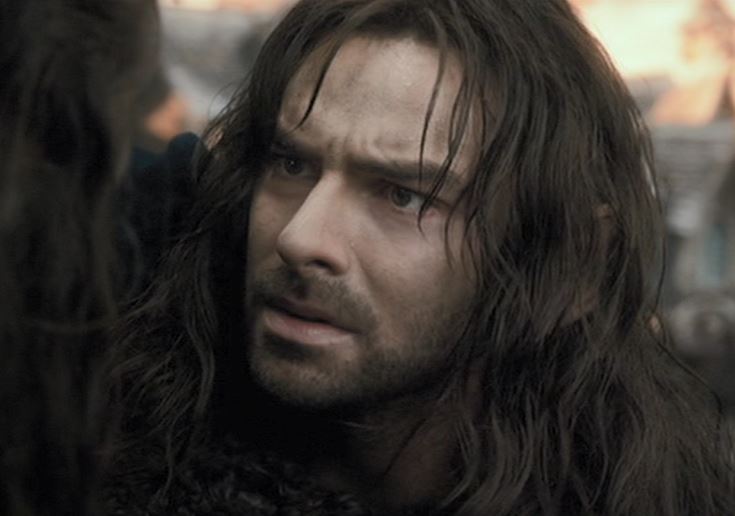
To continue with the movie dwarfs, Kili is hot and Bofur is adorable. And Ken Stott as Balin is thoroughly impressive in his ability to look affable and then stern, rather like Mark Williams as Father Brown.
 
Again, I approve, in part because I like the idea of the dwarfs varying in terms of appearance and background. Just as humans vary considerably in appearance, so do all the other sentient species of Middle Earth. Tolkien wasn't one for pure essentialism (the elves, for instance, are quite distinct in their beliefs, appearance, art/architecture, attitudes, language, and politics). 
 
The dwarfs are also given distinct personalities which, in the book, they gain only incidentally, with Bombur being the most distinct followed by Balin (after Thorin, of course). The movie audience needs to engage with this group of 12+ characters immediately, and it is much easier to engage if they are not "ha-ha" characters--well, not all of them and not all the time. (Even the "ha-ha" characters are given distinct features: an axe in the head, excitable youthfulness, an ear trumpet.)
 
Martin Freeman as Bilbo is, of course, immediately engaging. I had a student who complained about him not being a stout, jolly figure (like Rankin's Bilbo), but other than de-aging Ian Holm, Martin Freeman as Everyman is about as spot-on a casting choice as one can get. (The radio drama engagingly presents Bilbo as a kind of Winnie-the-Pooh character who keeps interrupting the narrator.)
 
The opening scenes of the movie are close to the first chapter, even to the joke about Golf (which, yes, comes from the book). The humor is there as well as the haunting "siren-like" call to adventure. One of my favorite movie scenes is Bilbo leaning against his bedpost while he listens to the dwarfs' song. 
 
He does make the decision to go "on an adventure" himself--rather than being harried into the adventure by Gandalf. Without a voice over--which absence I also agree with--the viewer needs to see Bilbo make the decision, and with a slight turn of his head and curling of his hand, Freeman pulls this off. 
 
The radio drama, of course, relies far more on the voice-over, both by Bilbo and the narrator. However, even there, the voice-over and narrator are not too heavily applied. In fact, the radio drama brings home how "scene-ready" Tolkien's text is. It may not seem that way since it is fairly heavy on exposition. But story with problem starts the book. Story with problem continues it.  

In fact, Jackson COULD have started with Freeman and Gandalf--but I appreciate the appearance of Ian Holm as Bilbo.
 
1931-2020