Showing posts sorted by relevance for query collins. Sort by date Show all posts

Why Darcy Is Often Justified

I am in the process of revising and expanding A Man of Few Words (new edition coming soon!). As part of that process, I have been examining critical commentaries about Darcy, those I agree with and those I disagree with.

One thing I have noticed is how often (some) critics will define Darcy's behavior at the beginning of the novel entirely negatively, forgetting that Elizabeth (who believes at this point that she dislikes him and who has condemned him for various perceived faults) actually defends many of Darcy's actions in the first few chapters. A good example of this is at the Netherfield ball when Mr. Collins approaches Mr. Darcy.
"You are not going to introduce yourself to Mr. Darcy?" [Elizabeth said.]

"Indeed I am. I shall entreat his pardon for not having done it earlier. I believe him to be Lady Catherine's nephew. It will be in my power to assure him that her ladyship was quite well yesterday se'nnight."

Elizabeth tried hard to dissuade him from such a scheme, assuring him that Mr. Darcy would consider his addressing him without introduction as an impertinent freedom, rather than a compliment to his aunt; that it was not in the least necessary there should be any notice on either side, and that if it were, it must belong to Mr. Darcy, the superior in consequence, to begin the acquaintance. -- Mr. Collins listened to her with the determined air of following his own inclination.
Mr. Collins does approach Darcy. The result is Darcy's "astonishment at being so addressed." The conversation (or monologue by Mr. Collins) ends when Darcy "made him a slight bow, and moved another way."

To modern (American) minds, Darcy is just rude. Why shouldn't Mr. Collins speak to whomever he wants? However, in Darcy and Elizabeth's world, Mr. Collins is completely out-of-line.

To modernize it, imagine you attend a dinner party put on by friends. The dinner party is intended to be relaxing, fun, a good time for all. But during the evening, this one guy keeps approaching people, forcing his business cards on them, and buttonholing them into buying life insurance.

This is EXACTLY what Mr. Collins is doing. He doesn't approach Mr. Darcy out of goodwill but out of a desire to aggrandize himself. And Elizabeth is rightly mortified.

Note, too, that although she is partly mortified by the ridiculousness of Mr. Collins' conversation with Darcy (not reported here), she is mostly mortified by his decision to introduce himself. That is, despite Elizabeth's egalitarian impulses, she still accepts, even practices, the routine civilities of her society.

The appropriate course for action would be for Mr. Bennet, who has already officially met Bingley and Darcy, to do the introductions: "Mr. Bingley, Mr. Darcy, I would like to introduce my cousin, Mr. Collins. I believe Mr. Collins has some acquaintance with your family, Mr. Darcy."

This is forestalled partly by Mr. Collins' smugness but also by Mr. Bennet's laxity. But the inappropriateness/wrongness of Mr. Collins' actions are not disputed by the characters.

What I think is in dispute is Darcy's reaction, and this is where personality (and possibly pride) come into play. If Darcy were a pure social extrovert like Bingley, he would be able to smooth over Mr. Collins' social infraction with an easy, blithe remark. But Darcy doesn't think that way. When Mr. Collins approaches him, Darcy's brain (which is wholly occupied with Elizabeth at this point) does something like this: Why is this guy talking to me? Why am I having this conversation? I shouldn't have to have this conversation! Go away! He isn't going away. I gotta get out of here. And he does. Darcy's "pride" is in not thinking beyond the temporary, annoying invasion into his space.

But even Elizabeth admits Mr. Collins invaded Darcy's space.

Why It Matters That Elizabeth Likes Pemberley: Chapter 7

Chapter 7 in A Man of Few Words is the Pemberley chapter--ah, yes, that part in the BBC series where Darcy goes swimming.

Unlike the ridiculous statues in the latest movie, I consider the BBC swimming scene plausible. It does not occur in the original text, and I did not use it in A Man of Few Words. What I did try to convey--as the BBC series conveys--is how comfortable Darcy is on his own property.

Mr. Darcy shows off Pemberley.
This is so in-line with his overall behavior that whether Austen was working off observation or pure instinct, she deserves major major kudos for understanding how someone Darcy could be stiff and uncommunicative at the assembly ball and downright friendly and outgoing on his home turf.

Austen uses the housekeeper and Pemberley's grounds to clarify this; the BBC series uses the housekeeper, the swimming scene, and Darcy wandering about Pemberley with his dogs. I used Darcy doing his job as a landowner, the housekeeper, and my dad.

I've mentioned before that my dad, an introvert, is a prototype for Darcy. When Darcy and Elizabeth are waiting for the carriage to take her plus her aunt and uncle back to Lambton, my Darcy goes through the following:
"Would you like to step in?" Darcy asked, thinking he could show her the improvements he'd made to the flue in the drawing room fireplace, the latest expansion to the library. But she had already seen the house and declined. So Darcy stood beside her under the glowing summer sky and thought how marvelous it was that Elizabeth liked Pemberley.
Every time my mom reads the part about "show her the improvements," she busts out laughing.

After I wrote it, though, it did occur to me that I was making Darcy sound rather like Mr. Collins bragging about shelves in his closets; when Elizabeth visits Hunsford, Mr. Collins also shows off his house.

Mr. Collins' shelves in the closet.
And then it occurred to me that Austen never makes mistakes. Darcy does show off Pemberley just as Mr. Collins shows off the parsonage. Is Austen making a statement about men generally or is she making the comparison to tell us more about Darcy?

I think she is telling us more about Darcy. Although Elizabeth is half-joking when she says that she began to fall in love with Darcy at Pemberley, she half-isn't. As many critics have pointed out, Pemberley is Darcy. Everything and everyone about Pemberley has thrived due to Darcy's involvement, his character.

Compare this to Mr. Collins who uses his house not to illustrate his good sense (which he doesn't have) or his wife's good sense (which he doesn't appreciate) but his relationship to Lady Catherine. He also wants to make Elizabeth feel bad for "what she had lost in refusing him."

On the other hand, Darcy--who has also been rejected by Elizabeth at this point--uses the opportunity to rebuild his relationship with Elizabeth. I use the word "show off" about Darcy; it would be more accurate to say that Darcy puts his house/lands at the disposal of others. He suggests that Mr. Gardiner come and fish; he invites Elizabeth and the Gardiners in for refreshments; he eventually encourages Georgiana to invite them all for dinner. Pemberley is a place of interest and ease; it also exists in its own right as an entity. It is not there simply to bolster up Darcy's ego, something Mr. Collins would not understand.

Awesome Character Actor: David Bamber

David Bamber is a fantastic actor. Full stop.

He is best known for his portrayal of Mr. Collins in Pride & Prejudice (1995). He manages to imbue Mr. Collins with conceit, low self-esteem, wounded pride, black & white thinking, condescension and even a kind of forlorn sweetness, all at the same time.

He shows up all over British television. In accordance with an earlier claim of mine, yes, he has appeared in a costume drama (see above), a mystery show (New Tricks), a Dr. Who episode, and an American show. Bamber has done it all, except that instead of American television, he has appeared in several Hollywood movies.

As Antonio, Merchant of Venice
I have an especially soft spot for him because he does so many mysteries: not only New Tricks but Father Brown, Death in Paradise, Poirot.

He is impressively versatile, having Gary Oldman's ability to disappear into a role. His voice is quite distinctive, but I don't always immediately recognize him. He can play cloying, good-natured, waspish, kindly. Everything. Yup, even Shakespeare.

Great Not Entirely Slimy Character: Gunnar Globle on Murder, She Wrote

In Murder, She Wrote, "The Corpse Flew First Class" (trope to be discussed in more detail later: the need for all mystery shows to have at least one episode in the air), a not entirely slimy character makes an appearance. 

Gunnar Globle (Pat Harrington), one of the first-class passengers, is a studio executive. He is presented as a kind of used-car salesman, the man "in the green plaid parka." Loud and obnoxious, he insistently drops the names of all the people he knows to anyone in his vicinity, boldly inserts himself into conversations, badgers Jessica into reading a screenplay, associates "good" with money ("You must be a good writer--you're flying first-class").

And he is totally lovable. In the airport lounge, he calls his secretary. "Who called? Joan? Rivers? Collins?"

Typical bombastic pomposity, one thinks. Except then he says, "Oh, Joan, my wife! Oh, I love her. Tell her I love her." He is entirely sincere. 

On the plane, while watching the obviously "B" action-film, he is totally captivated. 

And when Jessica later tells him that the script he forced her to read Aliens The Second Coming has "artistic potential," they both agree it won't work for the big screen.

Great character actor!  

Austen Satire Moment: Northanger Abbey and House Maintenance

Whilst revisiting Northanger Abbey, I encountered several caustic passages about Catherine's stay with the Tilneys. Catherine would prefer to meander about with the Tilney siblings, Eleanor and Henry. Instead, the father--who thinks she is a heiress and has pre-selected her for Henry--insists on showing off the house and acreage.

Since Catherine was hoping Northanger Abbey would be a deteriorating medieval abbey with lingering ghosts and hidden secrets--and instead got the equivalent of a suburban ranch house--she is less than excited.

What caught my attention, however, is that such a scene is not the first time Austen's narrator has indicated a lack of interest in other people's home improvements. Mr. Collins, for one, is spoofed for his tremendous excitement about "shelves in the closet."

It is never wise to assume that fiction writers MUST experience the events they detail but the reappearance of such a scene forces me to consider: was Jane Austen cornered at a house party by a happy homeowner with excruciating details about house maintenance?

Not quite as awful as having to watch other people's home videos--but one can see why Austen considered such a circumstance fodder for her novels.

Don't Entail Smentail, Me! The Difficulty of Entails in Persuasion and Persuadable

Money plays a big role in classic English literature, from Austen to Trollope. And it matters. Money may be about greed. It is primarily about survival, marriage prospects, and identity. In addition, money isn't a simplistic matter since money matters are complicated by debt, inheritance, financial opportunities, financial risk, and entails.

The ending of my book Persuadable is a rebuttal to the ending of the Persuasion (2007) film.

At the end of Persuasion (2007), Captain Wentworth buys Anne's family home. The film correctly indicates that part of Anne's attraction to Mr. Elliot, or at least her attraction to marrying him, is that she will be able to live in her family home. By buying her family home, Captain Wentworth resolves that dilemma (Anne doesn't have to give up anything for love!).

Unfortunately, having Captain Wentworth buy Kellynch Hall makes mincemeat of the plot.

If selling Kellynch Hall was this easy, why didn't Sir Walter sell it to begin with? That would be the easiest way to clear his debts.

An argument could be made that Sir Walter's vanity won't allow him to give up the manor; the solution still begs the question: Why would he suddenly be willing to sell at the end of Persuasion (2007)? (There is a possible explanation; the film just never supplies it.)

A possible Kellynch Hall from JASA.
In Austen's tome, Mr. Elliot wants Kellynch Hall because he is tired of being "Mr." and wants to try out being "Sir." He will be "Sir" without Kellynch Hall, but not to the same degree. And, in the book at least, there's no financial reason for him to give up the hall.

To explain Mr. Elliot's behavior, many movies make him (relatively) poor/in need of funds. This, of course, begs the question of why a poor Mr. Elliot would be chasing after women with small dowries and an estate encumbered with debt. However, even if we assume that Kellynch Hall, unencumbered, could bring in a decent income, there is still an underlying problem:
 
THE ENTAIL

Sir Walter's vanity is not the sole block to a sale anymore than Mr. Bennet's passivity is the sole block to his disposing of Longbourn. Both estates are entailed; they can only be passed on to the nearest living male relative: Mr. Elliot or Mr. Collins. And entails in the 19th century were rather difficult to break.

They can be broken, which the passage below discusses in some detail. However, Persuasion (2007) makes no effort to explain how the entail was broken, leaving the viewer to wonder what everyone has been fussing about for 120 minutes. Captain Wentworth just, you know, walked into an estate office one day and, like, said, like, "Oh, hey, I'll buy that."

My primary problem with Persuasion (2007)--which does have some redeeming points--is this assumption of dumbness by viewers. The writers come across as people writing for Austen fans, not as fans themselves: Oh, those Austen fans are silly airheads who only read Austen for the cutesy romance and the girl-talk and don't pick up on anything else.

Sites like The Republic of Pemberley and JASA (above) disprove this cynical painting of such fans. Jane Austen fans (and romance writers/readers) are remarkably well-informed.

I would have preferred Persuasion (2007) to have been written by true fans rather than by people-trying-to-make-the-fans-happy.

Setting aside the film, if you want to know how to really break an entail, read the following passage from Persuadable!
Captain Wentworth eyed [Will and Penelope] as they entered [the drawing room of their house]. Anne curtsied; Penelope responded quickly. Will returned Captain Wentworth’s curt bow, then stood behind Penelope’s chair. His stance mirrored Captain Wentworth’s. His use of mimicry, Penelope had learned in the last three years, was a protection against outsiders. She was an insider.

“You received my letter,” Captain Wentworth said to Will.

“You wish to discuss breaking the entail to the Kellynch Hall property.”

“Sir Walter’s health is failing. He has moved permanently to Bath. He is willing to break the entail for his daughter’s sake.”

Penelope scarcely believed it—the man’s self-love was so bound up in his ancestry—but then she realized that his self-love had always been as much for the form as for the substance. All said and done, Kellynch Hall was a means to an end.

Besides, attempting to break the entail would spite Will: Better his daughter in Kellynch Hall than the despised cousin.

“Are you committed to inheriting Kellynch Hall?” Captain Wentworth asked Will.

“It’s a pleasant area,” Will said.

“You don’t strike me as a countryman,” Captain Wentworth said.
No. Will was no countryman. After all, Penelope remembered, Captain Wentworth manages men on his ship; he isn’t lacking in perception.
Captain Wentworth continued: “Are you sure you would be accepted in Kellynch?”

His eyes didn’t flicker towards Penelope, but Will said sharply, “I believe the populace would be well-satisfied with the Hall’s lord and lady.”

Across from Penelope, Anne tilted her head. For the first time in their acquaintance, she looked at Penelope with real interest. Her eyes drifted to Will who had slouched to a half-seat on the arm of Penelope’s chair. So, her gaze seemed to say, you are not just opportunists.

Penelope said smoothly, “Town life certainly has more to offer.”

“We are country-folk,” Captain Wentworth said and settled into one of the armchairs. Apparently, he had decided that Penelope and Will were sensible people who would listen to reason. “Once I leave the navy, my wife and I would prefer a country residence. Kellynch Hall would be very much to our taste. We want to acquire it.”

Penelope silently applauded Captain Wentworth. Any other husband of a baronet’s daughter would have kept up the pretense of a friendly, non-financial visit for hours. The horror of appearing vulgar!

Captain Wentworth continued, “Since the entail has to be renewed in your lifetime, Mr. Elliot, this is a chance to review your options. And since renewal may not be possible—”

Because Will and Penelope currently had no son, and Jennie [Will and Penelope's daughter] could not inherit. The Wentworths weren’t fools; they were going to press their advantage now, even if it meant dancing around their dislike of Will and Penelope. At least, Captain Wentworth disliked them. Anne seemed more curious than disgusted.

“My husband will not give up the title,” Penelope said.

She felt Will’s bright gaze on her, but she didn’t look away from Captain Wentworth’s speculative stare.

“Do you think of yourself as a baronet?” Captain Wentworth said to Will in a tone that suggested he didn’t think Will merited any title, including “captain.”

“Of course Sir Walter’s cousin should inherit the title,” Anne said quickly. “You are my father’s heir, Mr. Elliot.”

To give the Wentworths credit, Penelope doubted they cared about the title. In the City, however, a title could open doors for Will. And Penelope saw no reason why he should give up what was rightfully his.

Will said, “Penelope’s father, Mr. Shepherd, should be kept on as manager.”

“He’s too good to let go,” Captain Wentworth said. His tone added: Despite his daughter’s scandalous behavior.

Penelope resisted rolling her eyes. She knew how to play this game. Everyone brought deficiencies to the table and every deficiency had a cost. My scandalous behavior versus Anne’s non-male gender. Anne’s lack of maleness cost her more than scandalous behavior ever cost Penelope; Penelope didn’t see why she should allow anyone to forget that.

She said, “Since only my husband can break this entail, we expect to be compensated. The property is nearly disencumbered of debt. It will make a tidy profit in a few years’ time.”

Anne leaned forward, her eyes filled with the quiet speculation that marked this middle Elliot daughter. Anne knew that Penelope had no real tie to or love for Kellynch; Anne would remember how quickly Penelope left it behind the first time.

For Will, Penelope might endure it. But Will had no interest in playing squire. However much he liked the idea of a country estate, he’d never bother with the day-to-day. He would hire a qualified agent (who only skimmed slightly off the accounts) and move on to another endeavor.

Penelope could direct his energies better elsewhere. The Wentworths would get all the unpleasant noblesse oblige of being estate landlords while Will and Penelope stayed in London and watched its neighborhoods grow. The Wentworths would thrive, Penelope assumed. Kellynch Hall was their type of place.

She thought fiercely: I want Will to thrive.

She turned back to Anne. Anne, still leaning forward, gave her a seraphic smile, and Penelope realized, Sir Walter’s unappreciated daughter is getting everything she wanted. Well, well, Miss Anne Elliot. Good for you.

Captain Wentworth said, “It is still encumbered, however. That should be a consideration.”

Will laughed. He tapped Penelope’s shoulder, rose, crossed to the decanter, and poured himself a glass. He held out another to Captain Wentworth who took it after only a slight pause.
Détente.

Every Childhood has an Arnold

In Andy Griffith, Opie has a friend, Arnold. Arnold is that kid--the kid who, without being actually bad, always seems to cause chaos whenever he comes around. He also is the kid who brings up stressful topics, like where babies come from.

Important point: Arnold stresses out the adults in Opie's life. But Opie doesn't mind him at all. Arnold isn't a bully, and he may not be obviously disruptive--and yet--

In one episode, Andy says to Aunt Bee, "Isn't it a little early in the day for Arnold?"

Every mother and father seems to think that their child has an Arnold--which brings up the question: Does any parent think, "My child IS Arnold?"

The only living or fictional parent I can think of who admits to having an Arnold in the household is Tim Allen as Mike Baxter and Tim Taylor. In one episode, he states, "Don't let the kid next to you get you into trouble."

"Did that work for you?"

"I was the kid next to me," he replies.

Sheldon Golomb/Collins, who played Arnold, grew up to be a dentist. 

Darcy's Possibly Happy Childhood

Because Darcy is glum and untalkative, some fan fiction tries to suggest that he has trauma.

I don't agree (and neither does Darcy, actually).

Austen siblings often have close relationships.
Henry & Eleanor Tilney protect each other,  
& their rakish brother, against their father.

It is customary to give heroes and heroines difficult family relationships. After all, it is more dramatic! And, to be fair, a number of Austen's characters do have dysfunctional home lives: Anne Elliot, Henry Tilney, Edmund Bertram, and Elizabeth herself. On the other hand, Catherine Morland, the Musgroves, Elinor's immediate family, and Emma all have good relationships with their families.

Even those without good relationships rarely spend time agonizing over their family issues--not a lot of Freudians in this crowd!

Darcy is one of Austen's characters who had a very happy childhood. His own description follows:
As a child I was taught what was right, but I was not taught to correct my temper. I was given good principles, but left to follow them in pride and conceit. Unfortunately an only son (for many years an only child), I was spoilt by my parents, who, though good themselves (my father, particularly, all that was benevolent and amiable), allowed, encouraged, almost taught me to be selfish and overbearing; to care for none beyond my own family circle; to think meanly of all the rest of the world; to wish at least to think meanly of their sense and worth compared with my own.
In other words, Darcy's pride though partly the result of how he was raised is not in any way the result of poor treatment: neglect or abuse.

Not only is Darcy's pride not the result of poor treatment; it isn't even the result of deliberate brainwashing: "Son, you are better than anyone else; don't you forget it!" Darcy's pride is actually much closer to that described by C.S. Lewis in The Screwtape Letters. In a letter to Wormwood, Screwtape suggests how to exacerbate (spiritual) pride:
[She makes the] quite untroubled assumption that the outsiders who do not share [her beliefs] are really too stupid and ridiculous...it is not, in fact, very different from the conviction she would have felt at the age of ten that the kind of fish knives used in her father's house were the proper or normal or "real" kind, while those the neighboring families were "not real fish knives" at all. Now the element of ignorance and naivete in all this is large...

Screwtape then goes on to discuss how Wormwood can use this perspective to push the cliquey idea of "us versus them."

The attraction of a clique or set to someone like Darcy is not the attraction of being superior to others ("We are so much more beautiful, successful, likable than you"), which is the Crawfords' type of pride in Mansfield Park. For Darcy the attraction of the clique lies in MY family, MY friends, MY people versus Mrs. Bennet, Mr. Collins, Lady Catherine, etc. etc. etc. 

Darcy's "MY" extends from his happy childhood.

Goldilocks Variations: Fairy Tales

In Fairy Tale: A Very Short Introduction, Marina Warner summarizes C.S. Lewis: 

C.S. Lewis pointed out that fairy tales don't even need to be especially well written to be unforgettable. Some of the most powerful tales are terse to the point of blankness, brimful of inconsistencies and plotted with a baffling lack of logic. (34-35)

One reason I like fairy tales so much is precisely  this blankness. It's the same reason I enjoy The Old Testament. Reading between the lines is possible since there are gaps built in--tales and incidences smooshed next to each other (likely from differing sources). The result is great possibilities!

Goldilocks & the Three Bears is not my favorite tale but it is a great example of C.S. Lewis and Warner's point. The tale is so basic yet so funny and well-plotted, it can be used for any purpose. I've used it when teaching persuasive writing techniques: Will you take Goldilock's side? The poor, wandering child whose breaking and entering is excused by dire need? Or the bears' side? Their home and food and furniture violated? By the way, can bears own property? 

For this post, I checked out multiple picture books based on the tale. In one, dinosaurs lure Goldilocks into their house, only she manages to avoid being caught in their trap. In another, Goldilocks encounters three hares while running from the bears (the hares have poor luck--after finally getting Goldilocks to leave, their warren is invaded by...Alice!). In one of my favorites, Baby Bear, all grown up, wrecks havoc in a high-rise apartment before he falls asleep. When the family of humans wakes him up, the mom is...Goldilocks! All grown up with a child of her own. 

In still another, Cajun-based tale, Goldilocks encounters the three Heberts near a Bayou. Turns out, the Heberts are people, not bears, but the tale got misheard (a clever take on the oral nature of fairy tales). 

Even more interesting is Goldilock's personality; she is sometimes portrayed as bewildered, sometimes as incredibly bratty. In his book of Vile Verses, Roald Dahl refers to her as a "brazen little crook," "that little toad," "nosy thieving little louse," "delinquent little tot," "freak," "revolting little clown." His poem ends with the father bear advocating Goldilocks be eaten up. 

In several versions, Goldilocks is sorry for her bad behavior and later makes up to the bears, three pandas in one case! 

But in one version, Goldilocks is unfairly accused, escapes into the forest, and becomes a kind of ninja-like bandit. And in still another, she is an animal biologist who wants to tag the bears. They eat her!

Of course, there are the  classic versions. I recommend James Marshall (of course) and Jan Brett's versions.

Classic is not the same as original. The tale has no definitive author or collector but in the oldest versions, the little girl is, in fact, an old woman! 

Robert Southey made the tale popular. Joseph Cundall made the supposed protagonist a young girl, Silver-Locks. Now the tale is like the Happy Birthday song. If there was an originator, nobody remembers who it was. The tale is there for anyone's use.  

Brett, Jan. Goldilocks and the Three Bears, G.P. Putnam's Sons, 1987.

Colfer, Chris, illustrated by Jon Proctor. Goldilocks Wanted Dead of Alive. Little Brown & Company, 2021. 

Collins, Sheila Herbert. Jolie Blonde and the Three Heberts: A Cajun Twist to an Old Tale, illustrated by Patrick Soper. Blue Heron Press, 1993.

Dahl, Roald. Vile Verses. Viking, 2005.

Garner, James Finn. Politically Correct Bedtime Stories: Modern Tales for Our Life & Times. Macmillan, 1994. 

Hodgkinson, Leigh. Goldilocks and Just One Bear. Nosy Crown, 2011. 

Marshall, James. Goldilocks and the Three Bears. Dial, 1988. 

Opie, Iona and Peter. The Classic Fairy Tales. London, 1974. 

Willems, Mo. Goldilocks and the Three Dinosaurs. Balzer & Bray, 2012. 

Yim, Natasha. Goldy Luck and the Three Pandas, illustrated by Grace Zong. Charlesbridge, 2014.

The Character Who Is Never There

In Sherlock 3.1, writer Mark Gatiss explores the
Holmes phenomenon--why people mourned
Conan Doyle's "murder" of his own character.
One of the most fascinating aspects of human behavior/psychology is our ability to believe thoroughly in things that are not directly in front of our eyes--to not just believe but to become invested.

Yuval Noah Harari believes that this ability to imagine, specifically to imagine the future, is what sets humans apart from animals. Pierre Bayard believes that this ability to imagine and invest accounts for people mourning the "death" of Sherlock Holmes (when Conan Doyle--tired of his creation--tried desperately to kill off Holmes in 1893).

What I find even more astonishing than believing in the future of an imaginary character is the human capacity to believe in an imaginary character who has only ever been referenced.

Maris is so real that when Niles shows up with his
whippet, everybody, including the audience, knows
it's a substitute for his estranged wife.
Frasier accomplishes this with Maris, whom the audience never meets. And yet we get to know her very well through how others reference her--and through the effects of her behavior--to the point where the writers can insert jokes about her and evoke a response. She might as well have appeared on the screen.

Along the same lines, a character can be so real and present and important that the readers or viewers will become invested to the point of believing the character is more omnipresent than he or she actually is. I often have to remind myself that actors and actresses see their jobs in terms of lines or time on the screen. In his initial seasons, Castiel on Supernatural is so omnipresent in concept, I have to remind myself that Misha Collins was only getting paid by appearance, not by how often people thought about him.

Likewise, I have elsewhere praised the Stargate writers for referencing Daniel so often in Season 6 (the season he was technically absent, guest-starring in three or four episodes), he might as well have been "there," simply hanging out in the infirmary or guest-lecturing on Atlantis.

This is the point where some people get cynical about human beings' gullibility, yadda yadda yadda. I think it is rather sweet: humans have this impressive ability to care absolutely totally unrelentingly passionately about the real and about the imagined.

Darcy & Lady Catherine: Chapter 11

Chapter 11 of A Man of Few Words includes the famous scene between Elizabeth and Lady Catherine where Elizabeth provides the impressive retort, "In marrying your nephew, I should not consider myself as quitting that sphere. He is a gentleman; I am a gentleman's daughter; so far we are equal."

Of course A Man of Few Words doesn't show this scene directly; rather, it is related to Darcy by Lady Catherine.

Lady Catherine reporting Elizabeth's behavior
and giving her consent to the match.
The question I had to answer was why on earth would Lady Catherine rush off to tell Darcy exactly what Elizabeth said to her? Geez, is the woman so obtuse she doesn't realize she is simply tossing oil onto flames, exciting Darcy's already excited interest?

The 1940 film solved this problem by having Lady Catherine be one of those crusty sharp-tongue old ladies who secretly adore outspoken girls like Elizabeth. This is a classic type and can be used to good purpose. The 1940 film does use it to good purpose although the first time I watched it with my mother, she (a fan of the book) couldn't resist leaning over and saying, "Lady Catherine does not do this in the book."

What the original text makes clear is that Lady Catherine possesses a substantial degree of cluelessness. Her cluelessness isn't rooted in stupidity but rather in her entirely subjective version of reality. After all, only Lady Catherine could continue to tout a potential marriage between Darcy and her daughter Anne when no one, including Darcy and Anne, imagines this will ever happen.

In A Man of Few Words, I portray Darcy as not even realizing that anyone thought it would happen:
"Can you believe it?" Lady Catherine said. "[Miss Elizabeth] knows that such a connection would be improper, but she refused to deny the rumor. Yes, I can see that astonishes you." Darcy had risen and was gaping at his aunt. "An obvious falsehood, yet she refused to admit it. I explained about Anne--"

Darcy blinked, head cocked. What about Anne?

Lady Catherine coughed and waved a hand. "And she still refused to acknowledge that there is no attachment between you . . ."

But then Lady Catherine is this type of woman: enough of a hard-headed realist to avoid spouting pure fantasies but too far invested in her view of the world to invite too much challenge to those fantasies. Truth is, Mr. Collins is the best possible clergyman for such a patron!

Q is for Quality Quattlebaum, Kids' Thoughts, and Quick & Quarreling Couples

What I read: Grover G. Graham and Me by Mary Quattlebaum.

There aren't many "Q's" when it comes to fiction authors. I'm sure there are loads of "Q" fiction authors in the Library of Congress, but "Q's" in local libraries tend to occupy one to two shelves--at the most. At my local library, I found Quattlebaum, and I decided that anyone with such an awesome last name deserved to be read!

The book is quite good. It belongs in the category, "Fiction about orphan/foster children." Cynthia Voigt's Homecoming series comes to mind. Grover G. Graham and Me is told from a young foster boy's point of view. He is on foster home number eight or nine. There he encounters a toddler who reminds him of himself (this is never stated directly) and decides to rescue the toddler when the seemingly irresponsible mother comes to reclaim him.

Harper Lee's novel is remarkable:
 she retains the child's voice yet adult
readers can winnow out more.

The rescue part of the book is actually, realistically, quite short. It would have been interesting to see if the boy could have survived with the toddler for more than a day, but the book is really about the boy deciding to set down roots, not about the kidnapping.

Kids' Thoughts

The only slight snag is the boy's voice, a common problem with books told from a child's point of view. How do you make the child sound like a child without making him or her sound, well, boring? I'm not sure that children are too different from my cats: I'm hungry. I'm bored. Is there anything to do? Are we there yet? Can I go out and play?

I mean, how much critical thinking actually goes on? I don't remember much in-depth philosophical contemplation from my own prepubescence, though I do remember certain breath-taking decisions about God and theology (though I didn't use the latter word) between the ages of five to twelve but these were decisions/ideas, not developed ideologies.

My lack of memory (or desire to remember) may be why I don't write children's books. C.S. Lewis, for example, a mature and thoughtful adult, vividly remembered his childhood. His child characters, therefore, although adult-like in many ways, have responses that are rooted in childhood's common experiences. For instance, there is a delightful passage in The Lion, the Witch, and the Wardrobe where Lucy "got the feeling you have when you wake up in the morning and realize that it is the beginning of the holidays or the beginning of summer." I remember reading that as a child and going, "Yes! Yes! That is the best feeling in the world."

On the other hand, C.S. Lewis provides his children with far more authority than your average child has--which is kind of the point. But "realistic" fiction can't make that trade-off. In real life, children don't have power. Consequently, "realistic" children are often given far more introspective thoughts about their powerlessness than I think they probably have. Most children are more like Billy Collins' "Lanyard" kid: Reality is whatever I'm doing right now. 

But then, a lack of introspection would make such books pretty uninteresting. When I'm reading books of this type, I simply increase the age of the heroes or heroines in my mind: the hero isn't eleven, I tell myself; he's fifteen. In my own story with a boy of about thirteen, I made that narrator an adult, looking back at his child self.

I will be tackling Quattlebaum for the Fairy Tale list! 

2023: I decided to read a "Q" book from adult fiction and settled on Amanda Quick, a romance writer. I've read a great many romance books over the years, but Amanda Quick is one I've usually skipped. 

I chose Slightly Shady because it has an investigation. The investigators, Lavinia Lake and Tobias March, fall in love. Although the investigation was of a "powerful villain [of] a vast criminal organization" (which plot line bores me  almost as much as conspiracy theories and drug tales), the same investigators appear in a later book, so I thought, "Hey, why not?"

I found the investigation more interesting than the characters. 

Lake and March, unfortunately (in this book at least), fall into the category of enemies to lovers who jump from bickering and arguing to kissing and other intimacies within less than a page and then jump back again. They are always going at each other about something.

When I read books with such characters, I wonder if the authors watch shows like Bones and fail to get anything out of the episodes beyond the bickering. Bones is graced not just by the initial arguments or disagreements or even the Thin Man repartee. It is graced by understanding and acceptance. The arguments--if they even rise to that level--are about insight and growth.

In Season 1 "The Man in the Bear," both Brennan and Booth are amused by the same things. In "The Man on Death Row" and "The Girl in the Fridge," Brennan and Booth demonstrate a strong understanding and respect for the other's ethics: what motivates that person. Their mutual knowledge expands until Brennan can say without hesitation to Booth, "I knew you would [fulfill my promise]. I knew you wouldn't make me a liar."

That is, the relationship changes--even in Season 1--even within the pilot--as the two become closer and gain insights and thrive in each other's presence. It is NOT a constant yo-yo of argue-argue-argue-make-out-argue-argue-argue.

The bickering in The Thin Man is never
about hierarchy. There's the case to solve!
By the end of Slightly Shady, I was still at a loss as to what the two characters liked about each other--but then I find the idea of constant so-called "challenge" dreary in the extreme. I find it infinitely more appealing to discuss a topic of mutual interest than to be constantly defending the topic, let alone one's stance on it. Bones doesn't revolve around "why did you bring that up?" or "how could you think that?!" or "you only think that because..." or "you really should care about this topic instead" but, rather, around "now that you have brought it up, let's move the conversation forward." (The expectation is so strong that at one point Brennan challenges Booth to present a new topic for discussion if he isn't willing to discuss the current one beyond "no, I don't agree.")

Constant fighting doesn't preclude mutual attraction, of course, and the suggestion of "wow, we can't stand each other but we do work well together--and then there's the sex" in Quick's book would have been somewhat interesting. 

That is not the direction the series is going. 

I may try a second book with the same characters, simply to see if they become less annoying once they are hitched.


J is for Janeites: Some Fan Fiction by Kate!

What I read: Darcy's Passions by Regina Jeffers

Darcy's Passions is the story of Pride & Prejudice from Darcy's point of view (mostly). There are dozens of these books on the market (including mine!). Part of the problem with writing an Austen tribute is the writing itself; part of the problem is the characterization of Darcy--which brings us back to the writing.

First, the writing: many tribute authors try to sound Austenian but end up sounding either ultra-modern or unsure. The 18th/19th century voice is terrifically difficult to pull off. The only contemporary writer who comes close is Susanna Clarke (Jonathan Strange & Mr. Norrell), and she is magnificent.

The best solution is to just write in a normal voice. I'm not saying Austen wrote in a "normal" voice—I personally think Austen's authorial voice was cultivated. But it was normal for her. Jeffers' attempt at Austen is better than many, but the switch in viewpoint doesn't sound omniscient and humorous (as it does with Austen); it sounds confused. (With A Man of Few Words, I stuck to limited third-person; I know when I'm out-mastered!)

Like in A Man of Few Words, Darcy's Passions is added dialog/exposition to already existent text. Jeffers' additions paint Darcy as the typical Alpha romantic male. He is overwhelmed by Elizabeth. He is impressed by her wit and anxious to exchange witticisms with her. He despises Miss Bingley. He is confused when the text absolutely requires him to be confused. He is masterly and insightful all the rest of the time.

But Darcy as typical Alpha romantic male is completely inconsistent with Austen's text. (To her credit, Jeffers is one of the few tribute writers whose add-ons include Darcy's knowledge of land management.)

I personally go along with Phyllis Ferguson Bottomer's argument in So Odd a Mixture that Darcy is borderline autistic. Her delineation of Darcy's character is one of the most accurate and delightful on record. She recognizes what few interpretations do: namely, Darcy is accused of pride in Hertfordshire for reasons that have nothing to do with familial or class pride.

Most tributes to Pride & Prejudice concentrate on Darcy's supposedly prideful thoughts, making him the standard aristocratic jerk; they fail to acknowledge, as my mother did long before Bottomer, that all of Darcy's problems in Hertfordshire stem from his behavior, not from his beliefs about himself (which beliefs he never communicates to anyone but Elizabeth anyway). He is perceived as proud because he won't dance or talk, not because he boasts about his position or even because he gives anyone the "cut direct." He doesn't even cut poor Mr. Collins.
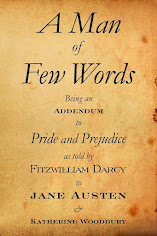
In other words, Darcy is accused of pride for the wrong reasons—and the accusations rest NOT on Darcy's sense of superior class (which he does, in fact, feel) but on Darcy's anti-social behavior. In other words, what Darcy thinks of as "pride" and what Hertfordshire and Elizabeth, to a degree, think of as "pride" is not the same thing. This results in the fascinating argument about their faults between Elizabeth and Darcy at Netherfield; they clash partly because they are talking about two different things. Elizabeth is quicker than Darcy at picking up on the communication gap, but, as Bottomer points out, Elizabeth continues to assume reasons for Darcy's behavior that are actually inaccurate; it doesn't occur to Elizabeth that Darcy is shy or uncomfortable. It did, however, occur to Austen, Colin Firth, my mom, and to Bottomer.

And me. Using this interpretation, I created my own version of P&P from Darcy's point of view. In my version, I do NOT have Darcy perceive Elizabeth's positive attributes (or any of her attributes) right away. I argue instead that Darcy is clueless because, let's face it, so many people are.

To give Jeffers credit, her Darcy is kind of clueless; he thinks Elizabeth likes him because she is playful in her rejections: she flirts, ergo, she loves me! Still, Jeffers has Darcy deliberately provoking Elizabeth, so he can exchange witty repartee with her. I don't think this interpretation is in keeping with the original text. Darcy doesn't do repartee. His remarks are almost always literal and straightforward. Elizabeth's triumph is not that Darcy loves bantering with her, but that she so often provokes him into saying what he thinks; what he thinks isn't witty or covered with savoir faire. Actually, most of the time, what he thinks is kind of rude.

2023: My tributes to Austen's texts now include Persuadable, a tribute to Persuasion told from the so-called villains' point of view. And Catherine Morland & The Matchmaker, based on one of Austen's funniest books, Northanger Abbey, told from the matchmaker's point of view. 
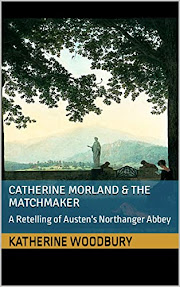
Although I generally try to avoid Austen's omniscient voice, deeming it too much of a challenge, I decided to give it a try in the latest novel by having the narrator--or matchmaker--be a literal semi-omniscient god, the god of love in a god-controlled off-shoot of our universe. 

The first chapter introduces the narrator. For this post, I present an Austen-inspired passage, namely Catherine and Henry's first meeting. Ven, the god of love, is speaking. 

And I had someone for Catherine to meet: Paul Henry Thebley. 

I spotted Catherine halfway through the evening, looking rather low-spirited. My guess: she was used to hometown social events where she knew everyone and could relax. At Aphrodisia, she was the “new girl” in the midst of cliques who had already spent several seasons together on the peninsula.

I don’t approve of cliques but some social behaviors are inevitable. Mrs. Allen, for one, was chattering away about how much she wished Catherine knew someone in the “crush.” Chatter. Chatter. Chatter. No action.

I got pulled away to resolve a question about engagement gifts. No, I don’t think an animal is suitable. Let’s avoid the implication of calculating dowries with livestock, shall we?

Issue resolved, I tracked down Paul Henry Thebley, a tallish twenty-two-year-old with aquiline features and thick dirty blond hair, the kind of guy who looks good in glasses. And Paul Henry is every self-conscious semi-intellectual young man since the beginning of time. He is perceptive and clever enough to be aware of his self-consciousness, so he takes refuge in irony. In my life in the other world, these were the guys who watched lots and lots of Monty Python.

And yeah, I was one of them.

I introduced him to Catherine as “Henry” (he prefers his middle name). She perked up. Henry bowed and immediately started making an ass of himself.

“I’m supposed to ask you the required meet-and-greet questions,” he told her and raised a single eyebrow. “Should I? Tell me, young lady, are you enjoying your time here? Have you been to all the temples? Did you offer a flower to Kouros? A poem to Apollo?”

Catherine responded eagerly. She stated that she was in good spirits. She hadn’t been to all the temples. What type of flowers should she offer? Did Apollo expect an original poem?

Henry isn’t much of an artist or writer. He moved on to the season’s calendar.

“No doubt you’ve been told which celebrations you absolutely must attend. And you’ll write about each of them in your journal, including a list of the people you’ve met. When you write about me, will you call me a goofball or simply a strange young man?”

Catherine assured him she wouldn’t write anything so unkind. Entirely guileless. She didn’t even mock his efforts at mockery, which is why I introduced them.

“Maybe I don’t keep a journal,” I heard Catherine say as I wandered away.

She was trying to be arch, bless her, and I gave her credit for continuing the conversation.

Henry, of course, insisted that she owned a pink, flower-covered journal with a lock. Despite the cliché, he was probably right.

I learned later that he managed to impress Mrs. Allen by complimenting not only her outfit but the outfit’s seamstress So Henry was in good form.

I want to go on record: Henry was not my first choice for a husband for Catherine.

I could easily claim, I knew they were perfect for each other from the beginning! Truth: I simply wanted Catherine to have a not-horrible time at Aphrodisia.

Still--I would never have introduced her to the Thorpes.

Great Jerks

There are good guys and there are bad guys and there are ambiguous guys. And then there are characters who function as jerks or bullies or losers. And some of them are so good at what they do, they become lovable. It isn't that they are mean--I've written elsewhere about my dislike of mean characters--it is that these characters perform a necessary function of unlikability, and they manage to embodied or convey unlikableness in a frankly likable way. They become whole and believable personalities.

1. Hodges from CSI

I love Hodges. He is nerdier than Greg, odder than Grissom. He toadies. He pushes people's buttons (not always on purpose). And he is great at what he is. One of my favorite episodes is when he smells a dead guy (or part of a dead guy) and is defensively embarassed when Grissom finds out. "You think that's gross, huh?" he says. "No," Grissom replies, "that's the first time you've impressed me," and Hodges is so surprised, he shuts up. It illustrates the quirky dynamic that is at the heart of CSI:LV.

2. Jayne from Firefly

He comes off as mean, stupid bully guy, but the thing I like about Jayne is that he remains himself. He doesn't suddenly morph into understanding guy. His apparent meanness isn't a coverup for a really sweet individual (which would make the meanness actually more icky). He is fully himself. He isn't a hero and certainly doesn't want to be mistaken for one. There's a kind of honesty about him except that Jayne would eschew even that praise. Consequently, Mal appears an even better captain for willingly taking Jayne aboard for the sake of his abilities (the episode where Mal remembers collecting his crew is one of my favorites).

3. Chase from House

I've written about Chase here.

4. Cordelia (Buffy Cordelia)

Cordelia was slated for a heroine role almost from the beginning, but she was played, at the very beginning, as the snotty, shallow individual who cuts down the heroine. However, even in the beginning Cordelia had certain attributes that ended up making her a heroine later. In "Earshot," for example, while everyone else is freaking out about what Buffy might overhear, good old Cordelia is saying exactly what she thinks. I'm bored--Can I leave now? "I'm bored. Can I leave now?" I also think Whedon & crew did something psychologically right about Cordelia. The snotty girl is so often cut down to size in teen shows but in Buffy/Angel, Cordelia's High School snottiness is (I think correctly) perceived as an adult strength. One of my favorite early episodes of Angel is when Cordelia gets her new apartment. The ghost woman is criticizing her, cutting her down, mocking her. "Bitch," she finally says to which Cordelia replies, "That's right. I am." She was the bitchiest, meanest, snottiest girl at Sunnydale High and she's going to let someone else push her around? I love that. I think that is the essence of Cordelia-ism.

5. The Thenardiers on Les Miserables

The singing version. First of all, they have great songs, but I also think it is interesting that they are not only not punished at the end, they thrive. Apparently, Hugo's Christianity was of the "it'll come out in the wash" variety. And I think that letting the Thenardiers thrive was, unfortunately but necessarily, truthful to reality.

6. Mr. Collins from Pride & Prejudice

There's only one Bingley (think Superman). There's really only two or three Darcys (think Angel and House). There's a few kinds of Wickham (think Hugh Grant in most roles). There are numerous Collinses. My personal favorite is the A & E version; he is so very pompous and so very self-confident for all the wrong reasons and so very off-putting and so very clueless. And so very, very funny.

7. Charles Grodin from Heaven Can Wait

Technically, he is a bad guy, but he is incredibly hilarious. Not that bad guys can't be funny (think Alan Rickman from Robin Hood) but Grodin's type of sarcastic and amoral badness makes him a likable jerk. He has one of those faces where he lifts an eyebrow and you just start laughing. He does it again, and you can't stop. Why? Why is that so funny? But it is.

8. Quark from Star Trek: Deep Space Nine

Granted, Quark borderlined bad/ambiguous guy at the beginning of the series but I think eventually he ended up as supposedly unlikable guy who yet manages to keep, barely, on the right side of the law. He was no Dukat and he wasn't really even like Garak. He was just Quark: not nice, not bad, not good, not ambiguous (he ended up ambiguous; however, unlike Spike or Garak or, say, Faith, Quark didn't set out to be ambiguous. He thinks he is acting morally according to his lights.) Shimerman played it perfectly (he played Principal Snider perfectly as well): nicely nuanced performances that never crossed the line either into totally unlikable meanness or into reformed gushy sentimentalism.

9. Wesley from Buffy/early Angel

I just rewatched some early Angel, and I didn't appreciate how funny Wesley was at the beginning of that show (and the end of Buffy). He was still playing incompetent, pompous guy ("I'm a rogue demon hunter!" "What's a rogue demon?"). Denisof has great comedic talents that were kind of wasted later on. I don't hold it against Whedon for turning him into brooding, dark guy at the end of Angel (and the episode where he shoots the robot version of his father is one of my favorites), but I recommend that fans go back and watch the Angel episode where Denisof and Boreanaz dance ("She" First Season). And then watch the scene again. And again. And again . . .

10. Michael Culver as Prior Robert in Brother Cadfael Mysteries

He plays the priest who is always giving Cadfael a hard time. Culver is one of those (mostly) bald sexy guys with a beautiful voice. As Prior Robert, he manages to exert a self-righteous authority that makes you dislike him without actually hating him. In the books, Cadfael says that he has learned to tolerate the Prior Roberts of this world and even to admire them for their basic toughness, despite the fact that in terms of mental makeup and ambition, Cadfael is Prior Robert's dead opposite. Culver manages to portray a character that fits that description surprisingly well. (I also like Prior Robert's toady, Jerome--played by Julian Firth--mostly for his voice. I can recognize it just about anywhere.)

The important thing with these jerks is that you want to watch them. Somehow the cleverness of their written characters or the self-sufficiency of their acting or the believability of their parts makes you want to watch them again and again, and you do.

CATEGORY: TV