Showing posts with label Stargate Reviews. Show all posts

Stargate, Season 9, Episodes 9-14

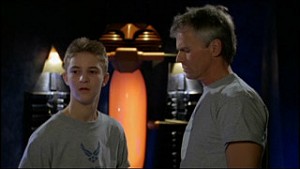
Not a Season 9 image but a great image of Don S. Davis.
I'm happy to say that not all Stargate, Season 9's episodes are a loss--the villain doesn't improve but ways of dealing with the villain do.

Episode 9: Prototype

This is a straightforward plot that keeps the Goa'uld in the running as potential bad guys (and isn't that how life usually works? nothing every goes away forever) though I was disappointed that Khalek didn't turn out to be an ambiguous villain who could help humans fight the Ori. Considering episode 14 below the writers may be attempting to kill off all Goa'uld characters, which would be a mistake!

Episode 10 & 11: The Fourth Horseman, Parts 1&2

This is an Ori episode, which means dull politics and dull acquiescence. How likely is it really that a Jaffa leader would completely accept Ori theology or that anyone would believe that he had? People just don't switch world views that fast. It would be far more likely that the Jaffa would return to believing in Goa'uld gods than get embroiled in Ancient stuff (which is very Terran).

Like all Stargate scripts, the two parts are well-written. The problem is the uncomplicated either/or reaction of entire planets to the Ori. As Joe points out, sentience is usually accompanied by disagreement. Hey, just look at the religions, causes, and political parties on our planet!

Regarding the rest of the episode, Orlin's reapparance (as a teen) is nicely used: the Sam-Orlin plot is one of the two parter's best storylines. I continue to enjoy Ben Browder's Jack-like insouciance. He has taken over the Jack part of the Jack-Daniel repartee with panache. It is always nice to see Don Davis again (he died later than I had realized--in 2008). 

Last but not least: the one good thing about the Ori is that their storyline puts context to the Ascended (Alterans)'s non-interferance policy.

Classic murder mystery ending--Tuvok as the detective.
Episode 12: Collateral Damage

Very nice episode that reminds me of one of my favorite episodes from Star Trek: Voyager, "Ex Post Facto,"  where Tuvok investigates a murder supposedly committed by Tom Paris.  There's a nice twist that I saw coming, but I never mind seeing twists coming--I still enjoy them! (I would never have seen The Sixth Sense seven or eight times if I didn't.)

Episode 13: Ripple Effect

Another nice episode with a classic sci-fi motif: parallel universes. I love how putting 2+ Carters in a room results in instant scientific breakthroughs! There's also a great Star Trek reference about having "beards" in an "evil universe." And a couple of pleasant guest appearances.

Ba'al in paisley--and he pulls it off!
Episode 14: Stronghold

Jaffa politics. Mitchell's subplot is interesting--his friend is one of those actors who show up all over television: Bones, Numb3rs, Whedon's Much Ado, CSI. Yup, he has one of those careers!

Ba'al is back--in pastel--I love his clothes! (And I hope someone got him into a sarcophagus. Pity to lose one of Stargate's more interesting villains.) 

More to follow . . .

Regarding Sci-Fi Villains and Stargate SG-1: Season 9, Episodes 1-8 (So Far)

My goal is to (eventually) watch all of Stargate SG-1 and all of X-Files. With SG-1, I have two more seasons to go (why give up now?!). With X-Files, I have three more to go.

Here's the truth about fantasy & sci-fi, and
clothes: the older they look, the cooler they are.
I finally began Season 9 of Stargate SG-1.

Initial notes:

So far I've been (mostly) disappointed. Not by the introduction of Ben Browder, whom I quite like as Richard Dean Anderson's replacement (although, of course, I would prefer to have Richard Dean Anderson!) but by the new enemy.

How would I describe the Ori . . . ?

Boring.

Regarding Sci-Fi Villains:
Goa'uld: Fun! (Great dressers. See above.)
Wraith: Fun! (Even better dressers.)
Replicators (when machines): Boring
Replicators (when human): Slightly more interesting
Borg: Fun!
Khan: Great fun!
Cylons: Kind of fun (I only watched 1 season.)
Cylon Two (played by Callum Keith Rennie): Amazing fun!
Cigarette Smoking Man: Even more amazing fun! 
Ori: Yawnsville
I realized, after scanning my list, that I like to watch bad guys that I can care about. I don't mean "care about" as in "sympathize with"--I don't actually want to applaud amoral evildoing. But I do want to care when and if the bad guys show up on the screen.

I care when Ba'al shows up and sarcasms his way around the set (what!? it should be a verb!!). I care when the Borg Queen makes an appearance. I care about Steve (Wraith from Stargate: Atlantis). I care about what Cylon Two has to say.  

I don't care about the Ori even a little tiny bit (not even when Julian Sands talks in that plushy voice of his).

It isn't that the Ori-as-enemies don't raise interesting ideas. I have to give Stargate SG-1 credit where credit is due: the writers tackle their semi-omnipotent/omniscient bad guys with more panache and insight than most shows. Not only is the problem of free-will raised (naturally) but also the rather more insightful question, "Is power by itself a good enough reason to bestow one's allegiance?" The writers also intelligently tackle the comprehensible motives people might have to bestow that allegiance (anyway).

It's the Ori themselves that don't raise a flicker of interest. They don't make me chuckle or sit-up-and-take-notice or wonder what they will do next. They don't even engender particularly interesting responses from the SG-1 team except from Daniel who gets to give a lot of well-written speeches.

Granted, the SG-1 writers have captured the humorless inflexibility of passionate fanaticism (whether it be found in religion or, say, environmentalism). But why would I want to watch a whole season of that?

Okay, so, William B. Davis shows up. Eh, I'm not sure Davis by himself is enough to salvage the concept, but then I only just finished episode 8.

Reviews of Episodes 1-8 can be found in the post below.

Stargate: Season 9, Episodes 1-8

Avalon, Part 1 and Avalon, Part 2: Good introduction of a new character! I didn't realize until I read Wikipedia that Ben Browder was that guy from Farscape (of which I only watched a few episodes). Not only is he well-cast, he is well-introduced.

Speaking of Farscape, I truly love how unabashedly the Stargate producers love their sci-fi. Even Master Whedon can't help but poke fun at his creations. Stargate SG-1 producers and directors do this too but a frank fan-boy attitude of "oh, wow, we are so lucky to get him!" runs through every season. It's refreshing.

Ben Browder's Mitchell is the extroverted, excitable version of Jack (Sheppard is the extroverted, low-key version of Jack). There's a very cute scene in this first two-parter (which is actually a three-parter: see "Origin") where Mitchell yells at Teal'c about ricochet--"Bullets bounce!"--and makes a Jack motion with his hands. Teal'c stares at him, then smiles fondly. It is very, very cute.

I love Teal'c's little smile
And the Arthur stuff is compelling--although I would have liked more of it. (I think the writers were nervous about trending on "sacred" fantasy ground.)

Origin: Interesting. And I LOVE the crisp banter between Daniel and Vala. Unfortunately, this was also the point where I sighed and went, "Oh, no. THESE are the new villains?" (despite Julian Sands).

The Ties That Bind: Cute, funny Daniel-Vala episode. Vala is a great match for Daniel! His girlfriends since his wife have been a little too serious. Vala has a serious side but she definitely knows how to keep things light.

The Powers That Be: At this point, I told myelf, "Well, you might as well finish this first set" (I got discs 1&2 out of the library). The Ori are not my preferred villain type. An Ori (actually, a Prior) shows up and makes threats. Daniel gives a good speech. The Prior makes more threats. Daniel and others resist. The Prior reemphasizes threats.

And repeat.

Beachhead: I would almost say the same about this episode EXCEPT Maury Chaykin shows up and steals the entire episode. I had no idea Maury Chaykin did Stargate (he died in 2010). He is magnificent as a fully-humanized if despicable Goa'uld. At one point, he discovers that Ba'al didn't give him credit in the past for an invention. His look of bewildered hurt is beautifully done. Why can't all bad guys be like this?!

Ex Deus Machina: Even though Ba'al shows up, I didn't watch this episode as closely as I should have. It contains a great deal of Jaffa politicking.

Having complained about Jaffa politicking, I must now give Stargate writers major kudos: in the Stargate universe, there is no such thing as a vacuum. Dispose of one enemy: another rises to take its place. Get rid of a common enemy: look out, factionalism! The double-cool thing, though, is that the Stargate writers have a fundamentally stoic attitude about it all: Another enemy rises? So you fight that one too. Factionalism takes the place of heroic solidarity? So you keep trying to find common ground.

Babylon: I quite like this episode. It has a vibe to it reminiscent of earlier Stargate episodes. Besides, Tony Todd is always a treat!

Stargate: Season 8 Review

I was very surprised by Season 8. Season 7 was so military, I assumed that the direction of the Stargate franchise was set, no looking back. And perhaps, overall, it is (Seasons 9 and 10 still to come!). But Season 8 was refreshingly full of one-story, adventure episodes.

Episodes #1 & 2--New Order: The season starts, however, with dreary military stuff (I'm not anti-military; I just get tired of having to keep all the enemies straight). It definitely relies on viewers with full knowledge of the show's previous seasons.

There are some good parts, naturally, and the resolution does tie the two-parter's story-lines together in a believable way.

Ba'al looking wry
Episode #3--Lockdown: Anubis is still alive?

Episode #4--Zero Hour: One of my favorite bad guys, Ba'al, shows up. I love his clothes! I also think he delivers nice ambiguity alongside a touch of wryness (more on this later).

I also like the point of view in this episode--it's about all the stuff that happens back in SG-1 when the team is off adventuring!

Episode #5--Icon: This episode addresses the unattended consequences of contact, especially when zealots are involved. I reference this episode, positively, in my post "Why (So Much) Dystopian Fiction Is Stupid".

Episode #6--Avatar: The classic "virtual-training-tool-run-amuck" episode. It provides interesting insights though I have to point out the silliness of nobody saying, "Hey, let's NOT turn on the machine that thinks for itself!"

Episode #7--Affinity: I got upset with this episode--why is Teal'c living off-base any more dangerous than anyone else living off-base? Yes, he was targeted but other members of SG-1 have been targeted. And I liked Teal'c's apartment life; of course he wears 70's clothes in his off-hours!

Episode #8--Covenant: Another "challenge to the Stargate Command conspiracy" episode. I don't much care for these episodes, mostly because the Stargate writers twist themselves into knots. By temperament, they are on the side of the truth-tellers, but they know the "truth" won't work for the show. Some interesting ideas are discussed. Otherwise . . . eh.

Wayne Brady
Episode #9--Sacrifices: Another Teal'c episode involving Jaffa marriage, a planet with the Goa'uld, and Teal'c's high maintenance girlfriend.

Episode #10--Endgame: Another hunt-for-the-gate episode. I get the impression that these episodes, which are overloaded with exposition, are necessary to plot development, so the writers can do cool episodes later. Still, I find them rather uninteresting.

Maybourne
Episode #11--Gemini: Very clever. I wasn't sure throughout the episode how trustworthy Replicator Carter might be!

Episodes #12--Prometheus Unbound: This episode is very funny. Daniel and the chick-of-the-week have great banter. I wouldn't mind seeing them together again.

Episode #13--It's Good to Be King: Maybourne! I always like it when he shows up. He looks quite good in his Henry V-like outfit. The episode is also a great pay-off for the character. And Wayne Brady makes an appearance!

Episode #14--Full Alert: Another Trust organization episode. Oh, yuck. (Insert snoozing.)

Episode #15--Citizen Joe: This is a great episode! Totally hilarious!! It is Stargate told from the point of view of someone who isn't already ensconced in the Stargate Universe. Consequently, the episode delivers critiques of the show as well as tributes--rather like "Wormhole X-Treme" from Season 5. The episode is also full of casual jokes, like the movers who come to take Joe's house: Brothers Grimm Reps.

And it is touching: Joe sobbing over Daniel's death (well, one of Daniel's deaths) is heart-wrenching.

I love Jack's attitude (at the end of the episode) about seeing Joe's life over the years: "I found it relaxing."

Episode #16 & #17--Reckoning: Replicator Carter makes the replicators marginally more interesting but passionless revenge is kind of dull. And Anubis is still around? Seriously? Please get rid of him already.

I do like how the Jaffa don't care about the replicators but use the distraction to further their own ends.

And Daniel's storyline is interesting.

The most interesting part of the story, however, is Ba'al. The actor manages to give the character this odd/attractive combination of arrogance, fear, wryness, and, even, flirtatiousness. He is far, far, far more interesting than Anubis.

I have to say, though, that even with Anubis, the Stargate writers managed to avoid The Mentalist's problems re: omniscient, boring bad guys, mostly because the Stargate writers didn't take their omniscient, boring bad guy too seriously. They weren't trying to point out the awfulness of life, just have fun.

Okay, exactly how many times can Daniel die????

Episodes #18--Threads: Neat episode. I like Daniel in alternative reality episodes and hey, George Dzunda shows up! (Can one really ask for more?) And it is a decent pay-off (hopefully permanently) for Anubis.

Episode #19 & #20--Moebius: This is a VERY clever "time-travel/everything has changed" episode. The time traveling isn't confusing, so much as silly. But it doesn't matter. The real issue here is "What would our characters be like without the Stargate Program?" The answer is hilarious and cute. Amanda Tapping especially does a great job as adorably nerdy Dr. Carter. And Jack and Carter finally get together!

I read somewhere that the Stargate producers were reluctant to make the Jack/Sam relationship "canon" (and never totally did). My personal theory is that since Richard Dean Anderson clearly wanted to retire from Stargate (he had a good run!) and Amanda Tapping was likely going to stay on into the sequels, the producers wanted to keep their options open. That Jack and Sam ARE in a relationship is clearly implied by the end of this season; the time travel story line lets us actually see it.

Samantha Carter and Jack O'Neill
Of course, Stargate doesn't rely on the Jack-Sam relationship the way, say, Bones relies on Booth/Brennan or X-Files on Scully/Mulder (the latter was always going to be canon whether it ever developed romantically or not). Still, I was glad to see Jack and Sam get together--in their mutually laid-back way!

Stargate: Season 7 Review

Continuing with my reviews! 

Episode #1--Fallen: Daniel comes back! (Because being human is so much more interesting than being ascended, as Cordelia from Angel could attest.) This episode definitely assumes background information on the part of the viewer, a trend that began in Season 5.

This episode and "Homecoming" form a pretty good military two-parter:

Episode #2--Homecoming: The relationship between Yu and his second-in-command has substance. In fact, Yu is one of the most interesting Goa'uld.

Jonas is conveniently, and intelligently, moved on.

Episode #3--Fragile Balance: Michael Welch shows up as a teen Jack O'Neill. He is almost pitch perfect (though a little off in intonation--Jack is more wry exasperation than angry irritation).

The episode makes lots of self-references. When Daniel remarks that "stranger things have happened," he backs up his statement with examples from previous seasons ("the time we became cavemen . . .").

Episode #4--Orpheus: This episode addresses Teal'c's adjustment to not being a superman anymore. There are nice growth moments for Daniel and Teal'c. And it's always nice to see an episode where SG-1 doesn't take out 2 million Jaffa all by itself but actually has to plan.

Episode #5--Revisions: An old-fashioned visit-a-planet-have-an-adventure episode! Christopher Heyerdahl shows up; he's a great sci-fi actor with a creepy, intense aura--and he's so tall! (He also plays a Wraith on SG: Atlantis.)

Episode #6--Life Boat: Michael Shanks gets to play multiple personalities. This is an interesting story using the stored consciousness motif, a motif I usually consider rather pointless. But it creates an interesting narrative here.

Episode #7--Enemy Mine: A battle over mineral rights, this episode includes very clear insights on why the European colonials stuck out life in the Americas despite being so non-politically correctness (from the point of view of future generations).

Episode #8--Space Race: This is a fun "must win the race" episode, complete with sportscasters! Naturally, there is a sweet, sportsmanlike hero racer versus dastardly, conspiring antagonists.

Episode #9--Avenger 2.0: Jay Felger (Patrick McKenna) shows up again for a virus story. It isn't as funny as "The Other Guys" (Season 6), but Patrick McKenna is always delightful.

Episode #10--Birthright: 20th century guys (and Carter) meet Amazons. The episode presents the interesting problem of culture being challenged by advances--should the ladies give up their symbiotes (slavery) in favor of tretonin? Slavery, when embedded within a culture, can be surprisingly difficult to sacrifice, especially when the ramifications of the sacrifice will hurt people in the short-run. There is also a neat subplot regarding Teal'c's pride, his reluctance to admit he is ashamed of not having a symbiote.

Episodes #11 & #12--Evolution: And Apophis has new scary warriors!

Apophis is a surprising weakness of this season. It's the problem of the BIG BAD being SOOO big and bad, the viewer stops caring.

Enrico Colantoni does show up up in "Evolution, Part 2"--it's always nice to see him!

Episode #13--Grace: This is a neat dream/ghost episode where characters represent parts of a person's psyche. Star Trek: TNG did many of these episodes. I always enjoy them.

Episode #14--Fallout: This is not a bad drilling-to-the-center-of-the-world episode. Unfortunately, Quinn's crush on a Goa'uld, the most interesting part of the episode, is brushed over.

Episode #15--Chimera: I like David DeLuise, but I confess I find him and Major Carter an odd pairing. He seems like such a goofy guy, and she is so not goofy. On the other hand, Carter may be trying the "not date my usual guy" technique, which isn't a bad idea.

The story line of Daniel and Sarah is very clever.

Episode #16--Death Knell: Fairly good episode that does a typically excellent job exploring the political quagmires that exist among allies.

Episodes #17 & #18--Heroes 1 & 2: Just when I start to think Stargate has used up all its stories . . . This is a really good two-parter, partly because it is such a thoughtful discussion of truth, the necessary use of free press in a democratic society, and the use of film (or documentation) as history (like the child who doesn't really remember her 1st birthday but has seen it so often on videotape, it has become a "real" memory).

Beloved Sci-Fi Star: Robert Picardo
The two-parter is also aided by great guest stars: Saul Rubinek, Adam Baldwin, and Robert Picardo. Saul Rubinek especially delivers a virtuoso performance.

I was truly surprised by the heroic cost at the end.

Episode #19--Resurrection: An X-Filey type episode.

Episode #20--Inauguration: A recap episode.

We finally get to meet the "president"! Of course, he's a new president with Senator Kinsey as his VP. Picardo as Woolsey does a great job as the tough, objective observer who makes good points (yeah, Stargate Command has a tendency to be invaded by alien entities) and is ultimately an honorable man.

Episodes #21 & #22--Lost City: A completely different Dr. Weir!

This is a nice intro to Stargate Atlantis.

On to Season 8: I will now be entering completely new territory, episodes I've never seen before! 

Sliders v. Stargate: Why Stargate is Better, Part II

As stated in my previous post, I will be comparing a Sliders episode to a Stargate episode:

Sliders: "Prince of Wails"--the gang shows up on a world where the British won the Revolutionary War, and the Sheriff of San Francisco is trying to overtake the throne (think Robin Hood). The gang stops him, helped by American Revolutionaries and a repentant prince.

Stargate: "Beneath the Surface"--the gang is trapped in a world where they have been brainwashed to believe they are part of a society recovering from an extreme Ice Age when actually they are slave-workers.

(a) The Slider world entails a greater suspension of disbelief .

From the descriptions above, this doesn't seem likely. But it is. Even if the Brits won the Revolutionary War, British society was already moving towards a constitutional democracy in the 18th century. A British America would be more like, well, Canada, than some medieval throw-back.

Now, I will grant that the "underground workers" motif is also rather overdone and slightly ridiculous. Where the Stargate writers come out ahead of the Sliders writers here is that they give their bad guy reasons that are entirely sensible within the bad guy's narrow worldview. He doesn't want to create problems with Earth; he also doesn't want to change his society's structure. After all, what would his society do with all those workers if they were let out?

(b)  The gang convinces the terrorist rebels in Sliders to follow Quinn. 

How many terrorist organizations do you know simply accept a new bunch of people with no prior credentials or previous terrorist behavior and put them in charge?

Yes, the answer is zero.

Any closed, paranoid system is riddled with rivalries, inside politics, and ladder-climbing. New people--including in the U.S. Senate--rarely walk in and just start running things.

In Stargate, SG-1 are the rebels. They don't convince anyone to follow them; they just convince each other.

(c) The rebellion in Sliders is enthused by Quinn's idealism: rob the rich to give to the poor. 

In Stargate, on the other hand, the other workers don't want to rebel, and they treat SG-1 like undependable mavericks. When the SG-1 members do rebel, they don't rebel in terrorist ways. Their goal, for most of the episode, is to keep the underground society working: survival is more important than idealism.

SG-1's dissatisfaction with the system begins when brainwashed Samantha Carter suggests to the higher-ups a way to make the equipment run more efficiently. After she is turned down for, unbeknownst to her, political reasons on the surface, she becomes suspicious. Her suspicions fuel the other SG-1 members' questions and their eventual rebellion.

In other words, if this really was an underground society recovering from an extreme Ice Age, SG-1 would eventually take over anyway, just because they are the most competent people in the society.

(d) All tension in the Sliders episode is due to the team needing to save the rebels before they slide. It is entirely external.

In contrast, the Stargate tension is caused by the behavior/interactions of SG-1.

If the SG-1 members just accepted their brainwashing and went on working, there would be no main plot. There is a respectable subplot in which General Hammond becomes more and more suspicious about the disappearance of his team, and, perhaps, eventually, SG-1 would have been found. But the actual episode is less about the imposition of an external problem (evil bad guys) and more about the team members dealing with an internal problem (who are we? why is this society so badly run? are we actually meant for something better?).

In other words, the friendship of SG-1 is the main material of the episode, not rallying the troops to fight back! Working through the problem matters more than confronting the bad guy who isn't confronted until the very end in an extremely short scene.

To summarize, in general, Stargate episodes are more about the problem and less about the chase. And that I like. 

Here are some not bad Sliders episodes--although the concepts behind some of these are extremely silly, the episodes focus on the problem (mostly), not the chase:

"Eggheads" (1.6)
"The Weaker Sex" (1.7)
"The King is Back" (1.8)
"Luck of the Draw" (1.9)
"Love Gods" (2.2)

You may note the episodes are all from Seasons 1 and 2 when John Rhys-Davies was still a powerhouse on the show. He is one of the most excellent aspects of Sliders!

Sliders v. Stargate: Why Stargate is Better, Part 1

I recently started watching Sliders again after many years. As with Stargate, I enjoyed Sliders when it first came out, stopped watching (probably because I lost access to a television), forgot about it, then resumed watching over a decade later.

The difference: I'm now a Stargate fan; I re-lost interest in Sliders after a dozen episodes.

On paper, this shouldn't be so. Both shows involve single-stories for most of their initial season episodes (I prefer single stories to ongoing arcs). Both shows have a fairly enjoyable scooby gang. Both shows' devices deliver both fantasy and science-fiction plots.

However, there are differences, and ultimately, those differences account for my lack of interest in Sliders. 

The listed differences below all refer to Sliders:

(1) The overuse of the "save civilization through revolt" premise. 

Every other, if not every, Sliders episode goes something like this: the gang shows up in a world that is corrupt in some way; the gang finds the underlying rebel group, supports it, and somehow leads it to victory.

Now, to be fair, Stargate includes a fair share of these episodes although, in general, the Stargate writers are rather better at implying things aren't that easily fixed; bad guys just don't fold; they do need to be blown up.

Still, SG-1 does spend a tremendous amount of time encouraging people to revolt against the Goa'uld.

The major difference: a Stargate episode concentrates on the discovery of the problem rather than on the revolt. Idealistic people being lead to revolt is, frankly, rather boring. Les Miserables' plot of Jean Valjean and Javert is two billion times more interesting than the leader of the students being stupid and getting everyone shot. (What makes the American Revolution so interesting, in my mind, is how surprisingly hard-headed and pragmatic the "rebels" were. The French Revolution, on the other hand, just makes me tired: idealism, corrupt idealism, more corrupt idealism . . . Napoleon. Okay, can it stop now?)

(2) Wade being in love with Quinn. 

Within about two episodes of Sliders, it becomes clear that the writers didn't really think through the whole Wade-Quinn equation. They actually wanted Quinn to be a kind of love-them-and-leave-them type, and having Wade along for the ride--the girl Quinn continually rejects by pursuing other women--makes Wade look somewhat pathetic and Quinn rather confused (since he is also supposed to also be harboring affection for Wade).

In reality, if Quinn were not a Lothario, he would hook up with Wade simply because there isn't anybody else comparably steady on his horizon. The fact that he doesn't . . . makes no sense.

In comparison, Stargate Samantha Carter's affection for Jack--while steadily maintained through several seasons--never gets in the way of her having a life (I consider Carter one of the most together female characters on all of television; yeah, she even beats out Scully and Bones). Also, the reason for the non-consummated relationship make sense: military rules and, frankly, Jack's incredible detachment. Carter may hold a torch for him, but she isn't an idiot. And she's got plenty of other things to do.

(3) Possibly the biggest problem with Sliders is the underlying plot device of the slide. Every episode is a "got to solve the problem before . . ." plot: every, single one. 

The irony here is that the writers treated the device of location as a deficiency--when it really wasn't--but not the timing device. In Season 3, the writers changed the underlying location rules to include all of California, not just San Francisco; this actually took away some of the show's coolness--the ways in which a single city can be altered by historical events. Without this ongoing issue, the episodes could be set anywhere: different planets, the past, the future, Mars, someone's mind. The idea of parallelism became a non-issue.

Meanwhile, the "have to slide in X hours" device continued to plague the show. Every episode is about corralling the characters, so they can leap. EVERY EPISODE. This results in lots and lots of running around, lots and lots of chase scenes, lots and lots of rescuing people at the last minute . . .

One or two episodes of this type is fine. Stargate (and Star Trek: TNG) did their own share of "got to get away before the sun/planet/starship explodes" plots--just not every single episode. AND both Stargate and Star Trek: TNG used different solutions to get away. With Sliders, sliding is the solution--every time.

(4) The premise of searching for home is weak. 

Yes, I know, this is Star Trek: Voyager's premise, but Star Trek: Voyager's premise makes sense because (a) it is actually possible within the confines of the show--since in Star Trek, space operates in a straight line, if the ship just keeps moving in one direction, it will eventually get home; (2) it is actually possible to shorten the trip; (3) the characters are already under the control of a benevolent dictator--that is, they are already part of an organization controlled by a single authority (Captain Janeway), so her insistence that she knows what is best for them makes sense psychologically.

But the first two seasons of Sliders continually underscore the idea that getting home is practically impossible, and the Earths that the characters encounter are increasingly out of sync with their original reality. Why not just stay somewhere? Why continue to follow Quinn who has no authority over the others?

I understand that at the end of Season 3, the Sliders writers inserted a new premise for leaping: the pursuit of the bad guy. However, this makes the show a serial, which I don't care for. (I endure The Mentalist by ignoring the Red John episodes as non-canon.)

Stargate, on the other hand, has the premise of protecting the planet the characters happen to live on plus the premise of FUN. When Daniel gets all archaeological and Jack starts talking about blowing things up, fun is what they are talking about: let's go explore places because it is a HOOT!

As my reviews of Stargate indicate, the show does become more and more serial after Season 4, and I have less interest in the later seasons. Still, the serial nature of SAVE THE EARTH makes substantially more sense than PURSUE THE BAD GUY. The latter becomes wearisome since not catching the bad guy is boring and almost catching the bad guy but continually just missing is aggravating and manipulative. The Earth, on the other hand, can be saved over and over and over.

In Part II, I will compare a Sliders episode to a Stargate episode.

Stargate: Season 6 Review

Redemption 1 & Redemption 2: Corin Nemac becomes a member of the team. The problem here is that Corin Nemac is supposed to be Daniel's replacement, but he comes off more flyboy jock than geek. Though Michael Shanks is quite buff (rather startlingly so), he always managed to project more diplomatic/investigator persona than soldier persona. Colin, on the other hand, looks like a gunny from JAG.

Still, he is a sweetie with a dry sense of humor.

Some good problems are presented. Anubis is a fairly boring bad guy, but the episode includes strong McKay-Carter interactions and a smart way to get rid of the Russian gate. (I love how the Russians would rather rent out their Stargate than fund their own program: it's so real!)

Descent: Okay underwater adventure. Like the next episode, this episode is prepping us for Stargate: Atlantis.

Frozen: And Stargate becomes the X-Files!

This was the first episode of the entire series that felt like a total non-story to me: stuff happens only for what needs to take place later on.

Nightwalkers: Adrian Cole is an interesting problem. Unfortunately, he will eventually be paid-off in a dismal fashion.  

Abyss: One of my all-time, absolute favorite episodes. I love the setting (the gravity manipulation is especially cool), Baal's clothes (seriously: they are incredibly sexy), and, of course, Daniel and Jack's deadpan interchanges. 

The episode also makes complete sense in terms of characterization. 

Jack isn't the ascending type. And Daniel isn't the sit-back-and-not-get-involved type. I love how it is heavily implied that Daniel helped solve the problem of getting Jack out.

Shadow Play: Another great example of Dean Stockwell's acting ability. He does an excellent job playing a non-playboy scientist.

(Even if this episode is a retelling of A Beautiful Mind. For awhile, after A Beautiful Mind came out, everybody was doing these types of episodes!)

The Other Guys: A fabulous episode! Patick McKenna and John Billingsley are hilarious. I love the Trek references though my favorite line is Jack's: "Why look everybody—he's got Coombs with him!"

I must mention Felger shooting randomly when he and Coombs arrive on the ship and Coombs walking indifferently down the middle of the corridor while Felger tries to act cool by skulking in the shadows.

My only problem is that the ending implies the whole thing was a dream. According to the commentary, the events happened, just not the kiss.

Allegiance: Tok'ra and Jaffa tale. Interesting tensions are presented. There are some GREAT Jack moments, which underscore his role as a natural leader. Also, Melek—a fairly interesting character—is introduced.

Baal isn't related to this episode--just those clothes!
Cure: This episode opens with another great Jack moment. The writers are definitely compensating for the loss of Shanks by giving viewers extra-Jack.

The episode has an "ends justify the means" plot with no definitive villains. I like how the "ends" themselves are quite problematic which is very real (no such thing as utopias on Stargate).

This episode also explains the origin of the Tok'ra which is fairly interesting. The Queen of the Tok'ra is a real class act.

Prometheus: This is a conspiracy theory episode. Unfortunately, the SGC as a big secret society breaks the magic for me. A faux fun secret society like in Men in Black is one thing; a real secret society turns the good guys into people invested in protecting their specialness: erk.

But at least I now know where the spaceship—which shows up in Stargate: Atlantis—came from!

Unnatural Selection: Replicators again! At least now they have a human face, but the story is rather shaggy and depressing and obviously just done to set up problems later on.

Another Teal'c like: Ben & Jerry's!

Sight Unseen: A rehash of earlier Stargate ideas—bugs, confused civilians, otherworld devices that cause problems on earth—not all that interesting an episode.

Smoke & Mirrors: An N.I.D./Senator Kinsey episode. Great beginning! There's a nice pay-off at the end.

And I get a kick out of the continual mention of "Daniel Jackson" (yes, folks, he is coming back).

Paradise Lost: Maybourne shows up! I like how Maybourne can't stay away from the SGC. Criminals return to what they know.

Which brings up: would it really be a good idea to set Maybourne loose in the universe?

Metamorphosis: Nirrti shows up! And dies!! What a way for her to go!!!

It really is quite a good pay-off.

Disclosure: A flashback episode. Generally, I dislike these, but this one includes a nice summary/overview of the Stargate universe/mythos.

And I love the diplomacy at work: let the United States fund the intergalactic space program; they will have all the responsibility while we reap the rewards of their research!

Forsaken: Pretty interesting problem, but, again, a rehash of a previous problem with a rather abrupt pay-off.

The Changeling: One of the best Stargate episodes ever! I love Teal'c's heroism. I love how the episode pays off with Jonas delivering similar lines to those he speaks at the beginning of the episode.

I also love how everyone plays the right role in T's alternate universe (of course, Jack would be fire chief!) and how Daniel is actually playing himself, ascended, as well as "the resident psychologist."

Great episode!! I discuss it more here.

Memento: Interesting look at first contact with a people who behave much like Earthlings. I admire the philosophy behind the episode (the Stargate philosophy is that exploration is better than playing it safe, no matter what the consequences). However, I wish that Kalfas hadn't been dismissed/overcome so easily. Just because we know SG-1 are the good guys (hey, we watch the show!) doesn't mean Kalfas should trust them.

Prophecy: Good episode, but it also illustrates a problem that plagues Season 6.

Jonas was brought in to replace Michael Shanks: he took Daniel Jackson's position on SG-1; he also took Michael Shank's position on the show in terms of plots/lines.

And at first, this worked, but as the season continued, Jonas needed to develop more of his own personality. This particular episode, however, was pure Daniel. Its problem is the kind of problem that would happen to Daniel, not Jonas, and Jonas behaves like Daniel, not like himself.

Naturally, it is possible that the producers knew that Michael Shanks was coming back at this point, but overall—despite some good episodes—the entire season has the feel of treading water.

Full Circle: Final episode of Season 6. Fairly good action sequence. Daniel's decision to finally, ultimately, completely interfere makes sense considering what is at stake.

And Jack gives a great line: "Personally, I think this whole 'ascension' thing is a bit overrated."

However, again, the episode is used to set up things that will happen later on. The show has become a serial.

To a degree this serial business is inevitable. Star Trek: Next Generation managed better than most shows in retaining its one plot/episode approach. Stargate post-Season 4 is something of a compromise. Like Season 5, Season 6 does offer fun/interesting/great single episodes. But there's this feeling of madly generating story-lines to keep the viewer hooked.

Seasons 1-4 are still the best!

Stargate: Season 5 Review

In this review, I discuss Michael Shanks' dissatisfaction with Stargate, the problem of spoofiness (when it works/when it doesn't), Stargate's best 2-parter, and why Jack is such a great leader.

Enemies: Jack, Daniel, Sam and Sam's dad are stuck millions of miles from earth and . . . they run into the replicators. Ugh. There are few things more boring than mechanical insects. This is one reason the Borg were so cool—technology PLUS a human face. However, this episode does prepare us for one of the most interesting Stargate episodes . . .

Threshold: As Teal'c fights his brainwashing by Apophis, we get to see his history/conversion to the Teal'c we know and love. The vignettes are well-done as well as believable: Teal'c's original story is one of slow self-discovery as he evaluates his personal theology against his own observations and cultural beliefs. His is less the act of a rebel and more the act of a mature man. He doesn't replace his old beliefs with anti-ism but rather with a new way of thinking (or, rather, he is waiting and hoping for a new way of thinking when he runs into SG-1). Very cool. 

Ascension: Nice alien-visitor episode starring the very sexy Sean Patrick Flanery. It is also a Carter episode that takes place outside the base, which is a nice change. And this episode tells us more about Teal'c's likes: Star Wars!

This episode also includes a great line by Jack. When Carter expresses surprise that he has never seen Star Wars, he says, "Well, you know me and sci-fi."

Absolutely! Sci-fi would be totally normal, everyday life to the people living it.

The Fifth Man: Interesting episode about a being that can insert itself into people's lives and thoughts. This episode establishes a technology/ability that will show up later in a very cool 2-parter. John de Lancie does a great job as the suspicious, antagonistic Colonel Simmons (a kind of terse "Q").

Red Sky: An episode that deals with potential bad consequences of SG-1's gate-travel. Me, I just always figured there was a mop-up crew who came along later to clean up SG-1's loose ends, kind of like the Federation diplomatic corp that comes along after Picard ushers a new planet into the Federation and takes off in his ship. (Although in general, SG-1 is more than willing to clean up its own loose ends when it knows about them.)

Rite of Passage: So, little girls from prior seasons do grow up to be obnoxious teenagers. (It is a different actress playing Cassandra although four years can make that big a difference!)

This is one of those episodes which is resolved with people breaking rules in a way that, if the SG-C wasn't such a secret organization, would result in a court-martial.

Beast of Burden: An interesting episode about slavery. The writers did an excellent job demonstrating the matter-of-fact attitude of the slave trader. It is despicable but true to life.

The episode ends in a fairly messy way, but it is one of those episodes where a non-messy solution really isn't possible.

The Tomb: The bugs are back! This time, it is a real bug. Ho hum.

Between Two Fires: This starts out as a murder mystery, morphs into a political-oriented suspense, and turns into preparation for later military-type episodes. In general, this season seems to be about the outcome of unintended consequences. It also mostly disposes of the Tollana.

2001: Nice episode referencing the episode "2010" from Season 4. It also has the feel of Season 4 episodes with Daniel doing archaeological research, Jack pointing out the obvious commonsense solution, and Carter saving the planet.

Desperate Measures: Not a totally uninteresting episode that sets up political and military conflicts for later. However, this episode reminds me that this is the season where Michael Shanks decided to leave (he then came back because in Hollywood a consistent income is harder to come by than even fame and fortune, and he's not an idiot). His decision, or at least part of his decision, to leave was that Stargate was no longer telling planet-based narratives, and he was right. The show was beginning to be more about BIG BAD ONGOING PROBLEMS than cohesive "figure out the issue on this particular planet" single storylines. Episodes still had strong individual arcs in Season 5 but more and more episodes depended on prior events and promoted military or diplomacy themes.

Brothers debating what to do with all
the dead bodies.
Wormhole X-Treme: One of those episodes that spoofs itself. This sort of thing is only possible in later seasons, and it doesn't always work. 

The problem with a show spoofing itself is that the writers risk losing the show's fans. I think Stargate fans are fun and relaxed enough to grin at some spoofing. But that's largely because the directors and writers of Stargate are pretty fun and loose people.

When Buffy mocked itself, on the other hand, there was always this feeling that the writers and director Really Meant It. They were using the spoof to comment on the wackiness of fans or the nature of reality. This sort of spoofiness can get tiresome.

In order for a spoof to work it needs to be either fun and cute (not take itself seriously at all) or have heart. When reviewing Princess Bride, I realized that although Goldman is sort of spoofing the fantasy genre, he does it with so much love and affection--heart--it doesn't feel like a spoof. The same is true of Galaxy Quest's spoof of Star Trek. These spoofs are tributes rather than mockeries.

"Wormhole X-Treme" is fun and cute. It has some classic moments like the moment when the director and Martin can't explain why a person out of phase wouldn't fall through the floor; when Peter DeLuise keeps shouting "Bigger" at the prop guys; and when Jack, as the Air Force consultant, keeps suggesting that the characters "just shoot" the aliens ("Sure, why not?"). The crew of Stargate SG-1 love their show. The spoof allows them to share that love. 

Proving Ground: One of my absolute favorites with Hailey (Elizabeth Rosen) and Lieutenant Elliott (Courtenay Stevens) plus Grace Park from Battlestar Galactica! (Before BG.) I love the ending—a wonderful rite-of-passage-meets-heroism moment.

48 Hours: Another diplomatic/military quagmire where Simmons puts pressure on Hammond to reopen the gate, Daniel deals with angry Russians, and Carter works with McKay to save Teal'c.

Stargate does diplomatic quagmire episodes very well, but I get a tad tired of them. However, this episode does one thing very, very, very, very well: Rodney McKay. I've always been impressed that they let McKay stay McKay. He becomes more likable in Stargate: Atlantis, but he is still McKay.

And I always love it when Maybourne shows up. 

Summit & Last Stand: This is one of the few military two-parters that I really, really like. Daniel is used intelligently in this episode as an undercover agent skilled in diplomacy and fluent Goa-uld. Courtenay Stevens shows up as Lt. Elliot in a marvelous and touching pay-off for "Proving Ground" (the character hopefully has his own fan fiction). The mission that SG-1 is on makes sense; it also makes sense to abort it. The new bad guy is introduced in a clever way. Compared to Stargate's 2-part season enders, this 2-parter is in a class by itself.

Fail Safe: An asteroid is going to hit the earth! I like the use of the SG engineers in the beginning of this episode. Otherwise, it is a pure action episode with a little bit of a twist. Again, it shows the growing difference between this season and the earlier SG-1 seasons. Not a lot of investigating-a-new-place going on! Michael Shanks as Daniel falls asleep in a chair at one point. Kind of indicative.

Warrior: This episode deals with an ongoing issue: what will become of the Jaffa once/if the Goa'uld are destroyed? It also addresses the problem of replacing one obsession with another. The ending is something of a let-down since it fails to address the problem, falling back on "hey, he was a Goa'uld all along!" However, there are two things I like about this episode: (1) Jack's unrepentant attitude that his modern, American, Western, secular view of the universe is in fact a darn good way to view the universe; (2) the explanation for why SG-1 continues to use guns rather than staff weapons even though staff weapons look cooler: guns are just way more practical.

Menace: This is one of those "bring an impossibly dangerous item back through the Stargate" episodes. You'd think General Hammond would stop allowing this to happen.

But it does put a face to the replicators (finally).

The Sentinel: Another ongoing issue episode (in this case, the N.I.D's nefarious behavior). There is a nice character arc/pay-off. Otherwise, this episode definitely confirms Michael Shanks' belief that Stargate was heading in a new direction. The end of Season 5 is considerably different in tone/style from Seasons 1-4.

Meridian:
Daniel's death/ascension and the introduction of Jonas Quinn. As a leave-taking, this episode is very well-done with a great heroic sub-plot. Also, we get to see how much Jack's personality/views have rubbed off on Daniel. I especially like that Daniel turns to Jack to explain his final decision.

Revelations: And...it's back to another military episode. And...I already miss Daniel. It's sad that he's not there to deliver deadpan looks when Jack starts rambling ("Don't you think we should put a seat back here?").

The new problem with the Asgard is fairly interesting, but Anubis as the new Big Bad is fairly boring. Again, no face. Ho hum.

I do love the little smirk Jack gives at the end of the episode, indicating that he knows Daniel is nearby. Jack's inner certainty dovetails with the Asgard's belief that despite Daniel's more philosophical nature and Carter's genius level intelligence, Jack is representative of the future of the human race. He is both down-to-earth and open-minded, rooted in the present and more than ready to take on the future. His leadership is based on letting other people do their thing, getting input, then making a concrete decision. And he always backs his people.

In fact, Jack is one of the best leaders/centers I've ever seen in an ongoing series. He never fails to interest/amuse, but at the same time, he doesn't hog the story. He's the non-sagging-part-of-the-storyline center.

Even with Season 5's new direction, Stargate is still great sci-fi!

Stargate: Season 4 Review

I continue my review of Stargate episodes with references to The Matrix, amnesia, the purpose of sci-fi villains, and Star Trek's strengths and weaknesses.

Episode #1: Small Victories--Part two of Season 3's season ender. It is somewhat more interesting than the first part. Still, bugs...yawn. I really do need a face to my villains, even if the villains are mechanical. Take The Matrix: the villains are the machines or whatever, but the villains' representative still wears a human face and has human emotions. 

Episode #2: The Other Side--One of Stargate's best episodes, starring the excellent Rene Auberjonois. Imagine that aliens finally contact us; they turned out to be human and...a bunch of Nazis. "The Other Side" is a really interesting episode about intentions and perceptions and contains strong argument scenes between Daniel and Jack.

Episode #3: Upgrades--Okay episode that introduces Tok'ra chick Anise played by Vanessa Angel. Several years ago, I was told that Anise was supposed to be Stargate's 7-of-9 (this was after 7-of-9 became really big news). If so, it didn't really work. The women on Stargate dress way too comfortably for Anise's uniform to make much sense.

Episode #4: Crossroads--Pretty good episode with Sela Ward look-a-like Musetta Vander. Turns out, Vander was on Buffy! There must be a I-will-do-fantasy-and-sci-fi circuit amongst Hollywood actors. I've always been proud of Frasier actors Kelsey Grammar and Bebe Neuwirth for willingly doing Star Trek: Next Generation episodes despite their roles in "real life" drama shows.

Episode #5: Divide and Conquer--Good episode which, unfortunately, disposes of Martouf (JR Bourne). I guess the writers decided they'd done as much with this character as they could (although I like Martouf, I think they were right). The episode also refers to the ongoing but in no way intrusive romantic attachment between Carter and Jack. This isn't Bones-Booth romantic stuff; it's pretty low key. (But it's there. One minor problem with early seasons of Stargate: Atlantis is that Sheppard doesn't have a honey; personally, I think his honey should be Teyla: together, they would make the most laid-back couple in television history.)

Episode #6: Window of Opportunity--Probably the first episode of Stargate I ever saw. I began rewatching the show several years ago to find this particular episode. I finally did in Season 4! It is a time-loop episode, a la Groundhog Day. Excellent denouement.

Episode #7: Watergate--Interesting idea; I always like episodes with underwater civilizations. However, despite the presence of Marina Sirtis (Star Trek: Next Generation), it's kind of boring.

Episode #8: The First Ones--Nice anthropological episode which adds more information to the Goa'uld mythology.

Episode #9: Scorched Earth--Okay episode that sets the needs of an unknown and bizarre alien race against the needs of a known and relatable alien race. Stargate does these types of episodes quite well by creating tension without messaging: both positions have merit.

Episode #10: Beneath the Surface--Possibly my favorite Stargate episode ever! Our intrepid heroes have been sent to work in an underground city. Their memories have been manipulated; they don't know who they are and don't realize they know each other. Over the course of the episode, they become friends and work together to escape/solve the problem.

If I ever suffered from amnesia in reality, I'm sure it would be horrible. But literarily, it fascinates me. I think my fascination has to do with the elements of personality: who are we? Are we an accumulation of our experiences? Probably. But what happens when the experiences are gone? What is left? Do we become new people? Do we revert to a basic blueprint? Do we perceive ourselves differently and, if so, how much does that affect how others perceive us? The episode tackles these questions. In a comparison of Stargate to Sliders, I comment:

SG-1's dissatisfaction with the system begins when brainwashed Samantha Carter suggests to the higher-ups a way to make the equipment run more efficiently. After her idea is rejected for, unbeknownst to her, political reasons on the surface, she becomes suspicious. Her suspicions fuel the other SG-1 members' questions and their eventual rebellion.

In other words, if this really was an underground society recovering from an extreme Ice Age, SG-1 would eventually take over anyway, just because they are the most competent people in the society.

Episode #11: Point of No Return--Cute episode that is actually funnier after a few viewings. Another of Teal'c's "likes" is presented in this episode. He likes vibrating hotel beds. (We later learn that he also likes Star Wars and toy laser guns.)

Episode #12: Tangent--Pretty good Apollo 13-like episode. And it's always nice to see Carmen Argenziano (although I now thoroughly associate him with House; he is the older doctor in the fourth season, the one who never actually graduated from medical school and is too much like House to be one of the chosen).

Episode #13: The Curse--Okay episode introducing another bad Goa'uld: Osiris. By the way, the actress playing Sarah, Anna-Louise Plowman, is married to Toby Stephens. (As I continue my hobby of identifying British and American actors in bit parts!)

Episode #14: The Serpent's Venom--One of Stargate's military strategy episodes. Teal'c gets tortured. There's a bomb. It's kind of boring.

Episode #15: Chain Reaction--This is one of those episodes where the problem has zero impact unless the viewer is already invested in the show/characters. This kind of thing is allowable once a show gathers a fan-base, but it always makes me wince. It is also, as Jack would say, a "a cloak and dagger-y" episode which, in general, isn't really my cup of tea. But Maybourne shows up!

Episode #16: 2010--Neat episode that I reviewed for the Mike-Kate Video Club.

Episode #17: Absolute Power--A Michael Shanks-focused episode where he gets to go bad (but it's only a dream). This episode makes clear why the Goa'uld aren't dealt with diplomatically:

One smart thing that Stargate does is to make their villains completely villainous. Although I mention elsewhere how boring villains are when they just happen to have all the habits and beliefs that the author personally disapproves of, I also admire villains who do their jobs. (I want my villains to be complex and villainous--not stereotyped and waffling). 

The Wraith in Stargate: Atlantis have an ambiguous side—leading to the creation of the marvelously conflicted Michael played by Connor Trinneer—but their needs make them "givens" as enemies.

The Goa'uld are just bad (the ambiguity is supplied by the Tok'ra and by Goa'uld infighting). This does two things: (1) it prevents Stargate having to apologize for being a military/warrior show; (2) it keeps Stargate mythic. In myth, although Hercules does in fact apologize for a lot of things, he doesn't apologize for being a fighter. Similarly, Stargate heroes don't apologize for saving the universe ("Oh, wait, maybe we should have tried to understand the creatures who want to put snakes in our bodies!") Jean-Luc Picard can do this kind of over-the-top diplomacy because he is Patrick Stewart and everything Patrick Stewart does has a patina of gravitas. But nobody else should do it in sci-fi.

The Stargate writers demonstrate their wisdom and skill again in this episode when they resolve another of Daniel's story arcs. Instead of forcing us to watch all 10 seasons of Stargate to find the Harcesis, they bring him up, deal with him, and dispose of him in one episode. Kudos!

Episode #18: The Light--One of my favorites although I'm not sure why. I don't really like angst, but I guess I like mental anguish, such as Daniel's breakdown at his apartment. There is also a mystery that needs to be solved. 

(As mentioned in my review of Season 3, Michael Shanks tends to be the main character in episodes that are more archaeology/team-oriented as opposed to battle-oriented. I prefer the latter to the former, so I tend to refer to Daniel/Shanks a lot.)

Episode #19: Prodigy--Introduction of that fantastic "4'9" fighting machine" Hailey (Elizabeth Rosen) who shows up in the later episode "Proving Ground" with the excellent Courtenay Stevens as Lieutenant Elliott.

Episode #20: Entity--Supercomputer-as-antagonist is about as boring to me as mechanical bugs-as- antagonist. And I just can't buy the whole "consciousness can be transferred in and out of a computer" thing. Oh, well, I guess these episodes have to be done. The script does have some nice moments that highlight the differences between Daniel and Jack/Teal'c.

Episode #21: Double Jeopardy--This is quite a nice pay-off to the robot story ("Tin Man" in Season 1) and to the Cronus & Teal'c story. One downside: the writers really should have said what happened to the de-activated robots at the end, but I guess they were worried the information would create too many problems for future episodes. They didn't want the viewers expecting the robots to show up every other episode!

This is to say, Stargate writers are even more fanatical than Star Trek writers about not leaving open-endings. On the one hand, as in Star Trek--especially Star Trek: Voyager--this sometimes strains one's credulity. On the other hand, I love single-story episodes and I really admire how completely cavalier Stargate is (even more than Star Trek) about avoiding soap-opera tangents. Their attitude is "this will cause us problems later; okay, let's just not deal with it!" There's something enormously refreshing about this type of approach.

Sidenote: In comparison, the Battlestar Galactica folks, who were also heavily influenced by Star Trek, got a bit too obsessed with "rebelling" against Star Trek rather than using its lessons intelligently.Although even Star Trek got it wrong occasionally--

Episode #22: Exodus--This episode reminds me of David Gerrold's analysis of Star Trek's weaknesses in his book The Making of Star Trek. David Gerrold points out that "Kirk in danger" episodes get tedious pretty fast (Kirk is in danger from the supercomputer! Kirk is in danger from the evil body-less psychopath! Kirk is in danger from the evil green monster-thing!).

Good drama (even action drama, I would argue) is better when it is about making decisions. Die Hard is a great action movie because Bruce Willis can't just blow things up; he has to make decisions about which course of action to take. Actually, he has to make the decision to get involved which influences how he gets involved.

Stargate military strategy episodes, unfortunately, have a tendency to focus on "the one thing that will save the earth!" Kill a bunch of mechanical bugs! Blow up a sun! Or...

And it gets old. It is much more interesting when someone has to make a decision. So, for example, in this season, my favorites almost all involve making a decision of some kind:

  • "Other Side"--Jack makes a decision about who to trust when he sees how Alar treats Teal'c. 
  • "Window of Opportunity"--the archaeologist makes a decision when Jack reveals to him how he feels about his own child's death. 
  • "Beneath the Surface"--the team members make the decision to trust each other and care about something bigger than their current circumstances.
  • "2010"--okay, this is a "must do one thing to save the earth!" episode. Sci-fi action/drama shows are allowed a few plus the "one thing" is pretty interesting. 
  • "Absolute Power"--Daniel makes a decision about what to do with the Harcesis (the potential for unlimited knowledge). 
  • "The Light"--the boy makes a decision to trust Jack and turn off the machine.
  • "Prodigy"--Jack makes a decision about how the team should escape/deal with the attacking aliens. (The action sequences are directly impacted by Jack's decision; the decision isn't simply one of a series of actions.)
On to Season 5!

Stargate: Season 3 Review

Episode #1: Into the Fire—Second part of Season 2 ender: one of those episodes where things become incredibly convenient (the Goa'uld can be removed that easily? really?).

Episode #2: Seth—Pretty good episode combining cults with the ATF and Sam's dad.

Episode #3: Fair Game—A fun episode that proves exactly how distrustful the Goa'uld are . . . of each other!

Episode #4: Legacy—One of my favorites in which Daniel is infected with a Goa'uld killing device that makes him temporarily crazy. This episode also contains two of my favorite lines by Jack: "Why don't we just put a little sign at the base of the ramp saying, 'Gate travel may be hazardous to your health'? I can live with that" and--when Daniel wants to know why he feels better--"I have a very calming effect on stressed-out people." (In this episode, Jack uses the word "ascribe," correctly. I think this is proof that Jack is way, way smarter than he presents himself.)

Episode #5: Learning Curve—Interesting episode that if I think about too hard doesn't make any sense (why would any culture, even one that learns through nanites, give up ordinary educational techniques?). However, I enjoy the episode's willingness to explore the issue (and it has a great scene about painting).

Episode #6: Point of View—Alternate reality episode with alternate reality fun!

Episode #7: Deadman Switch—This is one of those episodes that I should enjoy more. It has a wisecracking bounty hunter, for one thing. But I just find it boring.

Episode #8: Demons—One of Stargate's few forays into Christian territory. One of the really, really smart things about the Stargate writers is, no matter what they may think personally about religion, they go out of their way to make it clear that the Goa'uld impersonate all-ready extant gods. That is, "Ra" isn't really Ra; he impersonates Ra. I like this, not just for the Christian episodes but for all of them (ancient and otherwise). It maintains a respect for all the religions that SG-1 encounter. (The disrespectful folks are the Goa'uld who distort and play on people's beliefs.)

Episode #9: Rules of Engagement—Lord of the Flies, with guns! Not really, but it's an interesting episode about young warrior men abandoned by their instructors. It's one of those episodes that I'm surprised Stargate never did a follow-up on (maybe in Seasons 5-10?).

Episode #10: Forever in a Day—Great episode with alternative realities blending into dream states. Think of the Buffy dream episode "Restless" although, no offense to Whedon's creativity, I like "Forever in a Day" better. (Buffy is just a little bit too wisecracking-girl in "Restless.")

Episode #11: Past and Present—Remember Linea? Here she shows up again young. Great episode about the connection between memory and personality.

Episode #12 & 13: Jolinar's Memories and The Devil You Know—Pretty good two-parter where the team goes to "hell" to rescue Sam's dad. They are accompanied by two of those dark-haired, muscular but wiry young Tok'ra guys. I like the brutal logic of the Tok'ra; it makes them good antagonists to SG-1 (specifically to O'Neill's brand of heroism) but not bad guys.

And Apophis is still alive! Does he ever die? (In Seasons 5-10 maybe.)

Episode #14: Foothold—Fun episode with Maybourne; this episode prepares us for the later episode "Shades of Gray" by making Maybourne somewhat more approachable.

Episode #15: Pretense—Okay episode that takes care of the Skaara storyline. Nice pay-off at the end.

Episode #16: Urgo—Very funny episode although Urgo, played by Dom Deluise, is highly annoying. Consequently, not a very funny episode I watch very often.

Episode #17: A Hundred Days—This episode really annoys me, and I've decided it's a girl thing. This is one of those "our intrepid male hero goes to a planet where he falls in love with a woman and thinks he will spend the rest of his life with her, especially since he's been cut off from home, but then the people at home contact him, and he leaves her for a higher purpose."

Believe it or not, it isn't the higher purpose stuff that bugs me. When the writers redid this plotline in Stargate: Atlantis, I was pleased that Sheppard never settled into his new life. What bugs me is the "have my cake and eat it too" syndrome. Man gets to play at being a house husband for a few days except, guess what kids, duty calls. I just think the male heroes should be more Sheppardy and stick to their guns (literally).

Episode #18: Shades of Gray—Nice undercover spy episode. Maybourne's willingness to believe Jack is a bit abrupt. However, although Jack is acting out of character, he isn't acting so out of character to be unbelievable. And Maybourne is arrogant enough to think he can win people over.

Episode #19: New Ground—Pretty good adventure episode with a bit of theology/science thrown in.

Episode #20: Maternal Instinct—Pretty good episode with another "superior" alien race. I don't actually mind Oma Desala being superior because (1) she has a philosophy to go along with her superiority; (2) she doesn't rub it in; and (3) she's Mother Nature, and yeah, Mother Nature is more powerful than technology (think Hurricane Katrina, Mount Saint Helen's . . . ).

Episode #21: Crystal Skull—One of my all-time favorites. It has Daniel running around as a "ghost"; Asgard music; Jan Rubes . . .

It probably seems like I have a huge crush on Michael Shanks, and he is a handsome man. But I think I mostly prefer the Daniel episodes because they are the more human-interest/archeology/language episodes. I don't particularly mind episodes with guns, but human-interest/archeology/language is more interesting.

In any case, "Crystal Skull" has one of my favorite Jack lines. While everyone is oohing and awing about the immense pyramid, Jack goes, "Can you imagine what it takes to heat this place?"

Episode #22: Nemesis—Season ender. The Asgard and the mechanical bugs. Well, I like the Asgard, and the mechanical bugs are creepy, but I prefer bad guys that can talk back.