Showing posts with label Classics. Show all posts

T is for Terrific Trollope

What I read:
The American Senator by Anthony Trollope

Trollope is fun. Reading Trollope is rather like reading Dickens, Austen, and People magazine all at the same time. Trollope creates gentle yet ironic, deftly drawn characterizations. One of the most impressive achievements of The American Senator is that I ended up routing for the cold, manipulative femme fatale. Trollope does a fair job depicting the reality of life for a single English woman in the gentry class circa 1900. The machinations of the femme fatale become understandable, even justifiable, the further you get into that world.

I don't think Trollope would have expected me to side so much with this character (Arabella). I think I was supposed to be bowled over by the sweet, kind, heartwarming mirror to Arabella. But Trollope is too good at what he does to NOT to give Arabella a complex personality.

The book is also hilarious. Towards the end, the narrator tells us:
The duke had objected to the term "thoroughly bad girl," which had been applied by his wife to his niece. He had said that "thoroughly bad girl" was strong language, and when the duchess defended the phrase he had expressed his opinion that Arabella was only a bad girl and not a thoroughly bad girl. The duchess had said that it was the same thing. "Then," said the duke, "why use a redundant expletive against your own relative?" The duchess, when she was accused of strong language, had not minded it much; but her feelings were hurt when a redundant expletive was attributed to her.

This is Monty-Python level humor! Great stuff.

Despite liking Trollope so much, I probably won't be reading him again soon. The American Senator took me about 2 months. Seriously. It was like reading War & Peace except the names were easier to follow, and it was less depressing. But talk about long.

But I do recommend him!

2023: Review of Barchester Chronicles's Book One, The Warden, to follow!  

More Seminal Works: Alexander McCall Smith

Over two+ years ago, I determined to read all of Alexander McCall Smith's (current) No. 1 Ladies Detective Agency books.

With the most recent, published in October 2023, I have accomplished my goal!
 
The list comprises 24 books, which is a long list for me, but I didn't feel the need to read the books as belonging to a "oh, my, what happens next?" series. They are ostensibly mystery books but like many of McCall Smith's books they are truly more about a set of characters ruminating over and experiencing life: slice-of life stories with the added bonus that the readers get to see the characters grow and change (somewhat) over several years within a specific environment.
 
The writing is impressive! I rather assumed that the books would get repetitive and some of the more recent cases are similar to prior cases, but, hey, that's life! There are only some many frauds, cheating spouses, and money-based misunderstandings out there. The characters are well-aware when they encounter a case/situation similar to what they encountered before.
 
Part of what helps the books avoid the feeling of repetitiveness is the ongoing family events (Charlie actually got married!) and ongoing changes to the company itself (as Mma Matsuki's job titles become grander and grander). However, what is more impressive is what McCall Smith doesn't do to avoid that issue: he refrains for creating a cast of thousands. Charlie gains attention in several books, but he doesn't take over the books. Nor does anyone else, not even Violet Sephotho.
 
I equally admire the lack of soap operatic events and attitudes. In the hands of another writer, I fear such a gloss would become inevitable. But Mma Ramotswe, whose character and attitude run the series, continually delivers the perspective that life is ordinary and real and tragic and happy and wonderful, all at once.
 
Life is life. Here we go.

Consequently, large events are treated as something to be handled while minor events become--as they do for all of us--of relatively major importance. In the latest book, From a Far and Lovely Country, the first three chapters involve the introduction of cases. They also include Mma Ramotswe's disappointment that her husband and best friend forgot her birthday. Everything is part of life, from tension over parking spaces to Charlie adopting an elephant (prior book).

The latest book did reveal what I would call a "theme" in a more deliberate series. McCall Smith returns several times to the idea of an outsider (Americans, quite often) visiting the country as they search for family, connection, and meaning. They come to Mma Ramotwse for help with their searches.

I suggest that McCall Smith, a Britisher, who lives in Scotland but was born in Zimbabwe, relates to this theme of going home or going to a place that feels like home to shore up one's identity. 

I recommend all the books! I will admit that a few move faster than others, and I remember some better than others. Nevertheless, there is something to be said for books that are easy to pick up and put down and pick up again, and which never disappoint.

I is for Isolated: Ishiguro

What I read: Remains of the Day by Kazuo Ishiguro.

*Some spoilers included.*

I wouldn't ordinarily have picked up Remains of the Day because I'm not a big fan of broken-heartedness, and I knew enough about the book to know it nose-dives into broken-hearted territory. However, the structure of the book is so enchanting that the broken-heartedness or poignancy creeps up on you (rather than clobbering you on the head). It is inexpressibly touching and well-worth reading.

It is also surprisingly funny. The whole section about "birds and bees" and young Cardinal is hilarious. There are also a number of sad funny parts, like the section where Mr. Stevens allows the Taylors and their friends to think he is a gentleman (in the titled sense of the word) and then finds himself getting deeper and deeper into a conversation he doesn't know how to stop.

Basically, Remains of the Day is the story of a man with a remarkable gift for self-deception. What he doesn't want to see underscores the book. Part of this blindness is choice; part of it seems to be built-in. He adopts his father's lessons about dignity but fails to understand the real lesson of his father's example--for instance, how his father refused to drive around the gentlemen who were criticizing his employer. Stevens sees only the Spock-like "show no emotion/don't react" part of these examples, not the moral rightness behind them.

I knew a law professor who used Remains of the Day (the movie) to explore the idea of attorney ethics: at what point does an attorney have the ethical obligation to object to a client's behavior--not simply do what the client asks? It's an interesting question, especially since the book (and movie) make clear that Lord Darlington (Stevens' employer) is uncomfortable with many of his decisions and that Stevens could, in fact, have influenced him.

On the other hand, however, I think the book illustrates that Stevens' self-imposed isolation is partly psychological: Stevens is a fundamentally decent person as shown by his treatment of his father. Yet, he seems unable to connect with people. At several points in the book, Lord Darlington and young Cardinal give Stevens the chance to open up. These are people who care about him and who could directly improve his life. He backs away from these opportunities. I was reminded of Manor House in which the architect-become-temporary-butler reflects that the class structure makes communication--real, thoughtful communication--between master and butler tremendously difficult.

Except...Stevens' need to be butler for a man of great moral worth rests directly on the dilemma that his employer, a decent man, is behaving badly. In the one place where Stevens could directly object to that behavior--the dismissal of the two Jewish maids--he does not. The book, consequently, becomes a kind of monologue of justification. He WAS right to serve his master unquestioningly. He WASN'T responsible for the outcome.

The outcome is that his master is stripped of moral worth publicly (after the war) for being a German collaborator and pushing appeasement with Hitler. Stevens' road trip becomes not just Stevens' attempt to reunite with Miss Kenton but also his attempt to become the gentleman (from Darlington Hall) that his master failed to be. In that way, his life will not have been a failure.
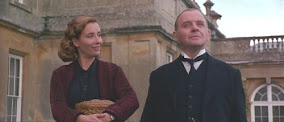
I watched the movie immediately after finishing the book. It was something of a disappointment. If I had seen the movie first, I would not have read the book since the movie is one of those depressing-atmosphere-included Ivory Merchant films. Still, Anthony Hopkins and Emma Thompson are right on as Mr. Stevens and Miss Kenton. I was especially impressed by Emma Thompson. From the ads (way back in 1993), I got the impression that Miss Kenton was a kind of virago: the stubborn outspoken housekeeper who softens the butler's heart. Well, that's kind of right. But she is much more complex than that, being kind, shrewish, passive-aggressive, emotive, wounded, somewhat immature, and inexpressibly lonely. In fact, what stands out in the movie is the loneliness of these two people.

The movie, by the way, shortens the time period between Miss Kenton arriving and WWII. The shorter time makes sense. On the other hand, I like the book's two-decade stretch. It helps illustrate how well-meaning elitism can, in its well-meaning elite way, cause such havoc in the long-run. Lord Darlington is not, necessarily, incorrect about the nastiness of the Treaty of Versailles. And he is very idealistic. And somewhat honourable. And completely and totally wrong.

The lesson here is a good one to remember. Many elite intellectuals in England initially supported Hitler as well as Stalin. Whenever people try to tell me that what America needs is a "really smart" president, I always remember this. Mob-rule has its problems. A well-meaning elite, whether aristocratic or academic, is nothing to get all excited about. When the two combine, as they have recently, the result is horrific. The politics of environmentalism, for instance, appear idealistic and honourable and right. They are supported by many (long-winded) intellectual and political elites. But so much environmental thought in the West rests on "great white man" arrogance.

I could say, "They don't mean it. That isn't how they see themselves at all." 

But I can't say I'm sprinting to their defense. (And these days, I think elites do intend their cruel, violent, inherently bigoted mob reactions.)

2023: I read Never Let Me Go by Kazuo Ishiguro. *Spoilers.*

It's a dystopia novel, which means the premise doesn't make much sense. Even in 1990, cloning individual organs was perceived as the future--and far more cost-effective than cloning full people for parts.

And yet, the book is exceptionally well-written. The quality of the book lies not in the premise but in the narrator, the business of remembering. The narrator will say, "Here's what I think happened--but of course, at the time I didn't realize it was connected to this other event--and then much later, I wondered--and here's what other people say, but I'm not sure it is that straight-forward." 

The voice alone is extraordinary--and the story steadily veers from the "shocking truth," to the business of simply coping with aging and adulthood and the realities of life. The end of "high school," the end of friendships, the recognition of what actually happened back then followed by the lack of surety--

Is that what truly happened? Is it? What was truly going on? Is it possible to know? 

After awhile, the dystopia becomes less a reality and more a metaphor--it isn't necessarily a metaphor I agree with since I have no desire to go back in time to my younger days and wallow in regret--but something like, "You grow up and life carves out your organs, including your heart."

In any case, the underlying "truth" is less important than the remembered truth. 

Ishiguro is an impressive writer.

H is for Hmmmmm (Hesse)

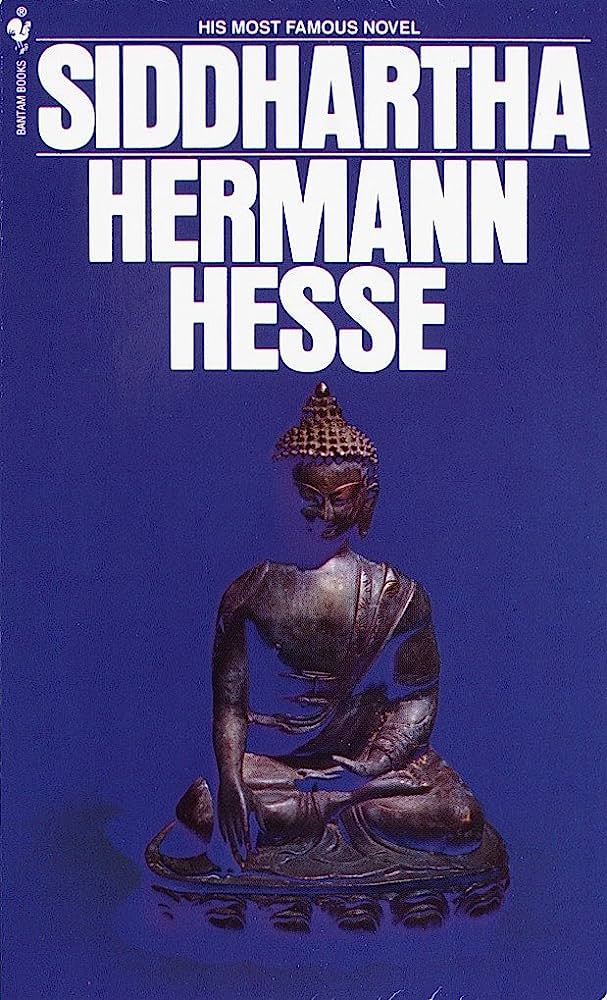
What I read: Siddhartha by Hermann Hesse.

H was very difficult. Considering where I ended up, I thought it would be appropriate to write about my journey through "H."

I first chose Joseph Heller's Catch-22. In fact, I got it out twice, fully intending to tackle it both times. For the purposes of this reading exercise, I don't actually make myself finish the books I choose. However, I couldn't even get Catch-22 started.

It could be that I'd just read Graham Greene, so I wasn't in the mood for "life is purposeless; life is random, hoo-rah." I felt the same way when a book club I attended read Confederacy of Dunces. It was promoted as a totally hilarious book. I thought it was a waste of time. A ship of fools is just not my idea of fun: why would I want to spend more than one page laughing at how stupid other people are? Perhaps Catch-22 isn't like that, but psychologically, I was at an impasse.

I was in a bit of a funk until I spotted Hermann Hesse's Siddhartha at the library. At the last moment, I nabbed it. It's short for one thing, and it falls into the category of "books that many people have read, so I might as well in order to be culturally literate." To be honest, I had always avoided it because I thought it was pretentious, mostly due to the contexts in which I heard Siddhartha mentioned.

I'm not sure it's pretentious so much as a whole lot of nothing about a little bit of something. I did finish it. It isn't too shabbily written although the writing style starts to grate after awhile. It uses the sort of stilted writing that people always associate with Eastern religions or Yoda--inaccurately in the first case. And Siddhartha is one pontificating dude (he's kind of like Socrates: I know nothing, but let me go on and on and on about how much I don't know). I mean, what can you do with lines like this:
No, a true seeker could not accept his teachings, not if he sincerely wished to find something. But he who had found, could give his approval to every path, every goal; nothing separated him from all the other thousands who lived in eternity, who breathed the Divine.

It reminds me of a Stargate episode where ascended-Daniel comes to help (or try to help) Jack ascend. Frustrated, Jack barks, "Daniel, so help me, if you start talking like Oma . . ." Daniel replies defensively, "I'm not talking like Oma. Oma would say something like, ah, ah, 'If the candlelight is fire, then the meal was cooked a long time ago' or something like that."

On the other hand, by themselves, these passages are quite readable (that is, when they don't run together in one big "insightful" mass).

Basically, Siddhartha is the story of a long mid-life crisis. It's about a man who searches for spiritual enlightenment all his life and finally discovers that searching for the thing doesn't produce enlightenment--living in the day-to-day world and showing love and kindness to people does. This is not too different from C.S. Lewis commenting in his autobiography Surprised by Joy that the way to find joy is not to seek it--that joy occurs while one is doing other things. In fact, there are many similarities between Siddhartha and Lewis's The Pilgrim's Regress (The Pilgrim's Regress is more grounded in analogy and more didactic).

And my reaction is, You gotta take a whole lifetime to figure out that one should be good to others and live life day by day?

Don't get me wrong: I'm a huge fan of C.S. Lewis, and Hermann Hesse has a point; it just seems like so much furrowed-browness over a fairly basic idea: Go to work, take care of your kid, leave off being a condescending jerk, stop running into the woods to find yourself. I mean, geez, this is Socialization 101.

Mary McDonnell as Sharon Raydor sums it up in Major Crimes in one phrase: 

Be safe and be kind. 

2023: Since I am currently working on Fairy Tales in my latest A-Z list, I decided to read Hermann Hesse's fairy tales. 

I was admittedly a bit nervous. Intellectual fairy tales tend to emphasize the negative. Not that Grimm isn't full of negatives! But they are the negatives of slasher films, not the negatives of starring at one's naval and being depressed. 

I should have remembered how nice Hesse is.

His fairy tale writing falls between C.S. Lewis's non-fiction and George MacDonald's fiction. Like them, he tackles the search for the ineffable and ephemeral spiritual experience through tales. He uses the same strong imagery--he is a good writer. However, the tales come across as part essay (except he isn't writing essay) and part fiction. 

To put this another way, he comes across as a tad didactic. 

Despite the Alexander Key-like "wouldn't another world be more peaceful" nonsense, I thought that "Strange News From Another Planet" was the best of the ones I read. It never strays from the young protagonist's point of view. The imagery is sharp. And despite the slight condescension of "how could a world be so evil--tut tut," the king is portrayed as intelligent, insightful, and courageous. And the tale concludes without commentary. 

Hesse is a good writer! 

Still, I tend to go elsewhere for my fantasy-religious tales. 

G is for Gloomy and Similar Depressing Literature Taught in High School: Greene

What I read: Doctor Fischer of Geneva or the Bomb Party by Graham Greene.

Graham Greene is one of those writers whose names I recognized but about whom I knew absolutely nothing. In some recess of my brain, I think I thought he was a Southern writer, like Faulkner or Flannery O'Connor.

He's not. He's English. But the comparison to O'Connor may not be totally off. The story by O'Connor that always sticks with me is "A Good Man Is Hard to Find," a super depressing short story about human fallibility and random acts of violence. "A Good Man is Hard to Find" is often located in anthologies alongside another depressing story, "The Story of an Hour" by Kate Chopin. Chopin is also Southern.

And, okay, all of them are good writers, and I quite like Faulkner (I love "The Bear").

Artist: Abigail Larson
But this type of depressing short story is the type of short story that made me detest high school English--and made me promise, "I'll never write a sad ending!" Greene's book reminded me of those stories. 

To clarify--I don't mind tragedy: MacBeth, Hamlet, Lord Jim--or weird fun: "A Rose for Emily" (Faulkner), "Roman Fever" (Edith Wharton). It's depressing angst I dislike. 

To clarify the difference: tragedy or weird fun is about sad events; depressing angst is about how pointless and stupid life is.

The former I can handle. The latter seems...kind of pointless.

By its very nature, writing is an act of construction. I suppose every generation has to have one writer who postulates that creation achieves nothing and has no purpose but since the position is obviously contradictory (since millions of English students everywhere are immediately put to the constructive task of providing the writer's work with meaning), I think it is rather self-indulgent.

And boring. And surprised angst (I can't believe how fallible human nature is!) is even more boring--well, exasperating and boring.

The above was my reaction to Graham Greene.

I read Doctor Fischer of Geneva or the Bomb Party. It's well-written. I read the entire book (it isn't long) in about two hours. I didn't lose interest, and I found the character delineations interesting. But not exceptionally so. I did not discover that Greene has a "gift for exploring the deeper recesses of human nature" as the flap claims. I've learned more about human nature from watching Star Trek. Writing a depressing book about greedy people doesn't make it automatically profound, even if the book is okay. To be fair, the actual reading of Doctor Fischer isn't boring, but Greene's insights aren't exactly fodder for a thousand dissertations (besides, I think he is wrong: human pride/self-image is a far stronger variable than money although the two can be related).

Sometimes, I think the study of literature suffers, not because it isn't respected (which I think it should be) but because people who write about it are so darn gullible. They always insist they've located the Holy Grail when they've really just found a very nice mug.

2023: One nice thing about not being in high school anymore: I don't have to voluntarily read depressing literature as if the books were some kind of self-help medication. I didn't bother to reread Greene.

Depressing Angsty Books From High School

Ethan Frome by Edith Wharton
The Pearl by Steinbeck
Tess by Hardy
Nectar in a Sieve by Kamala Markandaya
A Separate Peace by John Knowles

Sad But NOT Depressing and Angsty Books From High School

Lord Jim by Conrad (voluntarily)
Cancer Ward by Aleksandr Solzhenitsyn (voluntarily)
Shakespeare's Tragedies
The Crucible by Arthur Miller (which I LOVED although I don't much care for it now)
The Scarlet Letter by Hawthorne (which I've since reread--interesting book: Is Dimmesdale a jerk or a to-be-pitied guy?)
Lord of the Flies by Golding (voluntarily, in the summer--amazing book; too violent to be depressing)
Tale of Two Cities by Dickens (I adored Sidney Carlton--ooh, la la. I don't read any Dickens now. Way too much exposition.)

D is for Detached Irony

What I read: Sister Carrie by Theodore Dreiser.

I chose Sister Carrie because I had the vague idea that I'd seen a William Wyler movie based on one of his novels. Wyler did in fact make a movie of Sister Carrie (no, not the one with the high school burning down), but I haven't seen it. I did see Dodsworth directed by Wyler (novel by Sinclair Lewis), so I was sort of right!

On the other hand, I was completely wrong about Sister Carrie's content, which I assumed was about a nun. In fact, Sister Carrie is rather like an Americanized Tess of the D'Urbervilles except that instead of being an angelic innocent who falls into trouble after trouble after trouble, Carrie is an amoral innocent who takes whatever comes along, trouble or not.

Sister Carrie is WAAAY more interesting than Tess.

Beyond having an innocent heroine, the novels also share a sense of inevitability or fate. However, in Hardy, this sense of fate is tied to God or the universe or something "out there" while in Dreiser, the fate of Carrie and her lovers is tied to their personal inability to act. They are quintessentially amoral beings who react to whatever is in front of them. Carrie doesn't choose to become one man's mistress and another man's bigamist wife and then dump them. She simply takes whatever presents itself. 

The road to hell isn't paved with good intentions; rather, the road to hell is paved with no intentions at all.

Like I said, WAAAY more interesting than Tess.

The tone of the novel actually reminded me more of restoration comedies than Hardy. The novel is very much a character study, and Dreiser goes out of his way to give us Carrie's mentality without much moralizing; however, a consistent acerbic tone underlies the prose. I used "detached irony" for the post title because I couldn't come up with a "D" word that meant "sardonic and cynical without being totally pessimistic; also rather droll but not really funny and just a tad moralistic." 

2023: I haven't read Dreiser since, but I still consider Sister Carrie one of the great classics, rather like Middlemarch, which I haven't reread since college. 

In the world of "it is TOO worth reading the classics--hey, I got that reference in pop culture," Detective Goren makes a reference to Sister Carrie in the episode where he confronts Nicole Wallace regarding her fake identity.  

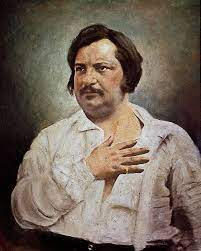
B is for Bizarrely Sweet Balzac

What I read: Novellas by Honoré de Balzac.

For no reason whatsoever, I'd always assumed Balzac was a long-winded "profound" writer—a French James Joyce. I'd also assumed he was really, really depressing; I guess I saw too many depressing French films in college.

He isn't—depressing, that is. And the first novella I read, "The Secrets of the Princess De Cadignan," had an unbelievably sweet ending. I thought it was headed towards Yes, Prime Minister type cynicism, and then, whammy, an ending which completely surprised and touched me.

I moved on to "Gobseck" which was interesting mainly because it proved to me that Balzac is a good writer—I'm always impressed by a writer who can effortlessly present a story told by a narrator who includes, in his narration, a story told by another character: all without losing me.

I didn't enjoy "The Vicar of Tours." One thing Balzac does supremely well is characterization. I cared far too much about the poor, vacuous Abbé Birotteau to endure what I knew was coming ("The Vicar of Tours" does not have a surprise sweet ending)—though Abbé Troubert is a great "bad" guy. (I put "bad" in quotation marks because I'm not sure Balzac created any total bad guys, but then my exposure is limited.)

Still, Balzac reinforces what I essentially believe, to a point: many truly great writers deserve their great reputations. I don't understand all the history stuff in Balzac but the prose is impressive. (He is yet another author who illustrates that throwing readers into the deep end doesn't mean abandoning them there.)

2023: I am sorry to state that despite obviously enjoying my exposure to Balzac, I did not--in the intervening years--become a Balzac fan. I haven't read anything by Balzac since. At some point, I will post about why people keep reading what they read: what we feel we should read, what we admire, what we consider well-written, and what we love. The four things are not the same.

Fairy Tales: Nicholas Stuart Gray, Fantasy, & The Free Imagination

Nicholas Stuart Gray is one of those important fantasy writers who is often overlooked. He was published from the 1950s through the 1970s. And he inspired a generation of British writers. 

My favorite book by him growing up--and a book I tracked down when I got older--is the short story collection A Wind from Nowhere (1978). I also admire The Seventh Swan (1962). 

The Seventh Swan connects with one of my favorite fairy tales so I will discuss it later. 

The short story collection includes a tale about a demanding yet ultimately self-sacrificing magical broom, a Screwtape-like devil telling a rueful tale of being outwitted (the devil's conclusion: Avoid humans!), a princess who gets herself into a bad situation when she badgers a witch into giving her magic lessons and so on. 

On the surface, Gray's work may seem standard fantasy fare. I would argue that standard fantasy fare is precisely why he made an impact on other writers.

Like Tolkien and C.S. Lewis, Gray was so steeped in fantasy/lore tropes, he could easily and imaginatively deploy them. 

Frankly, a great deal of literature that emerged in Tolkien and Lewis's wake comes across as Deliberately Fantastical or, once the hoity-toity crowd got a hold of the ideas, Deliberately Magically Realistic. (The latter delivers nothing so crass as in-your-face talking brooms and actual evil witches and undeniable other worlds: "hey, I'm going to invent something and see what happens" fun & play. Rather, Magical Realism carefully corrals the fantasy impulses into "ah, yes, the environment produces magical moments, properly taken in out of the corner of one's eye; now, now, don't take it too far" earnestness). 

Gray, who was writing concurrently with Tolkien and Lewis, ignores all that "I must remember my place and genre and deploy my fantasy with proper humility" stuff. He just writes it. 

He also exhibits a trait that shows up in Diana Wynne Jones and Roald Dahl at a slightly less manic level. That is, he is so comfortable with the tropes--and so indifferent to "propriety"--he goes off in exuberant directions, so the first story in the anthology, "The Wind from Nowhere," not only includes a broom that eats and drinks and complains but a toadstool that makes threats as well as sci-fi-like time changes (for no apparent reason).

In sum, Gray's work is a testament to the creative impulse. Current media commentary re: the arts crawls down the rabbit hole of "I'm breaking barriers because I've challenged what I designate the establishment and shown my disapproval," producing little more than self-congratulatory pieces of Victorian-like rectitude. Such commentary mistakes "I've performed meaningfully" for "I made something." 

Gray told story without apology because the story itself mattered. He added to the universe. 

Letting one's imagination roam is Nicholas Stuart Gray's gift.


Fairy Tales: Cinderella versus Beauty & the Beast

I will likely return to Cinderella and Beauty & the Beast on my fairy tale list at a later date. For now, I want to address the fundamental difference. 

Basically, Cinderella is Sleepless in Seattle. Beauty & the Beast is You've Got Mail. 

That is, Cinderella is about all the stuff that the heroine (and sometimes, the hero) go through before they meet. The family squabbles. The hopes and dreams. The suffering. The angst. The best friend discussions. Dancing mice. And so on. The meeting matters--all events lead up to it. And writers can pack a great deal of purpose into the meeting, so Martha in Castle can honestly state that the evening she met Castle's (spy) father, they made a real connection. He quite literally had to go off the next morning and save the world. 

Beauty & the Beast is about the relationship--the hero and heroine getting to know each other over time. 

Many pieces of literature, like Pride & Prejudice, will combine these two romance plots. And the plots will borrow from each other. But fundamentally, the difference is between focusing on the world of the protagonists versus focusing on the world of the relationship. 

I greatly prefer the latter to the former. The former always seems to involve (1) soap opera; (2) contrived ways of separating the protagonists; (3) shoe shopping and its equivalent; (4) shindigs (rather than conversation and shared interests). 

The focus on the close relationship comes with occasional red flags, such as a Stockholm Syndrome, but I'll take it (as will many people) for the sake of delightedly watching the protagonists grow closer. 

It's a comparison that keeps on giving, so one could argue that suspense where the big bad isn't revealed until the end is using the Cinderella plot while suspense where the protagonist and antagonist form a relationship, like Bourne Supremacy and Die Hard, is using Beauty & the Beast. 

In any case, the plot of growing affection explains why McKinley's Beauty is still a classic while the plot's classic rendition, Jane Eyre, places all other romances in the shade.

Austen Satire Moment: Northanger Abbey and House Maintenance

Whilst revisiting Northanger Abbey, I encountered several caustic passages about Catherine's stay with the Tilneys. Catherine would prefer to meander about with the Tilney siblings, Eleanor and Henry. Instead, the father--who thinks she is a heiress and has pre-selected her for Henry--insists on showing off the house and acreage.

Since Catherine was hoping Northanger Abbey would be a deteriorating medieval abbey with lingering ghosts and hidden secrets--and instead got the equivalent of a suburban ranch house--she is less than excited.

What caught my attention, however, is that such a scene is not the first time Austen's narrator has indicated a lack of interest in other people's home improvements. Mr. Collins, for one, is spoofed for his tremendous excitement about "shelves in the closet."

It is never wise to assume that fiction writers MUST experience the events they detail but the reappearance of such a scene forces me to consider: was Jane Austen cornered at a house party by a happy homeowner with excruciating details about house maintenance?

Not quite as awful as having to watch other people's home videos--but one can see why Austen considered such a circumstance fodder for her novels.

Great Story Dumb Philosophy

One of my favorite books is Alexander Key's Forgotten Door.

I've liked it since I was a kid and reread it every few years. The story is fairly basic: a young man from another planet falls through an ancient door that takes him to Earth. There, he suffers amnesia. However, he quickly figures out he doesn't belong. He likes the animals yet they aren't entirely familiar. Nor is the landscape. The people he initially encounters are unpleasant and do things like hunt and eat meat. 

He eventually encounters a pleasant family, the Beans. They take him in and protect him, even though he is accused of theft, which naturally he didn't commit, and are eventually hounded from the community. His family from the other planet calls for him and he escapes the fallen world with the Beans--and their dog. 

As another reviewer points out--referring now to the work that made Key famous, Escape to Witch Mountain--Key often used the entirely non-Catholic-influenced (as far as I can tell from his biography) trope of nearly saint-like characters moving through a sinful, fallen, and evil world helped by a few fellow saints. His saints are rarely government or social figures, by the way. In The Forgotten Door, Child Welfare is ranged on the side of the bad guys. Human institutions are no better than the humans. The saints are very saintly and almost always immediately believe the protagonists. 

Let's just say: the trope is a little lacking in complex character development. 

In addition, in The Forgotten Door, Key uses an argument spoofed on Red Dwarf, namely that aliens are inherently more advanced than us humans, precisely because they don't use things like "money."

I loathe this argument. Jon, the protagonist in The Forgotten Door, wears sturdy, well-made, elegant and useful clothes and boots. He carries a dagger with gems, not for hunting but presumably for things like cutting vines. He is well-fed and well-groomed, despite his longer than usual hair (the book was published in 1965). 

All those things equal money. Even if there is no bartering system. Even if there are no coins. Even if there is no debit card. Goods = wealth. That's a fact. The kid isn't swinging from vines and wearing a loincloth--and now, I'm being unfair to monkeys because monkeys in fact collect objects. 

All sentient beings (and a lot of animals) do this, no matter how advanced. One could argue that in a utopia, people would no longer covet each other's goods. Or they would self-sufficiently create their own goods (though Jon is somewhere between nine and fourteen and is likely cared for by others). Those goods allow them to stay alive and warm and free of wounds.

That's money. What do people think money is for? So they can sit in the middle of their living rooms gloating over a pile of greenbacks? I work so I can be inside when it rains and snows, so I can feed my cats, so I can feed myself, so I can travel from one location to another, so I can wash off dirt, so I can sleep without being eaten by bears. 

I also own a Kindle and TV and a computer and lots of books. But even if I didn't "indulge" in such items, I would still need to figure out some way to obtain the stuff that keeps me alive. And food, bed, and board are goods. 

The argument about "no money" drives me crazy!

Another good, unknown Key book.
Yet I love Key's book. 

I think one reason is that The Forgotten Door is a good story. Another is that it is told entirely from the characters' perspectives. I don't have time to roll my eyes at Mary Bean's confidence that Jon comes from another planet since the entire dialog unwinds quickly and naturally within the family home. I worry about Jon getting in trouble when I know it isn't his fault. I become enthralled by the investigation--Thomas Bean and Jon searching to find the "door" Jon came through. I fret about the unfairness of the people around him and worry throughout the final chase scene.

In addition, the outcome that he is trying to achieve, "re-entry," is powerful, way less maudlin and candy-strewn than in ET. And the book tackles liminality: Jon's adventure places him inside a fairly ordinary community (despite all the evilness) yet outside it at the same time. 

In sum, a good story transcends its philosophy. It's a powerful reminder of why we humans love story to begin with.

Dune: The Prior Movie

In preparation for the upcoming Dune movie, release date October 22nd, I reread the book. I'm now rewatching the best-known movies: Dune 1984 and the Dune miniseries, 2000. I suppose if there's a version out there with gnomes, I'll watch that too!

First, Dune, David Lynch, 1984.

The strangest thing about this movie is that Dune is not a complicated plot. And Frank Herbert doesn't present it as complicated. The book starts by introducing the reader to Paul, not to Paul learning about Dune, not to Paul as a threat to the emperor. But Paul as the hero about to be tested and set on his quest.

The movie starts, fascinatingly enough, with Princess Irulan. But it then skips to guild stuff and honestly, who cares? 

Okay, Dune votaries may, but I don't. And when it comes to storytelling, the best approach is to quickly identify the hero's quest and/or the hero. 

Star Wars (the first Star Wars--Star Wars IV) starts with Princess Leia--that is, it starts by introducing the quest, the person and plans that will propel the hero into individual action. Lynch's Dune starts with background on Arrakis, then skips to the guild and the emperor, then skips to Paul, then produces a lot of discussion. 

The result: the movie appears to be written by people who LOVE the Dune mythos, not by people trying to tell a story. And they give too much away too early. The book--because, ya know, Herbert is a decent writer--allows the action on Arrakis to unwind naturally. The only "give away" the reader is provided upfront is the name of the traitor. Even there, the moment of betrayal is a shock to the system since it comes without warning (though later in the text than I had remembered).

Perhaps the reason for the lack of focus (I'm thinking of the film editors now) is that Kyle MacLachlan as Paul is not that appealing a character. He comes across as a yuppie who decided to take an extreme sports vacation. The Paul of the book from page one is reserved, self-controlled, reflective, unusually objective (even before his vision after Leto's death), and somewhat uncanny. His youth explains his occasional immaturity, not his inherent personality. Kyle MacLachlan in 1984 was too old to get away with this. (Interestingly enough, both actors debut the role at age 25, but Timothee Chalamet looks younger than his years, and Kyle MacLachlan looked older. Alec Newman was 26--I'll get to him later.)

I've noted elsewhere that Timothee Chalamet is a gifted actor. He also looks the part. I try not to raise my expectations too much before a release, but in other roles, Chalamet captures "uncanny" quite well. So my hopes are reservedly high-ish. (I would really rather I had none--but hey, investment is investment!).

Things I like about the 1984 version:

  1. The voiced internal dialog is quite effective. 
  2. The movie includes the scene where the Duke prioritizes the men over the spice.
  3. The Harkonnens are disgustingly awful, the ultimate decadent and self-serving aristocrats. They are memorably terrible, irredeemable bad guys. Not entirely credible as a ruling family--but effective. 
  4. So many great sci-fi folks show up! Dean Stockwell, Patrick Stewart, Brad Dourif (go figure!), Max van Sydow, and Linda Hunt, who hasn't done that much sci-fi, but, ya know, it's Linda Hunt!

Major problem overall: The movie doesn't establish Paul and the conflict upfront. It spends too much time on background details that the audience honestly probably doesn't care about (I honestly, really, totally don't care how ships gets from Point A to Point B: warp drive, spice, folding space, a magic door: whatever). It spends too much time on Caladan, reducing the last 1/3rd or so of the film to a mishmash of "and then Paul became really esteemed...fight scene!" 

The problem with the mishmash is that 1984 Paul is presented as a military leader. He isn't. He is a reluctant prophet/messiah who is trying to head off a jihad through specific choices and actions, and it is not entirely clear if he succeeded. Stilgar and others are his military arm. Without that insight, the film after Leto's death lacks any kind of character growth. 

I originally blamed this lack of growth on the book. But there's plenty of inner conflict in the book's second half. Paul gets a little boring when he has his vision, but he continues to maneuver partly in the dark. His uncertainty makes him interesting! 

Dune 1984 is a compelling example of a movie that indicates deep fan love--yet, weirdly enough, bypasses the book for the idea. It might have been better to focus on the book. 

Best Non-Revenge Scene

In The Closer, Season 6, Flynn is attacked. Consequently, the squad goes through his files to discover who, out of the many people Flynn has arrested, might wish Flynn dead. 

Coming across one such suspect, Flynn admits that when the man was found guilty in court for one crime, Flynn vowed to spend the rest of his life proving that the man committed another, more heinous crime!

!!

The squad looks at Flynn. So, did you? 

Flynn shrugs. "Other stuff came up," he says. 

I love this, and it reminds me of a passage in one of C.J. Cherryh's novels where the protagonist discovers that "sleep" in hyperspace has even more ameliorating effects than sleep in everyday life. He comes out of hyperspace with a calmer attitude, aspects of his life placed in proportion. Some things simply aren't as important any more, including grudges. Like with Flynn, time and rest inexorably moved him on.

This is why (fallen) angels are inherently more prideful than humans. They never sleep--they never take a break. 

And this is why, too, mortality is a gift.

Thoughts on the Ending of Jane Eyre

Bicknell captures St. John's zeal.
Jane Eyre does not close with Jane Eyre's marriage to Rochester, the birth of their son, and their happily married life. It certainly mentions those things ("Reader, I married him") but it ends instead with several paragraphs about St. John. The passage is worth quoting in full:
As to St. John Rivers, he left England: he went to India.  He entered on the path he had marked for himself; he pursues it still.  A more resolute, indefatigable pioneer never wrought amidst rocks and dangers.  Firm, faithful, and devoted, full of energy, and zeal, and truth, he labors for his race; he clears their painful way to improvement; he hews down like a giant the prejudices of creed and caste that encumber it.  He may be stern; he may be exacting; he may be ambitious yet; but his is the sternness of the warrior Greatheart, who guards his pilgrim convoy from the onslaught of Apollyon.  His is the exaction of the apostle, who speaks but for Christ, when he says—“Whosoever will come after me, let him deny himself, and take up his cross and follow me.”  His is the ambition of the high master-spirit, which aims to fill a place in the first rank of those who are redeemed from the earth—who stand without fault before the throne of God, who share the last mighty victories of the Lamb, who are called, and chosen, and faithful.

St. John is unmarried: he never will marry now.  Himself has hitherto sufficed to the toil, and the toil draws near its close: his glorious sun hastens to its setting.  The last letter I received from him drew from my eyes human tears, and yet filled my heart with divine joy: he anticipated his sure reward, his incorruptible crown.  I know that a stranger’s hand will write to me next, to say that the good and faithful servant has been called at length into the joy of his Lord.  And why weep for this?  No fear of death will darken St. John’s last hour: his mind will be unclouded, his heart will be undaunted, his hope will be sure, his faith steadfast.  His own words are a pledge of this—

“My Master,” he says, “has forewarned me.  Daily He announces more distinctly,—‘Surely I come quickly!’ and hourly I more eagerly respond,—‘Amen; even so come, Lord Jesus!’”
Since I am not a fan of St. John's insidious bullying of Jane during the proposal, I've always shrugged off this part of the story as "spin"--Bronte's attempt to pacify her Victorian audience.

Buchan captures his honesty.
Recently, however, I rethought that idea. Victorians were domestic and pious (they were also earthier than we often imagine them to be; still, they thought of themselves as domestic and pious). Take Jane getting married and having a kid: Victorians readers wouldn't have been too happy about Jane's boldness in returning to Rochester before knowing for sure that his wife was dead and they wouldn't have been too happy about a lowly governess marrying the head of a household although Jane was of a legitimately good family and had her own inheritance. And they wouldn't have been too terribly pleased about her strong  physical response to Rochester's physical advances.

But, still, ya know, marriage and a kid isn't so bad.

St. John, however, for better or worse turned his back entirely on domesticity. Victorians, in resemblance to their beloved queen (who was far less motherly or wifely than she was portrayed: she image below), placed a high premium on loving God and supporting missionary work--from the comfort of hearth and home. Being religious was very, very important (no atheists here!) but in a restrained, civilized, non-weirdo American way (all those American cults!).

Queen Victoria and Prince Albert: Wedded Life
St. John is extraordinarily...Catholic in his response to his personal call to go abroad. There's a kind of fervor in his decision and in the outcome of that decision. The guy wanted to be a martyr and by George, he succeeded!

That is the furthest thing from the married, middle class, wedded bliss purported by the queen and her subjects plus Victorian painters and poets. And it made me wondered if Bronte was pushing the envelope in more than one direction--not just in extolling Jane's supreme self-confidence in her right to choose (rather than be guided by her male relative) but in praising St. John's supreme self-confidence in his single lifestyle that puts a cause above all else.

The St. Johns of the world make me mighty uncomfortable. I'm like Spike--I like the mundane fun of ordinary life. But I can certainly commend Bronte for knocking down all the fences in her path.

Jane Eyre Revisited: Here I Go Again!

Jane Eyre (1944), starring Orson Welles and Joan Fontaine

Joan Fontaine is more an Austen heroine than a Bronte one. She took on Jane Eyre at the age of 27 and exhibits all the confident maturity of, well, a 27-year-old woman. (She would make an excellent Elinor!) She comes off as didactic and well-meaning rather than smitten and raw.

This is more of a problem than it sounds. Fontaine's Eyre lacks mischievousness--in a later version, when commanded by Rochester to entertain him at the piano, Jane plays an overly performed tune, knowing it will irritate Rochester (similar to playing "Somewhere Over the Rainbow" or singing Whitney Houston's "I Will Always Love You" for an American Idol audition). Later film Janes--and for that matter book Jane--enjoy deliberately poking the bear.

1944 Jane, however, is more into "taming" the beast than provoking him. She endures Rochester's bullying not only passively but sympathetically ("oh, the poor man"). Consequently, she becomes a pitiable figure rather than an intrinsically tough one. Instead of studying Rochester objectively with eyes hooded, she seems to look past him to what he represents (husband material). Book Rochester would HATE that. While Orson Welles growls and beetles his brows and runs about in gorgeous (and well-fitted) dressing gowns, I keep expecting Joan Fontaine to say, "Oh, and when did you want your washing done, honey?"

On multiple occasions, the movie informs its audience that Jane loves and admires Rochester. Yet without the repartee--the arguing!--of other versions (and the book), that "fact" must be taken entirely on faith. Are they truly good friends? Eh... 

Peggy Ann Garner
The 1944 version does have good stuff. Orson Welles clearly comprehended his character (even if Fontaine didn't "get" hers) and delivers Rochester's best lines with deep-throated eloquence. As mentioned above, I love his clothes. I like his dog!

The movie is also beautifully filmed and impressively fast-paced. An adaptation of Jane Eyre takes anywhere from 2 to 4+ hours. 96 minutes--without the loss of anything of great importance--is impressive. (The one flaw, as mentioned above, is that the audience doesn't see Jane and Rochester's relationship grow.)

Amanda Root
As for casting Jane Eyre, the child Jane Eyre, played by Peggy Ann Garner, is exactly right. For black & white, Margaret Sullavan (if the film had been made 10 years earlier) would have made a fantastic Jane. (More recently, Amanda Root even at 32--when she did Persuasion--could have captured the essence of Jane.)


Good Things to Say About The Man Who Knew Too Much

Another great Hitchcock film!

Truth is, my favorite Hitchcocks are not necessarily his best. I adore Dial M for Murder with the snarky Ray Milland, the elegant yet warm Grace Kelly, and the self-effacing Robert Cummings. I love Rear Window. I quite liked Rope when I was younger and saw it multiple times.

These are all good movies, but they don't have the finished wholistic feel of Notorious, Shadow of a Doubt, and The Man Who Knew Too Much.

What's so good about The Man Who Knew Too Much?

Doris Day and Jimmy Stewart

Jimmy Stewart is an amazing actor, a  Tom Hanks progenitor--the guy who can play everyman with full individualistic flair. Or maybe it's the individual with full everyman flair. Whatever it is, both Stewart and Hanks capture the everyman experience without American Beauty ennui: oh, look, everybody, I'm being NORMAL. They just are normal.

In fact, there's an extremely funny comparison here. In The Man Who Knew Too Much, Jo (Doris Day) and Ben (Jimmy Stewart) go to a restaurant where they have to sit on low cushions. Jimmy Stewart delivers about 2 minutes of pure physical humor when he tries to sit comfortably on the cushions and keeps sliding to the floor. It reminds me of Tom Hanks in You've Got Mail trying to get comfortable on his father's new couch. 

Stewart is perfectly cast as the husband/father in The Man Who Knew Too Much with Doris Day as wife/mother. Doris Day is a particularly fine choice here. She has all the appearance of a 1950s cliche, but her character (and possibly the actress herself) is India-rubber tough.

Not tough as nails. Rather Jo McKenna exudes brassy good cheer which masks high-strung intensity which in turns covers a strong, endurable will.

The suffering parents of kidnapped children have, of course, been done a billion times by now. In 1956, it was still fresh and new enough that Day and Stewart were operating without all those television cliches (I'm not opposed to television cliches, by the way; I'm just impressed by Day and Stewart). They managed to capture the fear, desperation, and resilience of this all-American couple without hitting a single wrong note (ha ha--sorry, you have to see the movie).

The Camera Work

Yes, yes, everybody praises Hitchcock's camera work, but I actually noticed something this time!

Many of the Marrakesh scenes use the blue screen effect or whatever the equivalent was in Hitchcock's day. It is obviously not-on-location. I shrugged my shoulders when I saw it; eh, so, CGI has improved since then.

But then, a little later, Jo and Ben walk through the Marrakesh marketplace with Drayton and a police officer behind them--that is, regular characters. Yet Hitchcock deliberately presents Drayton and the police officer as if they are part of the rolling, outside Marrakesh shots.

It is very cool. It deliberately emphasizes Jo and Ben's role as innocent tourists--look at those people wandering blithely through a PBS special! (Since, after all, they are exactly the type of people who watch Nova and Nature.) It underscores their innocence, making their exposure to spies and assassins and kidnappers that much more inexplicable.

The one rough spot in the film occurs towards the end. Right after the denouement at Albert Hall, Jo and Ben could easily have whisked themselves to the ambassador's house to find their son. It would have taken a single line of dialog (the inspector saying, "You should go with that guy!")

Instead, there are several minutes of pointless conversation with police characters who don't need to be paid off in the slightest (one thing about kidnapping stories: the audience will care about little but the parents and child).

Que Sera Sera

It's great! Apparently, it wasn't Doris Day's favorite song, but she sure does it justice.

What is the Classic Era? And Why?


Eugene's most recent post about dress and hairstyles (notably, Audrey Hepburn's) reminds me of a question Mike posed recently: Why do so many movies and shows perceive the 1950's to 1970's as classic? Mike points to "the current trend to try to create a kind of 'timeless' era, that isn't really specified" and points out that this "'timeless' quality tends to have a late fifties, early sixties feel" (or, as Mike puts it, "Rockwellian").

Mike points to Christmas movies like Polar Express as using this particular time period but also to the following movies:
  • The Incredibles
  • Meet the Robinsons
  • The Iron Giant
He also points out that many sci-fi films re-imagine NOT the current modern age but the '50-70's in the future.

So why is this?

I think one possibility is that these movies are evoking feelings of nostalgia, and nostalgia is always about 40-50 years in the past: 40-50 years ago, life was perfect! Which is nonsense, of course, but it has made me wonder if, in another 20 years, people will be waxing nostalgic about the 1980s and 1990s. (A friend of mine does own a book about mullets.)

I also wonder if the '50-70s are seen as the end of the mechanical age before the digital/computer age came along. And maybe we humans miss the hands-on aspect of the mechanical age--like on Star Trek: Voyager when Tom changes all the buttons on the shuttle to blinking, punchable lights. Way more fun!

In other words, all this nostalgia is nostalgia for the pre-computer/pre-cyber age. Right now, we are inventing a new mythology (The Matrix, Ghost in the Machine, etc.), but before we have a complete new mythology, we have to rely on the old mythology. In about 30 years, laptops will be seen as cute, nostalgic technology, but right now, to get really nostalgic, we have to go back to blinking lights and clumsy robots.

Or it could just be that the 50's-70's do provide classic images, and the 80's (fashion-wise at least) are just a complete embarrassment (and we are too close to the 90's and 2000's to see the trends yet).