Showing posts with label Buffy. Show all posts

Everybody Needs a Spike: Thoughts on Supernatural

Mark Sheppard as Crowley
Both Whedon's Buffy and Kripke's Supernatural tackle theological themes. Buffy provides demons, vampires with souls, and the Powers-that-Be. Supernatural--with slightly less depth but a whole lot more complexity--supplies demons, self-serving angels, confused angels, and a writer who may or may not be God.

Both also provide a self-serving and sarcastic bad guy who helps the good guys while helping himself.

James Marsters as Spike
In Buffy, this guy is Spike (played by James Marsters).

In Supernatural, this guy is Crowley (played by Mark Sheppard).

They both deliver their clever lines in crisp British accents--acquired by Marsters; the real thing for Sheppard.

Both characters are impressively at home in the real world:
Buffy: What do you want?
Spike: I told you. I want to stop Angel. I want to save the world.
Buffy: Okay, you do remember that you're a vampire, right?
Spike: We like to talk big, vampires do. "I'm going to destroy the world." It's just tough guy talk. Struttin' around with your friends over a pint of blood. The truth is, I like this world. You've got... dog racing, Manchester United . . 
 Crowley is Spike's brother under the skin.

It raises the question: Why are these guys so necessary to theologically-themed fantasy? Supernatural went through several ambiguous bad guys (Gordon Walker, Ruby, Bela) before settling on Crowley as a long-term player. Crowley's appeal was so readily apparent, reasoning backwards from Crowley can help explain Spike.

Three reasons why Crowley is necessary to Supernatural

(1) Crowley (like Spike) wants something.

The brothers want things, but their things--like Buffy's things--involve the future: I want my brother to survive. (I want to be a normal girl.)

Don't get me wrong: these are great things to wish for, and they help to ground the characters. But such things--accompanied as they are by highly emotional states of mind--make the characters extremely vulnerable and serious.

The angels--and Angelus--also want futuristic things though their futuristic things are far grander: cosmic show-downs, the end of the world, etc. etc. 

Crowley (and Spike) want things in the here and now: fish 'n' chips, big house, big dog.

Characters who want specific things in the here and now lend themselves much better to episodic writing than characters who want futuristic things. And if too many of the latter type want grand futuristic things, the episodes sadly run to (bad) ground on the ridiculous sandbank of big-bad-conspiracy-theories.

Crowley (and Spike) keep things real.

(2) Crowley (like Spike) is irreverent. 

Theological shows need irreverence because they need to be able to discuss doubt and faith without becoming too dogmatic. Despairing angst is no better than Touched by an Angel.

Crowley's irreverence is quite distinct from Dean's (as is Spike's from Buffy's). Dean is a believer who doesn't want to believe because he doesn't want to doubt. In many ways, the internal arc of Supernatural belongs to him while the external arc belongs to Sam (since Sam is ostensibly more intellectual and insightful than Dean, this may seem contradictory but actually it makes a great deal of sense).

A character who can be disillusioned is not a character for whom irreverence is a comfortable state of mind. Dean's irreverence (which can be quite amusing) is tied directly to his weary calls for aid. He is Job-- overwhelmed by catastrophe and his inability to fix his family's lives--demanding that God intervene. He is Dylan Thomas's father "raging against the dying of the light."

One of Dean's favorite memories: when he was able to "fix"
his brother's problems.
All the above makes Dean a great character! But the irreverent Crowley (or Spike) is necessary to restore balance. Rage all you want--you still gotta buy gas. What can it hurt to call for aid? It doesn't change what's going to happen to you anyway. And by the way, you need more chips.

While Sam and Dean are (enchantingly) willing to throw themselves in the fire for each other, Crowley (and Spike) are looking around for an actual match--or a fire extinguisher: Kind of depends on the day. 

(3) Crowley (like early Spike) is an outlier.

From a writing point of view, the outlier is a necessary character. The outlier--like the omniscient narrator--can step outside the action and explain what is going on.

Dean: Is this a fight? Are we in a fight?
Castiel: [Hugging] is... their handshake.
Dean: I don't like it.
Castiel: No one likes it.
Regular characters must be committed to their narrative arcs. This is one reason that Castiel, however amusing at times, is NOT the outlier. He is committed to the narrative arc of questioning his faith. Castiel does provide a nice foil to everyone (including Crowley). But he has chosen a side.

Chuck--despite his outlier tendencies--also has a side. Only Crowley (and Buffy Spike) don't.

In mystery shows, the outlier is the audience or occasionally the newest member of the team--or Watson. It is to the outlier that characters deliver long-winded explanations about how DNA works, the ins and outs of game theory, and the exculpatory nature of tainted evidence.

Fantasy suffers from the same need for definitions: who is that guy? why did he show up again? The audience needs to know the information but is less willing to be educated in the same way as mystery audiences. After all, if you were a real fan and watched the show every week, you'd know already! Since the audience is less willing to BE the outlier, the outlier must be a character--but not one of the main characters (see above).

Not only does the fantasy outlier get told stuff (both Spike and Crowley operate as "new" members, who occasionally need to be caught up), the fantasy outlier also possesses the ability to deliver information in tidy ways that don't appear explanatory (even though they are).

Crowley explains that Bobby can now stand:
Crowley: Bobby, you just gonna sit there?
Bobby Singer: No, I'm gonna Riverdance.
Crowley: I suppose if you want to impress the ladies. Bobby, Bobby, Bobby. Really wasted that crossroads deal. In fact, you get more if you phrase it properly. So, I took the liberty of adding a teeny sub-clause on your behalf. What can I say? I'm an altruist. Just gonna sit there?
Spike explains that the scoobies need to fight the Native American demon, no matter how politically incorrect:
Spike: Oh, someone put a stake in me.
Xander: You got a lot of volunteers in here.
Spike: I just can't take all this mamby-pamby boo-hooing about the bloody Indians.
Willow: Uh, the preferred term is...
Spike: You won. All right? You came in and you killed them and you took their land. That's what conquering nations do. It's what Caesar did, and he's not goin' around saying, "I came, I conquered, I felt really bad about it." The history of the world is not people making friends. You had better weapons, and you massacred them. End of story.
Buffy: Well, I think the Spaniards actually did a lot of - Not that I don't like Spaniards.
Spike: Listen to you. How you gonna fight anyone with that attitude?
Willow: We don't wanna fight anyone.
Buffy: I just wanna have Thanksgiving.
Spike: Yeah . . . Good luck.
Willow: Well, if we could talk to him . . .
Spike: You exterminated his race. What could you possibly say that would make him feel better? It's kill or be killed here. Take your bloody pick.
Xander: Maybe it's the syphilis talking, but, some of that made sense.

Buffy, Harris, and Lots of Thoughts about the Appearances of Good Guys and Bad Guys

Darla doing her
innocent school girl
impression.
I posted this in 2006. I am moving it up because I will be discussing Charlaine Harris in my next Authors A-Z post (I discussed Kerry Greenwood in the last A-Z post).

In Seven Seasons of Buffy, a book of essays about the television show Buffy: The Vampire Slayer (ed. by Glenn Yeffeth), Charlaine Harris (of True Blood fame) writes, "The monsters [in Buffy] are all evil. The good guys are all pretty" ("A Reflection on Ugliness"). Whedon, she argues, "uses physical attractiveness to signal moral decay."

I disagree; I also consider Harris reveals a far more obsessive regard for appearance in her books than Whedon does in his work. I'll deal with the first point, then the second.

It is true that the demons in Whedon's universe transform before they attack, gaining vamp faces or serpents' bodies, etc. However, Harris's reasoning that Whedon uses these transformations because he equates ugliness with evil (or wants to make evil obvious) is unreasonable.

Here's why:

1. Harris sees the Buffy demons as ugly; that doesn't mean everybody does. Granted, the vamp faces in early Buffy are a bit cheesy, but the make-up improves and, if anything, vampires in eat-mode achieve the same coolness level as the Wraith. Okay, I happen to think the Wraith are the coolest looking bad guys ever on television, so . . . maybe not. Still--Whedon's vampires have their own cache of wowness as do the other bad guys: I'm not too hip on bugs ("Teacher's Pet"), but I do think serpents are very awesome (Glory, "Graduation Day: Part 2").

I also happen to be a big fan of Armin Shimmerman, whom Harris cites as an example of an ugly bad guy. Really? He's about as adorable as a principal can get--and he has all the good lines. ("There are things I will not tolerate. Students loitering on campus after school. Horrible murders with hearts being removed. And also smoking.")

Harris attempts to use Count Dracula as a counter-argument--sure, he's cute, but he isn't THAT cute. Dracula, by the way, is Rudolf Martin who would look drop-dead gorgeous if he were dying of plague: not much of a counter-argument.

In addition, although humans may regard demons as ugly (though that's inconclusive), that does not mean the demons do. To borrow an example from the first season (before Whedon became "sophisticated," Hollywood help him), the Master makes it clear that as far as he is concerned, humans are annoying and whining and just so darn pudding faced. He and his loyal Luke, of the lovely deep voice, never change to look human; they are too advanced for that.

I would agree that Oz's werewolf is disgusting, but I think that's more bad make-up and the inability to hire REAL wolves (which are probably more expensive than human actors) than any specific statement about ugliness and evil. In any case, nobody but Kane ("Phases") considers Oz a bad guy in his monster state, and Willow doesn't seem to have much problem adjusting to his "other" self.

There are at least three other indications--one of which Harris brushes over, the others she misses--that the "good guys" on Buffy don't always find demons disgusting: when Buffy kisses Angel while in vamp face, and when Giles confronts Buffy's come-alive nightmare of being a vampire. Buffy is ashamed, NOT because she is ugly but because the vamp face reveals one of her deepest fears. With no revulsion whatsoever, Giles looks at her and says gently, "Why didn't you tell me?"

Additionally, when the swim team morphs in "Go Fish," not one of our good guys judges the changed team members as intrinsically evil. Buffy is downright sanguine, putting their animalistic behavior down to their animalistic state. Harris appears to have made the leap from ugliness to evil when no such statement was intended by the writers, but Harris' faulty assumptions are hardly Whedon's fault.

I also must mention that I consider one of the truly good guys, Sid ("The Puppet"), to be thoroughly disturbing (not exactly a "pretty" good guy).

2. Harris argues that Whedon should have recognized that "evil is not so clearly denoted in the real world." She asks, "Wouldn't we learn a more graphic lesson if the monsters retained their more attractive aspects even as they showed their most monstrous behavior?" Yes, we would learn something, especially since that's exactly what Whedon did.

Now, I have my own problems with Whedon regarding Buffy (namely, Seasons 6 & 7), but I don't see any point in accusing him of something he hasn't done. The first episode of Buffy opens with sweet-faced, pretty Darla luring a teenage boy into the deserted high school. Eh hem, Harris, she certainly didn't do it in vamp mode. True, she changes to vamp mode when she is about to feed, but I'm afraid her victim doesn't have much time to react. The evil has been accomplished long before Darla changes.

Likewise, bad Angel stalks and seduces women with his "golly, gee, whillikers shucks" act multiple times and his friendliness on those occasions is terrifying precisely because the viewer knows that this is bad Angelus but his victims-to-be do not. Likewise, Ted ("Ted") is far more terrifying before we--and Buffy--learn he is a robot who can be smashed to bits. Granted, the wonderfully slimy mayor transforms into a reptile at the end of Season 3, but there is such a thing as making a show exciting. Besides, who can pass up a huge snake going, "Well, gosh" over a pile of dynamite?

Over and over again, the villains of Buffy use prettiness to obtain their ends; they also, I would argue, commit more depraved acts in their pretty states than as demons (the mayor's seduction of Faith is far more vile than anything he does, briefly, as a snake). This is backed by the fact that Buffy can sense vampires long before they change (by their bad clothing in one case but intuitively in many other cases).The transformations, quite frankly, appear to be more for the sake of fun than for the sake of making moral declarations.

After all, this IS a show about the supernatural; although I agree with Harris that Warren, Season 6, who never transforms into anything, is the worst of the bad guys (Harris perceives this as a sign that "Whedon's view is growing more sophisticated"), multiple seasons of Warren would make Buffy . . . what? One Tree Hill?

In any case, Whedon's view of evil in the early seasons is quite sophisticated (if sophistication is required) because he doesn't confuse cause and effect. Evil isn't simply evil because our heroes got hurt/bitten (outcome). Evil is directly tied to motive and process, why and how the outcome occurred.

3. Harris contradicts her premise in her books.

This brings me to the end of my problems with Harris' essay. I would still have disagreed with her essay if I hadn't known her name. As it is, I have read several of Harris's Sookie Stackhouse books. In fact, when I first opened Seven Seasons of Buffy, I wanted to read Harris' essay because I had read her novels.

I was somewhat surprised by her essay. After reading the fifth book in the Sookie Stackhouse series,  I realized Harris may not realize how completely at variance her criticism of Buffy is with the messages of her own work.

To back up: I do understand where Harris is coming from psychologically. I happen to find negative discussions over appearance rather distasteful. I was one of those unfortunate weedy teens with bad acne, and it took me a long time to realize that although teens and some adults will make fun of bad acne, even teens will respond to the unfortunate's sense of personal authority. If you act coy and ashamed, people will pick up on it. If you don't, they tend to respond to your sense of confidence.

Still, I've never shaken my distaste for discussions about people's clothes or skin care or weight. Which is all to say that I understand where Harris is coming from in her essay. It also explains why I stopped reading her books: I found her obsession with appearance distasteful.

To return to Harris's Sookie Stackhouse series: Sookie is a nice, average looking (pretty but not glamorous), normally weighted young woman who encounters vampires in her neighborhood near New Orleans. She is telepathic but otherwise fulfills the respectable role of so many suspense/mystery heroines: the good girl next door who finds herself in extraordinary circumstances.

Extraordinary circumstances that involve her being ogled by a truly stunning number of men.

Before I continue, I should state that the books are great examples of modern fantasy writing; they combine an underground world of vampires and fairies, etc. with the everyday work-a-day world. One reason I stayed with the books as long as I did, other than the ebullient Eric, was the layered society created by Harris--something I find extremely difficult to do in my own writing and always admire in other people's work.

In book 5, however, Harris begins to head Sookie down a path that so many female suspense/mystery writers seemed compelled to take: the Road of Multiple Suitors. I can only surmise, based on the Twilight series' existence and success, that female writers and their readers enjoy fantasizing a princess-quest allotment of suitors for their heroines. Too many female-written mysteries contain if not several suitors, at least two who vie, unceasingly, for the heroine's attention. I have no very high opinion of the heroines and almost no opinion of the suitors (get a life already, people).

At least Buffy's two obsessed suitors occurred at different times! Sookie, however, Sookie belongs to that echelon of female heroines who don't believe in their own prettiness. When dealing with glamorous women, said heroines (1) befriend them, thus rendering the glamorous women clawless; (2) despise them because said glamorous women are also snotty; or (3) feel dowdy in comparison at which point a suitor's ogling will reassure our heroine that she is quite attractive.

My feminism rebels!
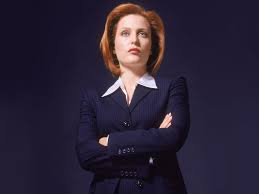
Scully being herself!
Give me an indifferent heroine or a heroine who knows her attractions and flaunts them over a heroine who isn't into her appearance but happens to be pretty anyway and whose writer never lets you forget the fact. Give me Samantha Carter or Seven of Nine or Teyla (all completely unapologetic gorgeous women). I'll take Captain Janeway, who is largely indifferent to her appearance (except her hair), or any of the doctors from House. Give me Scully, who is so wonderful to watch, being so fastidious in her dress and so consumed with her personal interests (and Mulder). Give me Buffy who worries about her appearance but doesn't try to tuck it away! Give me Pam Ferris as Laura Thyme who doesn't let anyone, including her ex-husband, get her down!

Spare me the heroine who will say she isn't pretty but has plenty of supporting cast characters to show/tell her exactly how sexy they think she is.

In Book 5, Dead as a Doornail, Sookie goes to clean out a dead relative's apartment. While there, we, the readers, are presented with 2,000 reasons why Sookie MUST, against her own inclinations, wear skin-tight lycra pants (those pants people wear to gyms). I don't remember all the reasons--something about the cousin being a smaller size and not owning any sweats and Sookie not having a car or the wherewithall to call a cab (perhaps she doesn't have any money either; I forget) let alone time to go to Walmart and buy some sweatpants. We are presented with a trillion excuses--that any reasonable adult would be able to circumvent with reasonable ease--that force Sookie into wearing the lycra pants, which, we are assured, isn't typical of her. She doesn't usually go around showing off her body like that, gasp gasp, not because she is old-fashioned and modest, you understand, but because it isn't how she sees herself.

But *oh, a woman's burden* she puts them on anyway and then proceeds to go out into the apartment's main living area where two of her current oglers, sorry, suitors are stationed and, presumably forgetting they are there, she bends over to put her hair into a twist or a ponytail or something. And when she straightens up, well, wouldn't you know, they are staring at her. Obviously, those horny men were checking out her . . . wink wink nudge nudge.

But Sookie isn't the kind of girl to flaunt her stuff, because, you know, she doesn't think she's, like, all that gorgeous or stuff, and Harris certainly isn't totally, like, obsessed with people's appearances. (Sorry, the whole thing is just so . . . teenagerish.)

I finished the book; I've never picked up another.

Talk about pure Victorianism; the idea of the devouring gaze is tied to medievalism. But the linking of coy physicality and ogling men is pure Victorianism. The medievals, at least, didn't make it so creepy.

I considered the modern, female mystery/suspense version of the devouring gaze creepy. Not the lycra pants, you understand. I would have applauded a Sookie who put them on because she didn't want to run to Walmart and didn't care what she wore OR a Sookie who thought, "I've got a darn fine body. I'm gonna go flaunt it!" In the Regency romances I read, the heroines often dress up to impress their rake husbands; they never pretend that isn't what they are going!
Speaking of Victorians, here's a species that knows
how to flaunt its stuff!
That's Steve, by the way.

What I find creepy in Harris's and similar type mystery series is the heroine's Victorian-like ingĂ©nue innocence. She never actually engages with the impact of her appearance--it's all happening to somebody else. Look, the reader is constantly being instructed, look at how much she doesn't care about appearance. She isn't shallow and trite like those snobby glamorous bimbos. She doesn't know she's pretty at all. But notice how often other characters comment on her hair, her face, her body. Oh, wait, here's another conversation where her looks are praised . . . oh, my, she's so terribly, terribly surprised. She can't believe that anyone noticed her boobs in that push-up bra she was forced to wear! 

Because she's an idiot? Or because women have a double standard?

Case in point: I recently (2006) picked up a Kerry Greenwood novel. Kerry Greenwood is an Australian writer who produced the Phryne Fisher mysteries, an interesting series (and great television show!).

Greenwood has come out with a new series with a heroine, Corinna Chapman, who is an unrepentantly size-large baker. She certainly isn't into all that model-type starving that her assistants practice. Nope, that's not her style. Take her as she is.

And I respect that. I like that attitude in people. Except Corinna has a handsome boyfriend with a washboard stomach about which the reader is reminded incessantly.

No reason why she shouldn't have a handsome boyfriend with a washboard stomach except it fits into my beef with Harris and all female mystery writers who play this particular game. For instance, in the mysteries with two suitors, one suitor will sometimes be a bit homely (the best friend the heroine grew up with), but the other suitor will always be a hunk; neither suitor will be especially nerdy or especially plain or an especially bad kisser or especially plump.

So, the heroines of these series aren't obsessed with appearance, but can the writers truly claim they are not?

Doesn't look like it.

High School as Narrative Structure (Including Digressions on Mysteries and Romances)

I'm a huge Agatha Christie fan. But I have to admit, I rarely try to figure out her mysteries. I'm too invested in the idea of human uncertainty and randomness. Since a large number of Christie's mysteries rely on split-section timing (during which every single person on the entire planet sticks to a carefully laid out time table), I never see the plan coming.

Take Death on the Nile--nobody saw the murderers running all over the boat? Really? Nobody stepped into the lounge at the wrong moment? Or Evil Under the Sun--nobody else is wandering around on the beach? The "right" person just happens to stay with the body?

Agatha Christie was well-aware that a well-planned murder can be instantly toppled by human vagaries, and she uses this truth to her advantage--often, the second murder victim in one of her books is the unintentional witness: that poor slob who just happened to be wandering around in the wrong place at the wrong time. She also has Miss Marple point out that the best "unprovable" murder is the "accident" (though don't get me started on how easily Christie characters die from eating a few leaves of foxglove or falling down a few steps) rather than the carefully planned murder.

Yet despite their illusory nature, Christie's carefully planned murders work as stories. The murder plan is the structure upon which each narrative is organized. That structure keeps the narrative from running off into digressive pointlessness; it gives the narrative a sense of "reality" even when it isn't much. Narratives without structure are not only boring and difficult to read but oddly enough, often fail to deliver that sense of "this really happened to someone."

How does the need for structure relate to high school?

A good cozy mystery, like a good fantasy or a good romance, has an underlying structure which delivers the product (the narrative). For example, Regency romances use a society containing specific rules and requirements, making it possible to deliver a narrative in which the hero and heroine are kept apart by social pressure, an occurrence that would provoke a "huh?" response if it showed up in a modern setting (it can be done in a modern setting; it is just more difficult).

Likewise, the high school provides a structure that explains, among other things, why certain people keep hanging out together. It also creates specific restrictions and expectations upon which a narrative can lie.

In Buffy, for instance, high school explains why the scooby gang gets together and, also, why they see each other so often. It explains why Buffy wants to be "normal" and also why she needs to be "good." It restricts her movements--she can't be out fighting monsters all day everyday. It poses challenges and growth moments.

The show faltered once the gang graduated. Nobody left town. Nobody got new friends. Nobody, until Xander, took a step into the whole job/bills/apartment stage of life. The suspension of disbelief became harder to maintain.

High school creates an assumption of settlement and order that doesn't have to be explained. This is both its use and its weakness. I imagine one reason Meyer (Twilight) put her vampires in a high school in a small town was to create structure, but the utter silliness of 20-year-olds "hiding" this way pushed my particular suspension-of-disbelief thermometer (which goes fairly high!) into too-hot-to-handle territory. It is much easier to "hide in plain sight" in even a community college than the average high school.

On the other hand, Rowlings' school years inevitably meander on too long, but at least there is a school year--a reason for Harry to stay in one place for so long--that doesn't have to be explained.

I would argue that any fiction book or series that has to sell a long-term idea needs an underlying culture/structure of rules and assumptions. Although any underlying culture/structure will bring along some narrative holes (wouldn't she have been kicked out of school by now?), the benefits outweigh the flaws.

Just look how long Star Trek (U.S.S. Enterprise as Regency culture/murder plan/high school) has lasted!

Of course, the real trick is to create the best culture/structure--one with lots of potential and few long-term problems. And if I could do that, I'd be writing these posts as a wealthy dilettante rather than in my spare time!

Folklore: Puritans, Magic, and Witches

Puritans brought over from the Old World a belief in magic. The difference between magic and religion is that magic is about controlling the supernatural (for gain), and religion is about supplicating the supernatural. Naturally, Puritan theologians preached against magic and so did some believers, but just as many believers switched between and combined the two ideologies--kind of like a fundamentalist Christian who also adopts New Age health practices.

Of course, New Age health practices don't get you hung for being a witch, but then, neither did a belief in magic all that much. Many more people practiced magic, including counter-magic (against witches) than were ever considered threats to their communities.

Basically, there were two types of magic: "like produces/cures like" (a leaf shaped like a kidney will fix that organ) and "part of the whole effects the whole" (think of the Buffy episode "The Witch" where Willow tests a piece of Amy's hair to find out if Amy is, in fact, a witch). Like in Buffy, counter-magic involved identifying the witch and then practicing one of the two types of magic against the witch.

However, the theological stance was that magic was the result of a contract with the devil and should be avoided. (In fact, some preachers opposed the practice of counter-magic, stating that all negative effects should be endured, even effects brought on, supposedly, by an evil agent; since the devil, not the witch, was the real culprit, it was God's will that the sufferer be afflicted, and the sufferer should just grin-and-bear-it.) The contract is what jeopardized the witch's soul, not necessarily what the witch did.

This motif (devil and human sign a contract which then must be honored or somehow voided, sometimes through a contest) has produced some real literary/music classics: "The Devil and Daniel Webster" by Stephen Vincent Benet, "Young Goodman Brown" by Nathaniel Hawthorne, and don't forget "The Devil Went Down to Georgia."

But what about those witches?

A lot of scorn has been poured on, well, everyone in Puritan times from the victimized witches (who are always portrayed as feminists) to the evil paranoid ministers. The scorn ignores some important points:
1. The Puritans, including many accused witches, truly believed in magic. Think about it: how would you feel if your neighbor could actually control the weather, crops, and livestock? Oh, wait, the environmentalists do believe that! (Sorry, I would never bring up environmentalists in the classroom: I would say something like, "Why would the belief that others could control nature be both frightening and comforting?")

2. Although most accused witches were female, witchcraft was also practiced by men, and some male witches were accused, and some were hung (but yes, women were the bulk of the accused and executed).

3. Witches (male and female) tended to be accused in batches (this was true in Europe as well). Arthur Miller was right: you really did have to have a zealous McCarthy type on hand to get witch trials started at all. Kramer, author of the big witch book that supposedly paints the entire Middle Ages as prejudiced and anti-fun-loving-witches--Malleus Maleficarum--was a real zealot, who just about everybody in power thought was nuts (I agree with scholars who claim Sprenger's name was added by Kramer to add gravitas to the work.) Of course, it doesn't say much for the Middle Ages that this crazyman ended up giving public lectures, but he was one guy, not everybody in Europe at the time.

Absent a zealot McCarthy-type, witch accusations tended to occur in small communities against a particular individual (gives you a whole new respect for civil lawsuits!).

4. Throughout the Middle Ages, it was more likely for a woman to die in childbirth than to be accused of being a witch. (Check out Magic, Mystery, and Science: The Occult in Western Civilization by Dan Burton and David Grandy.)

5. Witches were NOT, collectively, sweet, wise, herb-collecting midwifes. In her excellent book The Witch Throughout History, Diane Purkiss tackles the New Age image of the sweet, wise, herb-collecting midwife witch. Purkiss, by the way, represents the commendable side of Women's Studies: women scholars who refuse to accept comfortable, self-gratifying images at the expense of true history or at the expense of the real women who struggled and believed and endured those times.

Many witches in Europe and Puritan New England believed they were witches. Many midwifes were not only not witches but helped to identify witches. And whatever anyone likes to tell you, the environmental/Wiccan stuff is a late development.

6. The push to stop witchcraft trials came from Puritan ministers (who were bothered by the lack of tangible evidence), not from "enlightened" outsiders. Prolific blatherers like Increase Mather expended great energy trying to focus attention on the theological principle rather than on the accused: "It is then evidence that the devil himself did that mischief [not the self-accusing woman]. It must, moreover, be sadly confessed, that many innocent persons have been put to death under the notion of witchcraft, whereby much innocent blood hath been shed." Of course, Mather then goes on to paint Catholics as more likely to burn witches than Protestants. This is incorrect. Inquisition or not, Protestant countries hung/burned as many if not more witches than Catholic countries. So, he's a two steps forward, three steps back politically correct kind of guy.
Now, none of my points make up for what we moderns consider innocent people being tried and convicted on what we consider false testimony. Just: any trial/accusation should be judged by the times in which it occurred.

In terms of folklore, despite my list of "true" facts, the popular image of the witch--female, crone, pointy hat, broom (think Wicked Witch of the West)--appeared very early on. And, whether I like it or not, the image of the witch as a sweet, peaceloving, herbal collector has gained sway in popular culture. The Wiccans are right about one thing: beliefs in witches and magic lasted long after the Puritans morphed into gentler (but just as noisy) religions. Stories about magic and witches were collected from the Schoharie Hills (New York) as late as the 1930s:
Mrs. Elisha Case used to be witched. She would sit in a chair with one knee uplifted, the foot off the floor, hours at a time. When her folks asked her why she sat like that, because of course it was "an awful hard position to keep," she said she couldn't help it. Her family sent a lock of hair, her name, and her age to Dr. Jake Brink, and he cured her.
There are literary and film references to the older folkloric image of the witch--The Wizard of Oz being an excellent example. However, contemporary thought is more in sympathy with the witch than with her accusers. One common literary motif (not necessarily a folktale) that I've encountered is "teenage girl accused of being a witch and then saved by providential (scientific) intervention": The Witch of Blackbird Pond by Elizabeth George Speare; Elizabeth in which Willo Davis Roberts basically stole Speare's entire book and rewrote it as a Sunfire romance; Gallow's Hill by Lois Duncan (nice twist at the end); Buffy episode "Gingerbread" (Season 3).